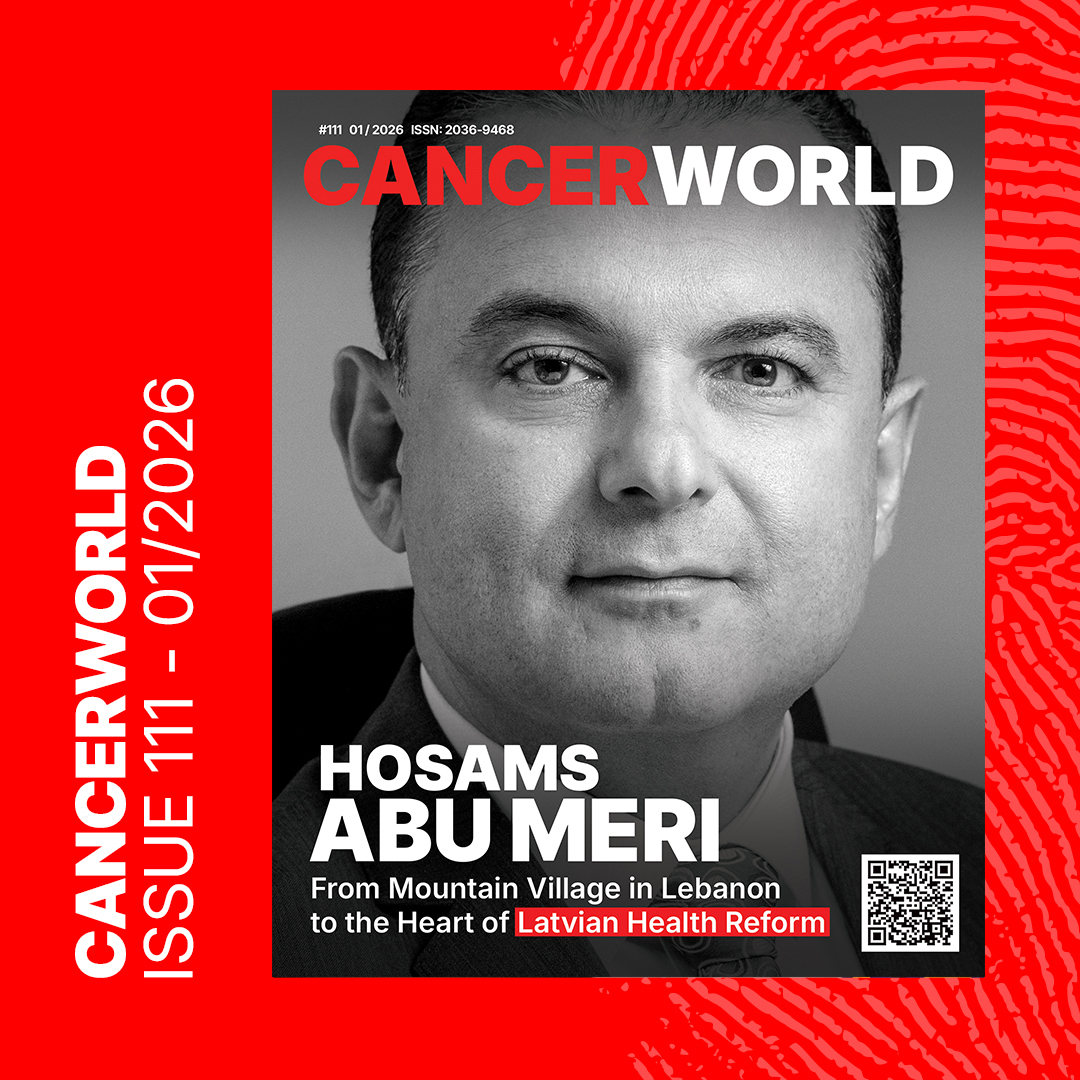
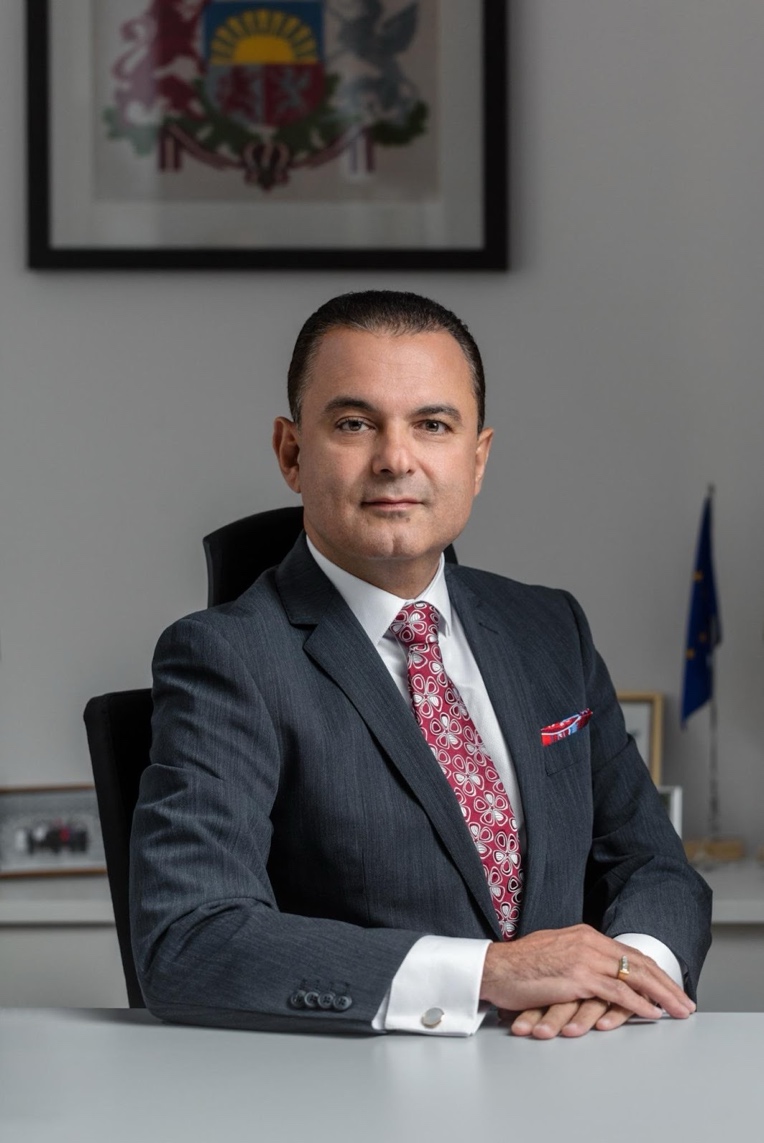
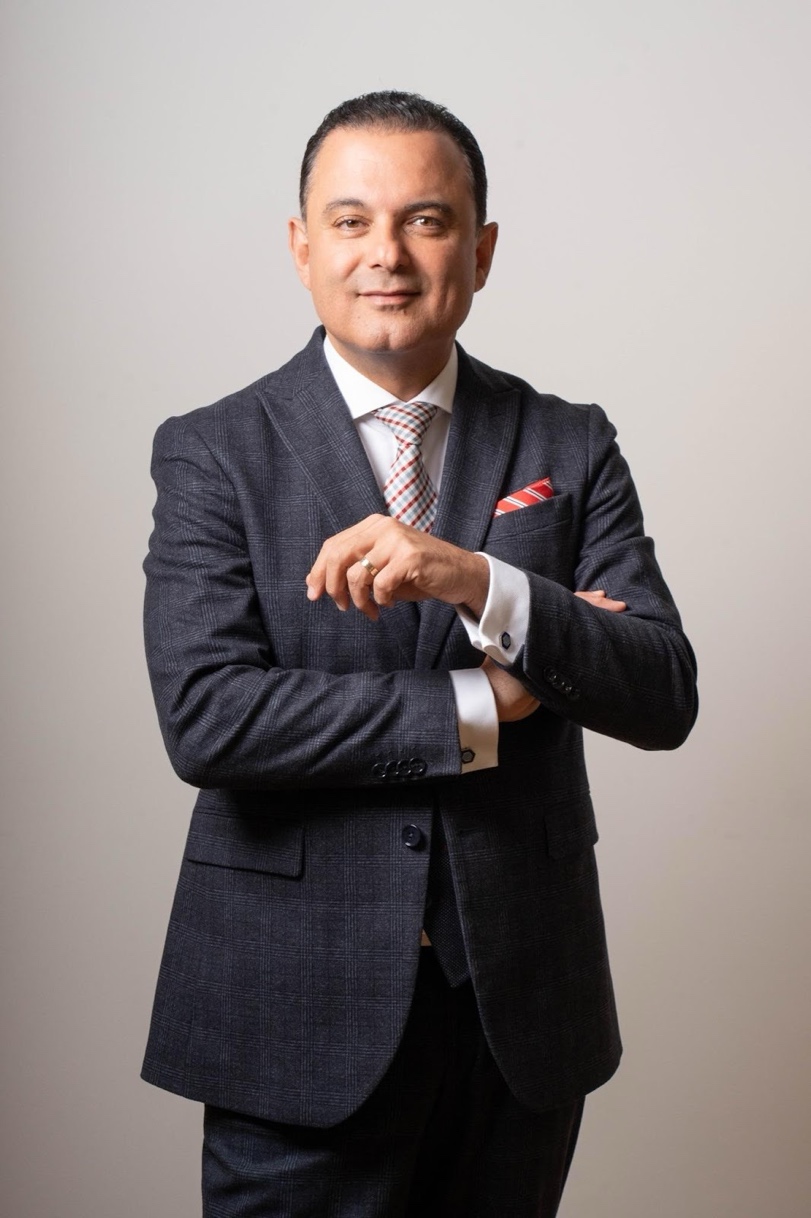
When Dr. Hosams Abu Meri walks into a clinic room in Latvia, patients see something very unusual. The person doing their gastroscopy or colonoscopy is not only a gastroenterologist, he is also the Minister of Health of the Republic of Latvia.
He still gets selfies in the endoscopy room. Patients apologize for asking, then say what many of them feel:
“I trust you more. When you explain my diagnosis in one sentence, I already feel healthier.”
His story is not a simple one of career change from medicine to politics. It is a story of family, migration, responsibility and dual loyalty, to his patients and to his adopted country.
Born Into Medicine, Born into Politics
Hosams Abu Meri likes to say that both of his professions started in childhood.
He grew up in a village in the mountains of Leban
on, in a large extended family.
“I was born in a family of doctors, a lot of doctors. Two of my uncles are doctors, my friends, my cousins. When we met in summer at lunch or dinner there were always three or four doctors at the table. So, it is something like genetics.”
Medicine was one side of the family tradition. The other side was politics and public service at the local government level.
Half of the village shared the surname Abu Meri. His grandfather and relatives often chaired the local council or sat on it, led municipal campaigns, organized candidate lists, and wrote programs for each four-year cycle.
“I saw my grandfather holding meetings at home, preparing lists, planning for the village. That stayed in my mind. Maybe that is why I wanted to be a politician one day, although I never imagined it would be in Latvia.”
Choosing Gastroenterology, A Whole System from Mouth to “Canalization”
He finished medical school in 1999 and faced the classic residency decision.
“I had to choose between internal medicine specialties. I was thinking about cardiology and gastroenterology. I was also calculating the risks and workload of each profession.”
Cardiology attracted him. Yet the complexity and continuity of the digestive system drew him even more.
“Gastroenterology is a huge system. It starts from the mouth and ends, as I joke sometimes, in the canalization of the body. You can diagnose and treat with endoscopy. That is very challenging for me.”
Endoscopy gave him exactly what he wanted: a mix of diagnostics and active intervention.
From Lebanese Village Politics to Latvian Parliament
His path into politics did not start from a party office. It began with community work and identity.
After the 9/11 attacks and the rise of Islamophobia and Arabophobia, he felt a responsibility to explain the Middle East and Arab culture to Latvian society.
He founded the Lebanese Cultural Society in Latvia, then the Arabic Culture Center, and became a frequent commentator in the media on the Middle East, the Arab Spring, and regional conflicts.
At the same time, he learned Latvian, worked as a physician, and built trust in his local community.
“All this together, plus being a doctor and speaking Latvian, gave me a certain popularity.”
He obtained Latvian citizenship in 2007. Friends in politics soon approached him as they were forming a new Unity party, bringing together three parties with a centre right ideology.
“I liked their idea. Around 2009–2010 I started my political career in Latvia.”
The boy who grew up watching his grandfather write local programs in Lebanon was now shaping policy in a Northern European state, as an MP and later as Minister of Health.
A Bridge Between Latvia and the Arab World
His background gives him not only a personal story, but also a strategic advantage.
“Arabic is an additional language I can use here. It allows me to speak directly with ministers of health and politicians from the Arab world and to use contacts across the region.”
He points out that the Lebanese diaspora is spread across the Middle East, Europe, the Americas and beyond.
“You always have someone, a friend or relative, somewhere. You can always find a contact to help the mission I am doing right now.”
This is not theoretical. He recently visited Egypt and toured three major pharmaceutical manufacturers.
“I am looking at Egyptian production as effective and cheaper than many European products. If we can bring lower cost but effective medicines to Latvia, especially for expensive treatments like hepatitis C or biological agents, we can help our people.”
These ties also help raise Latvia’s profile outside the European Union, where the Baltic states are less well known.
“In Europe everyone in politics knows Latvia and the Baltics. Outside the EU you first have to explain where Latvia is, our population, borders, the situation in Ukraine. These connections help us get to real cooperation faster.”
A Minister Who Still Does Endoscopy on Saturdays
Unlike many ministers who leave practice entirely, Dr. Abu Meri still sees patients regularly.
“On Friday morning I had two hours of consultations. On Saturday I worked the whole day and did 19 endoscopic procedures, colonoscopies and gastroscopies.”
Patients are often surprised to discover that the person treating their gastritis or performing their colonoscopy is the minister himself.
“I get a lot of selfies in the clinic. People say, ‘A gastroenterologist and the Minister of Health, I am proud to meet you.’”
For him, continuing to practice serves two purposes.
First, clinical quality:
“I must keep my skills. I am a doctor.”
Second, direct feedback on policies:
“As a doctor and politician, I feel the direct consequences of my decisions. When a patient sits in front of me and tells me how they feel after a reform, after one or two years, I am not far from reality. This is very important.”
“Smile and Keep Hope for the Patient”
Asked about the most important trait for a doctor, he does not hesitate.
“Fifty percent of a medical doctor’s job is communication.”
He insists that explanations must be clear, calm, and in normal language.
“You must let the patient feel comfortable, not push or press them, and build trust. When you explain what they have to do in a comprehensive way, many patients leave already feeling better.”
He tells the story of a couple who drove 60 kilometers from Riga to find him after three years.
They had seen other gastroenterologists and respected them, but insisted on seeing him again.
“The wife told me, ‘When you tell me one sentence about my diagnosis and the tablets, I immediately feel healthy. Thank you that you are still practicing.’ She needed five minutes. I repeated what she has to take and when to return. For her, this was enough.”
Even on the most exhausting days, he insists on kindness and composure.
“Sometimes you are tired, you feel sick yourself, but you must still smile and keep hope for the patient.”
The Weight of the White Coat, Burnout and Workforce Shortage
He is candid about the pressure doctors face, and he speaks from experience.
“I had a lot of hours, like everyone in Latvia now. We have a problem with human resources, a shortage of doctors, nurses and assistants.”
Doctors compensate by working extra shifts and long days.
“There were days I had 20 or 25 consultations and no time to eat. Imagine, a gastroenterologist who does not have regular meals, while telling all patients to have regular meals.”
Burnout shows up in complaints.
“85% of all complaints to our health inspectorate are about communication. Not because doctors are bad people, but because they are exhausted, physically and mentally.”
He recalls nights when difficult cases followed him home.
“You go to bed but wake up in the middle of the night, thinking of a patient. You take books, you search online for answers to unclear diagnoses. It is a very stressful job.”
Yet, he admits something surprising.
“Compared to the job of a minister, the job of a physician was better. As a doctor you feel positive reactions quickly. As a minister, you work 24/7 and the impact is slower and less visible at the moment.”
Why Latvia Lost Health Workers and How It Is Rebuilding
He traces Latvia’s workforce crisis back to the 2009–2010 economic crisis.
Budget cuts hit health care, hospital networks were reorganized, and the medical sector was not a political priority. Salaries were low, and many doctors and nurses left for other EU countries.
“We estimate that about 300,000 people left Latvia in the last 10 to 15 years. Now maybe 25,000–30,000 are coming back.”
At that time, there was also insufficient state support for medical education and residency. Many trainees had to pay for their own specialization or rely on a hospital sponsor.
The situation today is different.
Over the last decade, Latvia has increased public funding for health from around 800 million euros to almost 2 billion euros.
Residents’ salaries have risen from 700–800 euros to almost 2000 euros, and they can earn more by taking on duties in different institutions.
Doctor salaries are now close to EU averages for those who work the many hours available. The bigger gap is in nurses’ pay and numbers, which the ministry is trying to address with better salaries, working conditions, insurance and bonuses.
“We need five to seven years to really feel the effect. We are also redesigning the hospital network and making education more flexible, for example allowing specialists to learn additional procedures in parallel, updating credit systems, and reducing unnecessary bureaucracy in partnership with professional associations.”
The Abu Meri Plan, Cheaper Medicines and a Digital Health System
When he became Minister of Health, he sat at home one night with a pen and a small napkin and drew what he calls the “Abu Meri plan” for the health system.
“I needed a strategy from day one, short term and long term.”
His short-term priority was very concrete: reduce medicine prices.
At that time, wholesalers received a percentage margin on every package, which he considered excessive.
“We fought for one and a half years with the wholesalers. It was a very tough fight.”
From 1 January this year, a new pricing system came into force.
- Prices of about 70% of medicines decreased by 15–20%
- Some dropped by 50%, for example a migraine drug that fell from 33 euros to about 15 euros
He also redefined the role of pharmacists.
“I do not want pharmacists to be just sellers. They study five years at university. They must become part of the treatment team.”
Now, for each prescription, the pharmacist receives a small fixed payment, shared between the state and the patient. In return, they are expected to counsel patients on how to take the medicines, interactions, and side effects.
On the long-term side, his focus is digitalization.
- The e-health system has been technically improved
- A new Laboratory Model now allows patients to see lab results for free in e-health
- From November, e-referrals have started, and e-booking will follow, to cut waiting times by 15–20%
- A Health Digital Center has been created to coordinate these efforts
Methodological centers have also been established, including in oncology and rehabilitation, to develop guidelines, monitor quality of care and calculate realistic costs of services.
Latvia is also piloting “hospital at home” services for chronic conditions like lung and heart disease, using digital monitoring to keep patients at home rather than repeatedly admitting them.
Primary care is being strengthened, with more funds for family doctors and additional incentives for those willing to work in rural and remote areas.
“You cannot move forward if you work on only one level. You must move in parallel.”
Cancer in Latvia, Progress and Persistent Gaps
Oncology is both a professional and political priority for Dr. Hosams Abu Meri.
Recent years have brought pilot projects with increased funding for reimbursement of cancer medicines, particularly for innovative breast cancer treatments, and a stronger push on screening.
He notes an improvement of around 27% in 5-year survival in some groups, including stage IV patients, after better access to therapies and more timely diagnosis.
Screening coverage is rising from very low baselines:
- Cervical cancer screening participation is now above 50%
- Breast cancer screening has increased to about 38–40%, up from 15–20% a few years ago
- Colorectal cancer screening has risen from around 15% to 27–28%
A digital mammography bus travels through rural areas so that women who cannot easily reach hospitals can still get mammograms.
The HPV vaccine is now funded by the state up to age 24, for both boys and girls, to reduce future cervical cancer risk.
However, Latvia still lags the EU average of 70% screening participation.
A major weakness has been data.
“When you compare Latvia with EU countries, we are often at the bottom of the list in incidence and mortality statistics. But I feel that part of this is lack of data, not just bad outcomes.”
A national screening registry and platform is now being built so that participation, diagnoses and outcomes can be tracked in detail and analyzed.
Cancer funding for medicines has increased from 50 million to almost 80 million euros, and the total reimbursement budget has grown from 220 million to 320 million euros in two years.
“I cannot show all the results today. But I am sure that in two years we will see important impact on mortality and survival.”
Tobacco, Vaping, Alcohol, Obesity, A Public Health Frontline
He sees cancer not only as a matter of treatment, but as the result of behaviors and environments that must be addressed together.
As an MP in 2023, he worked on amendments to the tobacco and nicotine law.
From August 2024 and fully from January 2025, Latvia has:
- Banned flavored e cigarettes and vapes
- Prohibited advertising of such products
- Raised the legal age for purchasing and using tobacco products from 18 to 20 years
- Set a limit of 4 mg of nicotine in nicotine pouches, down from previous much higher levels
The aim is to protect children and young people, whose vaping rates climbed sharply during the COVID years, with nearly half of pupils having tried cigarettes or flavored vapes at least once.
Industry has responded by creating flavor drops and other workarounds, so new challenges keep emerging.
Latvia has also raised excise taxes on tobacco and alcohol and passed stricter laws on alcohol advertising and sales hours, particularly around holidays, to reduce harmful use.
“We are among the highest in the EU in alcohol consumption, around 11.7 litres per person. Alcohol is a major cause of pancreatic, colon, liver and other cancers, as well as cardiovascular disease.”
Obesity and low physical activity are additional priorities. Recent government plans on obesity and a new oncology plan were adopted by the Cabinet, and he stresses that all these issues, from tobacco and alcohol to inactivity and obesity, must be fought together.
Europe as One Health Space
When he talks about the European Union, he speaks about health as a shared responsibility.
“We live in one region and one space as one whole area. We should be united, especially in health.”
For him, that means:
- A unified EU policy on tobacco and nicotine, including stricter directives on flavors and e cigarettes
- Common approaches to obesity, addiction, non-communicable diseases, and preparedness for infectious threats
He argues that if member states adopt regulations that are not matched at the EU level, illicit trade and cross border purchases will undermine national efforts.
“If I have a law that I cannot implement 100%, it will not work well. We need European solutions for European problems.”
Mentors, Books and Continuous Learning
Dr. Hosams Abu Meri does not name a single mentor. He has many.
He often meets former presidents of Latvia, including Vaira Vīķe Freiberga, whom he deeply admires.
“She is a politician who has done a lot for Latvia, with a brilliant mind and wide cultural experience. Sitting with her for a few hours, you learn a lot.”
He also seeks advice from senior economists, journalists, professors from different sectors, and even younger colleagues.
Inside the ministry, he considers his own team a source of learning, from advisors on law and communication to technical experts.
“They tell me what is possible and how to implement ideas. You must be ready to learn from everyone around you.”
His reading time has shrunk dramatically in the last two years, but one book stayed with him, a large work by former US Vice President Al Gore on climate change, the economy and politics.
“It showed me the scale of global challenges, especially climate change. It made me think, what will the world look like in 100 years and what can I do today to help change the course.”
He also likes small handbooks from airport bookshops, short reflections on life, stress, friendship and daily behavior that can be read in one flight.
Two Messages for the Next Generation
His advice to young people is simple and firm.
First, guard your health.
“Health is not something you just receive at birth and then ignore. It is everything for you. You must take responsibility for your sleep, physical activity, food and nervous system from the very beginning.”
Second, do not be afraid of big dreams.
“Any dream you have in childhood, any goal you want to reach, is possible. But you must be patient, work hard, and not get angry when you fail. Stand up again, try again and again. You will reach your goal.”
How He Sees Himself, and Who He Thinks You Should Talk to Next
Asked to describe himself in one sentence, he answers quietly:
“I am a person who has devoted himself to the benefit of the people I live with.”
He acknowledges that not everyone agrees with his decisions and that some letters he receives are harsh or insulting.
“But it means I am doing something. If nobody reacts, it means you do nothing.”
As for who should be interviewed next, his choice is personal.
He recommends Ivars Godmanis, former Prime Minister of Latvia, who led the government in the early 1990s when Latvia regained independence and again during the 2008–2009 crisis, and who is also a professor of economics and former Member of the European Parliament.
“To talk with him is a pleasure. You always learn something new. Even now he sometimes calls me and says, ‘You gave an interview, I did not like that answer, you should say it like this.’ He is a very dear mentor for me.”
From a mountain village in Lebanon, in a family of doctors and local leaders, to Riga, where he now balances an endoscope in one hand and a health system strategy in the other, Dr. Hosams Abu Meri has built a life at the intersection of medicine, politics and identity.
He calls it simply service.