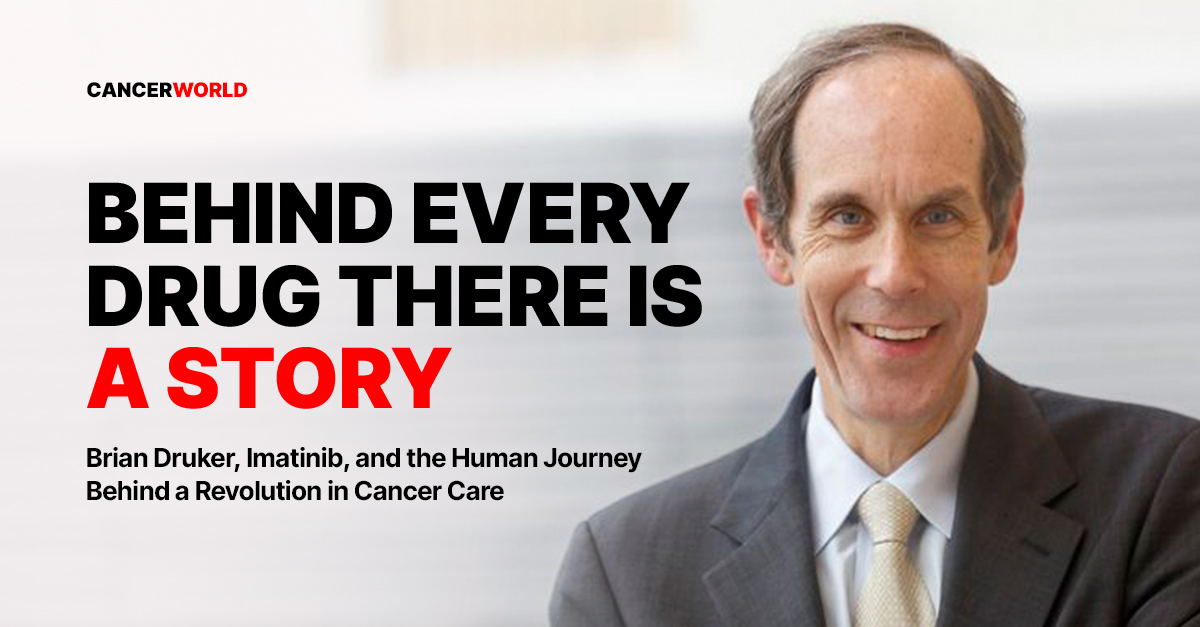
Twenty-five years after imatinib transformed chronic myeloid leukaemia from a fatal diagnosis into a manageable disease for many patients, Brian Druker reflects on the curiosity, setbacks, and patients who shaped one of oncology’s greatest breakthroughs.
Long before I understood the science, I understood the impact.
Growing up around oncology, I learned early that behind every advance in cancer care stood individuals whose curiosity, persistence, and courage changed the lives of countless patients they would never meet. Brian Druker was one of those individuals.
Sitting down with Brian Druker during the 25th anniversary of imatinib and the tyrosine kinase inhibitor revolution it helped launch felt like a rare full-circle moment, personally and professionally. What emerged from our conversation was not simply the story of a groundbreaking drug. It was a powerful reminder that behind every drug there is also a deeply human story.
Twenty-five years ago, imatinib changed the course of cancer history.
For patients diagnosed with chronic myeloid leukaemia (CML), the drug transformed what had once been a devastating diagnosis into a disease that many could live with for decades. It ushered in the era of targeted therapy and fundamentally altered the trajectory of oncology. Entire generations of cancer medicines would follow.
Today, imatinib is rightly celebrated as a scientific triumph.
But science alone does not tell the whole story.
The Curious Boy Who Never Stopped Asking Why
One of Brian Druker’s earliest memories is following his mother around the house asking a single question.
Why?
Why this?
Why that?
Why does it work the way it does?
The youngest of four children growing up in Minnesota, he developed a habit of taking apart clocks, radios, and watches—not because he knew how to put them back together, but because he wanted to understand what was inside.
“I always wanted to figure out how things worked,” he told me.
That curiosity became the defining thread of his life.
His father, a chemist and first-generation immigrant, believed deeply in education as a path forward. Expectations at home were high. If a report card arrived with five As and one B, the conversation focused on the B.
Beneath those expectations, however, was a lesson that stayed with him: never settle for what already exists if it can be made better.
Years later, he found himself asking the same question of cancer treatment itself.
Can we do better?
The Moment the Path Revealed Itself
As a medical student, Druker immersed himself in the history of childhood leukaemia.
The early papers were heartbreaking. Children diagnosed in the 1950s often survived only weeks. Through decades of research, chemotherapy transformed those outcomes, converting a fatal disease into one that many children could survive.
He admired that progress.
Yet something unsettled him.
The treatments worked, but at an enormous cost.
“There had to be a better way.“
In an essay written during his first year of medical school, he expressed an idea that would later define his career:
“Only by understanding what drives the growth of cancer cells can we devise better cancer treatments.”
Years before targeted therapy became a clinical reality, he was already imagining it. Looking back, those words seem remarkably prescient.
Rejection as Redirection
Scientific biographies often celebrate achievements.
Far less visible are the moments that almost prevented them.
For Druker, one of those moments came early in his academic career.
Several younger colleagues had received promotions ahead of him. When he met with institutional leadership to discuss his own future, the message was unmistakable.
He did not have one.
“The biggest low really was not getting a promotion,” he reflected.
The experience was devastating.
Today, however, he sees it differently.
“It was a gift.”
Until then, he admits, he had often given projects ninety percent effort. The disappointment forced him to decide where he wanted to make his greatest contribution.
He committed himself fully to one goal: bringing a BCR-ABL inhibitor into the clinic for patients with CML.
What first felt like rejection became the turning point that defined the rest of his career.
The Patients Who Would Not Let Him Quit
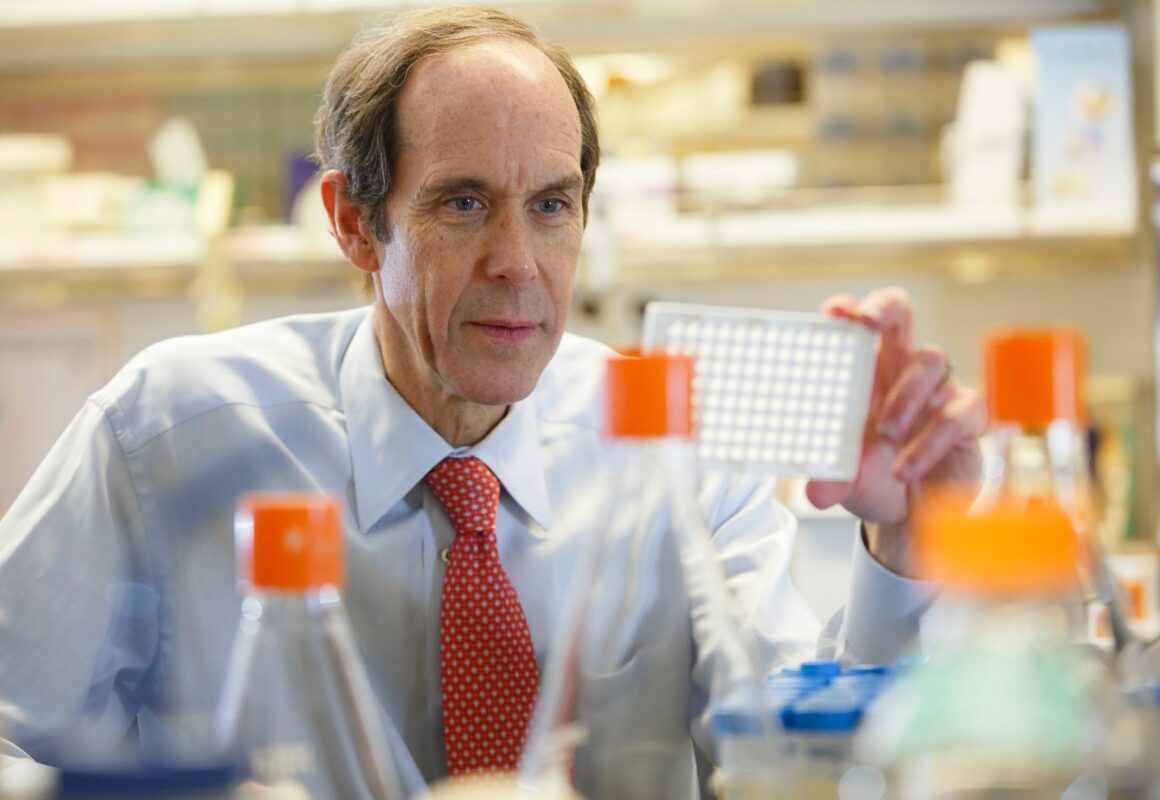
Brian Druker, M.D.
When Druker arrived in Oregon, he quickly obtained experimental compounds designed to inhibit BCR-ABL.
One stood out immediately.
It selectively killed CML cells while sparing normal cells.
The science was compelling.
The challenge was convincing others.
Pharmaceutical companies remained unconvinced. The market seemed too small, the financial risks too great. Developing a new drug required enormous investment, and few believed the effort would succeed.
While those conversations continued, Druker was sitting across from patients whose options were rapidly disappearing.
One young man, in particular, stayed with him.
A gifted technology enthusiast, he dreamed of building a revolutionary internet search engine.
His CML progressed into blast crisis before the experimental treatment reached him.
“It could have been the founder of Google sitting right there in my clinic,” Druker told me.
The patients were never statistics.
They were the reason.
The reason he refused to give up.
June 1998
Every field has moments that become part of its mythology.
For oncology, June 1998 is one of them.
That month, the first patient received imatinib.
Druker remembers checking on him constantly throughout the day.
Excitement mixed with fear.
Nobody knew what would happen.
Cancer drug development had conditioned oncologists to expect toxicity. Serious side effects were common. Failure was common.
Then something remarkable began to unfold.
Patients who had exhausted available treatment options started seeing their blood counts normalise.
Symptoms improved.
The disease receded.
Even then, Druker remained cautious.
The moment that convinced him came during an ordinary clinic day.
Three patients arrived one after another with the same story.
They felt well.
Their blood counts were normal.
For the first time in years, they believed they had a future.
“They were in tears. I was in tears.“
Then came the lesson that has stayed with him ever since.
“The greatest gift is hope.“

Working process
The Gift Returned
We often think of medical breakthroughs as gifts given by scientists to patients.
Listening to Druker, I realised the relationship runs both ways.
Hope was not only something imatinib restored.
It was something patients gave back.
Twenty-five years later, many of those original trial participants are still alive.
Druker has watched them marry.
Raise children.
Become grandparents.
Experience milestones that once seemed impossible.
The drug changed their futures.
They changed him.
When he speaks about those patients, his gratitude is unmistakable.
Not because they validated the science.
Because they trusted him.
And because they allowed him to witness what happens when a scientific idea becomes a human reality.
The Personal Informs the Purpose
As our conversation drew to a close, I found myself reflecting on a theme that had surfaced repeatedly.
The curious child.
The painful rejection.
The mentor who believed.
The patients who inspired.
The setbacks that became gifts.
Together, they shaped the purpose that followed.
Scientific breakthroughs do not emerge in isolation from human experience—they emerge through it.
The same curiosity that led a little boy to dismantle clocks eventually helped him dismantle one of cancer’s most important molecular mechanisms.
The resilience that carried him through disappointment sustained him through years of uncertainty.
Looking back, it becomes clear that imatinib was never simply the product of a scientific discovery.
It was the culmination of decades spent asking one question:
Can we do better?
Twenty-Five Years Later
Today, as oncology celebrates twenty-five years of tyrosine kinase inhibitors in CML, there is much to honour.
The science.
The patients.
The clinicians.
The researchers.
The generations of discoveries that followed.
Imatinib transformed the outlook for people living with CML and established a new paradigm for cancer treatment. It demonstrated that understanding the biology of a tumour could lead to therapies capable of changing the course of disease while sparing patients many of the toxicities associated with conventional treatment.
Its legacy extends far beyond a single drug.
Yet perhaps its most enduring lesson is a human one.
Behind every major medical breakthrough are people willing to challenge accepted thinking, persevere through failure, and earn the trust of patients prepared to believe in something not yet proven.
Brian Druker’s story reminds us that progress in medicine is driven not only by scientific discovery, but also by curiosity, perseverance, and the partnership between researchers and patients.
Twenty-five years after the first patient received imatinib, that partnership continues to shape the future of cancer care.
Perhaps it all began with a curious little boy who simply refused to stop asking one question:
Why?
About the Author
Aleksandra Filipovic (MD PhD) is a medical oncologist, cancer cell biology scientist, drug developer and educator. Having obtained her PhD at Imperial College London, she now serves as the Head of Oncology/CMO within the biotech space. Dr Filipovic practices and teaches integrative oncology globally. Dr Filipovic is also the host of the OncoDaily TV’s Podcast “Into the Body, with Dr Aleks”.