What children with cancer may be teaching us about medicine, uncertainty, and what it means to be human
There are conversations in oncology that begin with a question.
And then there are conversations in which, somewhere along the way, the question itself changes.
My conversation with Dr Jorge Ricardo Galvez Silva was supposed to be about pediatric oncology.
About what it means to treat children with cancer.
About parents.
Hope.
Fear.
Resilience.
The emotional landscape of walking into a room where a child is ill and somehow holding not one human being, but an entire family.
We spoke about all of those things.
But somewhere between science and childhood, between certainty and uncertainty, between what medicine can measure and what clinicians sometimes simply know, Jorge introduced another possibility.
He called it D.
And from that moment, D quietly sat with us for the rest of the conversation.
The Doctor Who Learned to Slow Down
Dr Jorge Ricardo Galvez Silva is a pediatric hematologist-oncologist and Medical Director of the Bone Marrow Transplant Program at Nicklaus Children’s Hospital in Miami. He trained in medicine at the Autonomous University of Honduras, completed his pediatric residency at what was then Miami Children’s Hospital, followed by a pediatric hematology-oncology fellowship at MD Anderson Cancer Center and further specialist training in pediatric stem-cell transplantation and cellular therapy at the University of Minnesota. His clinical and research work spans pediatric blood and marrow transplantation, malignant and non-malignant hematologic conditions, bone marrow failure syndromes and cellular therapies.
But Jorge brings something else into the room. Something that does not appear on a CV.
He grew up and studied medicine in Honduras, at a medical school with more than a century of history and, as he describes it, a very strong tradition of hands-on clinical training. Students embarked on a journey through the history of medicine, learning the vital elements of symptoms, signs, and physical examination that forge the foundations of being a doctor.
At the time, some of it seemed boring. Later, he understood why it mattered. They were being taught not simply what doctors know, but who they are as doctors.
When he eventually came to the United States, Jorge entered a medical culture with extraordinary technological capability. Rather than choosing between those worlds, he began to see the value of merging them.
Technology and touch. Diagnostic precision and listening. Innovation and history.
He still tells students that most of what they need to understand about why a person is sitting in front of them will emerge from listening to them. “Pay attention to signs and symptoms,” he tells them. And: “Pay attention to what a mother or a father says about their child.” Perhaps this is why Jorge’s presence feels unusual. He does not seem to be trying to arrive at the answer before the family in front of him has finished becoming the question. That was not always the case.
As a young man, he told me, he wanted very badly to be the best. Life softened that ambition. Or perhaps refined it. Jorge describes life like a car accumulating dents, miles, and the occasional flat tire along the journey. The dents slow you down. And when you slow down, he says, “You see better, and perhaps you see more. Eventually his definition of success changed. “It’s about the life you touch, the people you come in contact with.” Then he said something I repeated back to him because it felt too important to allow it to pass unnoticed:
“This is something you don’t need to fight for.”
Maybe that is where D begins.
A + B = C, Jorge thinks in equations. He had been thinking about one in particular before our conversation.
A + B = C.
We learn this structure early. Do A. Add B. Expect C. Medicine is built upon it.
A diagnosis plus an evidence-based intervention should produce a predictable outcome.
We refine A. We optimise B. We stratify risk, personalise treatment, sequence genomes, measure biomarkers, calculate doses and build increasingly sophisticated models to make C more predictable. Jorge knows this world intimately. Transplant medicine depends upon extraordinary precision.
And yet, after doing the same thing again and again, something begins to become impossible to ignore. “You start realizing that your A probably is very, very similar. Your B is also very, very, very similar, but your outcomes are very different.” The same disease. Comparable treatment. Comparable biological parameters. Different C.
Why?
This is where Jorge introduces D. “I’ve been lately calling it D,” he told me. What is D?
“I don’t know.”
And then came perhaps the sentence around which our entire conversation began to orbit:
“We don’t know what moves in between.”
D is not an alternative to biology. It is not an argument against evidence. It is not permission to replace oncology with something unmeasurable. It is the intellectual humility to acknowledge that our equation may contain variables for which we do not yet possess instruments or metrics. It makes the “D” no less real, no less omnipresent. Jorge calls what we are beginning to observe “the shadows of D.” And I love this description. Because a shadow, an announcement perhaps, tells us something exists before we can necessarily see the thing itself.
When Attention Changes Biology
During our conversation, Jorge referenced a paper he had just read in Nature Human Behaviour. Published in August 2026, the study examined whether voluntary attention could influence acute immune responses in humans. Across three preregistered experiments using acute skin inflammation, directing attention toward bodily sensations rather than away from them was associated with substantially more regulated inflammatory responses. The authors identified both sensory-dependent and top-down pathways involving parasympathetic vagal activity. Attention was not merely changing the experience of inflammation. Attention was associated with changes in the biology of inflammation itself.
To Jorge, this was fascinating. Perhaps, he suggested, science is beginning to see some of those shadows. I found myself wondering whether medicine is slowly becoming ready not necessarily to fully believe in what it cannot yet measure, but simply to doubt it less. Afterall, we cannot see gravity, we cannot see the Wi-Fi signal connecting our devices. Their invisibility does not make them unreal. Perhaps there are dimensions of human biology for which the measurement unit simply has not yet been discovered.
And perhaps discovering or uncovering them requires something surprisingly difficult in science: Remaining open.
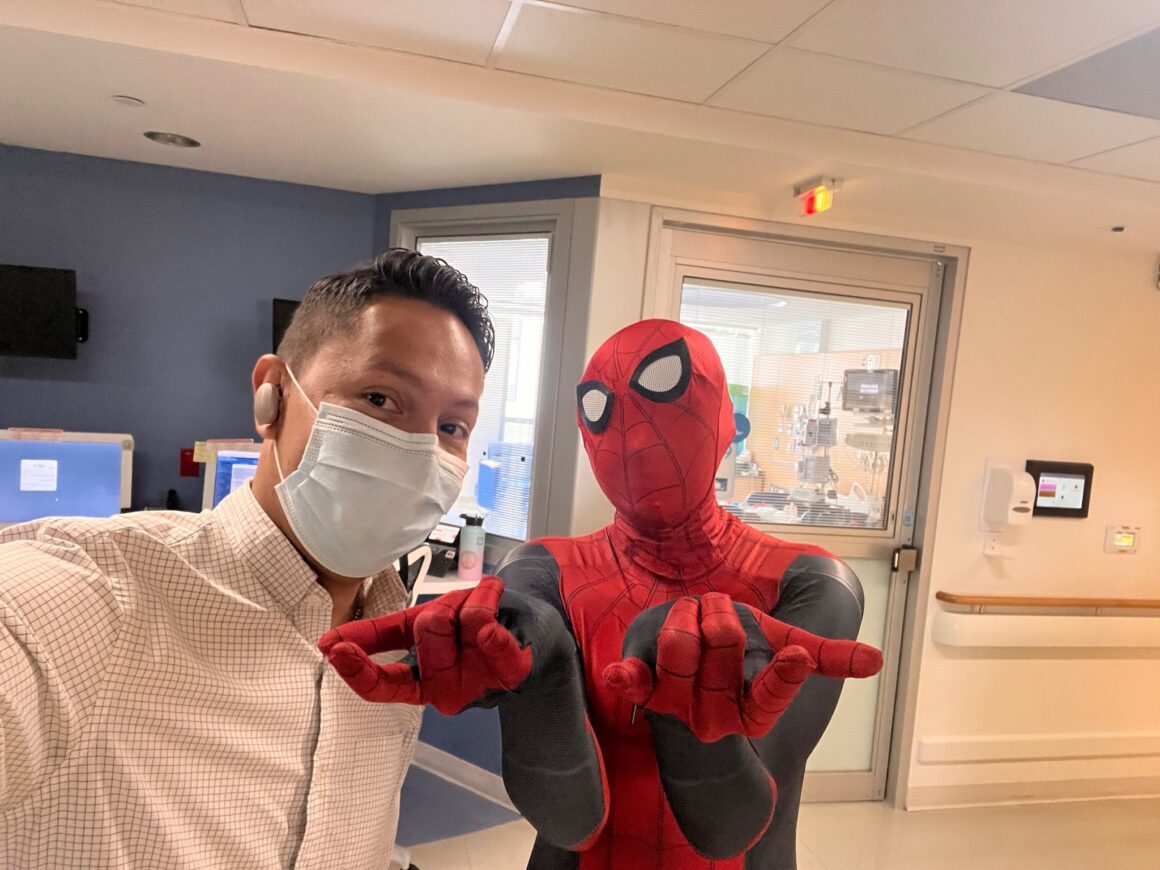
At the hospital
The Child Who Wants to Go to the Playroom
This becomes particularly interesting in pediatric oncology because a child arrives with an identity that is still being formed. Ask a young child in hospital who they are and they may tell you their name. They do not necessarily say:
I am a patient.
I have leukemia.
I am sick.
“The child is just the child,” Jorge said. The diagnosis may exist. The hospital certainly exists. The treatment exists. But the child’s immediate concern may be entirely different.
“Doctor, can I go to the playroom?”
Because that is their day. That is their childhood. That is who they are becoming. “If you don’t let me go to the playroom, it’s going to be a very sad day for me.” Across the room sits a parent.
And the parent’s internal landscape is entirely different.
When is the next scan?
When is the next treatment?
Has the tumour disappeared?
Has the transplant worked?
Is my child going to live?
The child wants the playroom. The parent wants the future. Same room. Same cancer. Completely different internal worlds. I told Jorge that what struck me was the absence, particularly in younger children, of the blending between person and diagnosis identity that we so frequently encounter in adult oncology. The child is having a childhood. It simply happens that part of that childhood is occurring within a medical context. The parent, meanwhile, understandably develops another identity: My child has leukemia. And yet children are not oblivious. Quite the opposite. They are extraordinarily perceptive. They watch their parents’ faces. They notice when their mother looks worried. They notice when their father becomes unusually quiet. And they watch us. More importantly, they SEE us.
Jorge has had children tell him:
“You are worried. I know that you are worried.”
Imagine the sensitivity required to perceive that. The child may not understand every word spoken in the room. But the child is reading the room.
Holding the Child, Holding the Parent
Being with Jorge as he speaks about this, something became very clear to me. His loyalty is to the child. But he holds the parents. And sometimes, the parents require more holding than the child. That is one of the unique emotional geometries of pediatric oncology.
Jorge describes certain moments as “landmark encounters.”
Diagnosis is one. Relapse is another. The end of treatment is another. And sometimes, palliative care. When the emergency department calls about a child with an alarming blood count, Jorge already knows what awaits him before he enters the room. He walks in carrying science. But that first encounter, he says, is not primarily about science.
“That part is in providing hope.”
The detailed treatment discussion can come tomorrow. He deliberately gives parents information in pieces. Not because they do not deserve all the information, but because human beings in such situations can only metabolise so much uncertainty at once, particularly a mother or father who has just learned that their child has a serious diagnosis. He tells them what the next few days may look like. What their child may experience. What they should expect.
Then, when something happens, he can say: Remember when I told you this might happen? This is that moment. The unknown becomes slightly less unknown.
And the family can walk through their experience until they begin to develop their own.
This is not separate from medicine. This is medicine.
Humaning
At one point, I told Jorge that although he had gone to medical school, completed fellowships and acquired extraordinary technical expertise, what I was hearing could not be reduced to qualifications. “You’re humaning with your patients,” I told him. Not performing humanity. Not adding compassion as an accessory to clinical excellence. Humaning. Allowing oneself to remain a human being while practising medicine. That distinction matters because pediatric oncology asks something enormous of the people who practice it. You meet children you cure. You meet children you cannot. And sometimes you know them for years.
The day before our conversation, Jorge had lost a patient with neuroblastoma whom he had first cared for as a resident. Later, he cared for him as an attending physician. Later still, as his transplant physician. A child became an adult. And Jorge remained somewhere within the architecture of that life. Then the biological life ended.
“It just sucks,” he said. “It just feels bad for the ones who cannot make it.”
There was no attempt to make the sentence more sophisticated.
It did not need to be. He then said something else. “I owe it to the patients that are not here that they have a voice.” He dedicated our conversation, in his own way, to them.
The Dents That Remain
I asked whether there was one patient who had changed him. There was. But Jorge was careful. He did not want one story to erase the many others. Often, he said, it is the patients who are no longer here who leave “a very big dent” in his life. The word returned.
The dents that once slowed down an ambitious young doctor. The dents left by children he could not save. Perhaps they are part of the same story.
Children, Jorge says, have taught me everything; they have guided his practice. They have told him when he was right. They have shown him when he was wrong. And sometimes they have shown him that being right does not guarantee the outcome. That knowledge grounds you. They have also taught him hope. Their resilience, he says, is “infinite.”
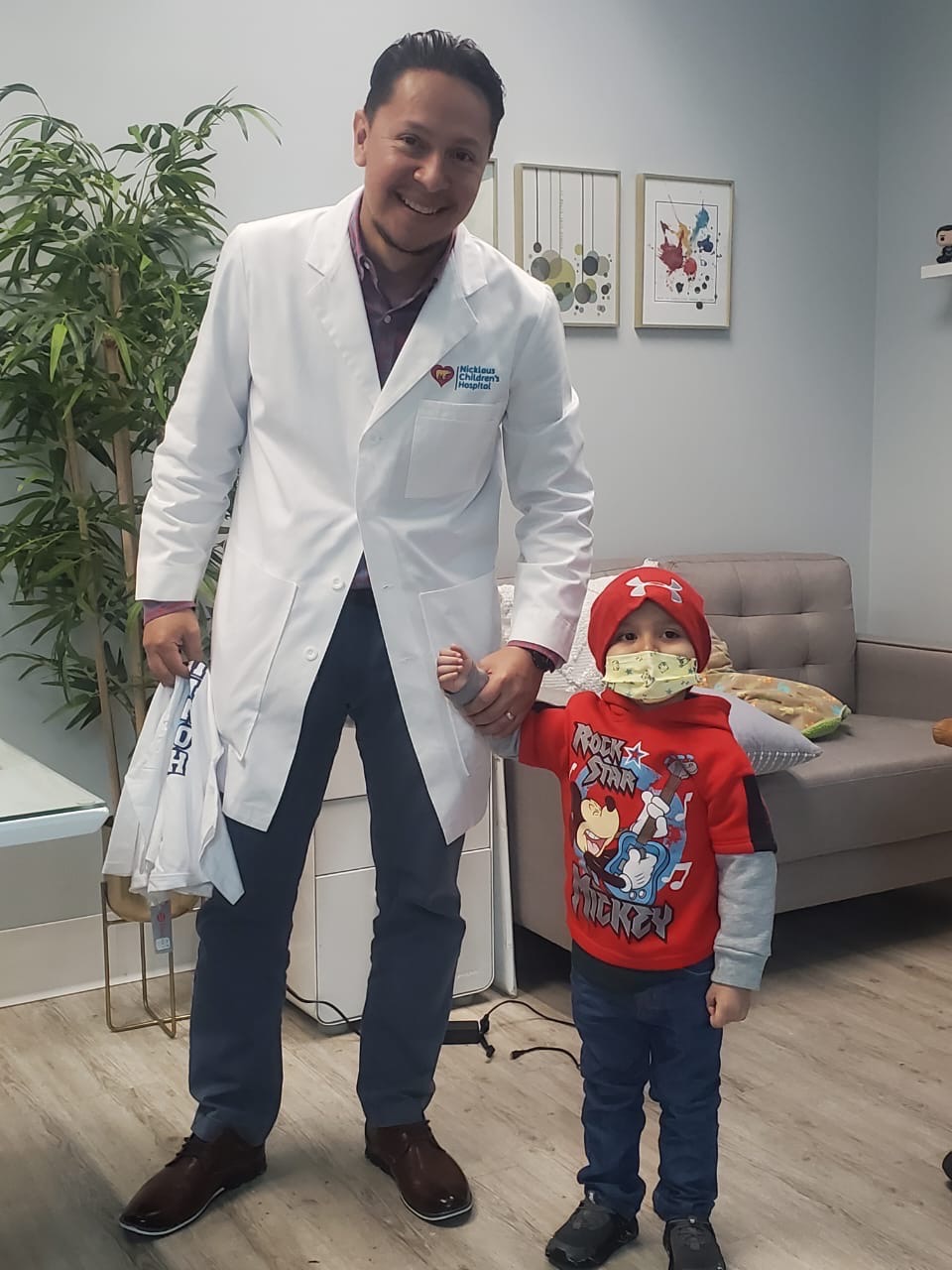
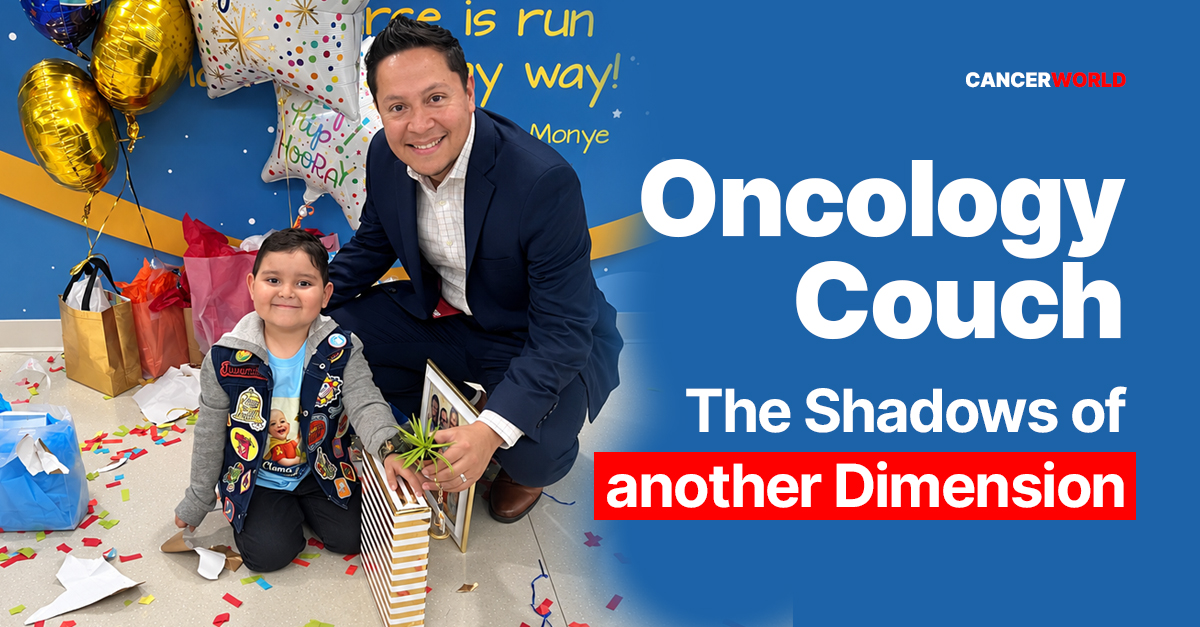
Dr Jorge Ricardo Galvez Silva with his little patient
Perhaps Children Remember Something We Have Forgotten
There was another quality to the way Jorge described children that stayed with me.
Children trust. Children inhabit time differently. Children can be extraordinarily mature and extraordinarily playful within minutes of each other. They are perceptive without necessarily having constructed the elaborate narratives adults build around what they perceive. Perhaps this is why they offer medicine something beyond pediatric expertise. Perhaps they remind us of something. Toward the end of our conversation, I suggested that perhaps D is not something humanity is going to discover. Perhaps, this Dimension is something we are going to simply remember, because it was there all along.
Maybe this is one of the gifts children offer us. They have had less time to ‘cover it’ with external conditioning of an internal system that is already so intelligent.
Why Does a Child Get Cancer?
There is one question pediatric oncology makes particularly difficult to avoid.
Jorge believes we need to remain willing to ask this question even when the answers are uncomfortable, incomplete or scientifically messy and slippery. In adult oncology we can point toward ageing, accumulated exposures, environmental factors, lifestyle, inherited susceptibility, acquired mutations. But a child is, in Jorge’s words, “brand new.” A new life. A developing nervous system. A developing immune system. A rapidly developing body. And cancer appears. We have biological explanations for some of this. We will undoubtedly discover many more. But Jorge’s point is not that biology is wrong. It is that our biology may still be incomplete. Perhaps, once again, we are looking at the shadows of D.
A Dream
Eventually I asked Jorge whether there was anything left on his heart that we had not spoken about.
He answered simply. “I have a dream.” One day, he wants to wake up and no longer have to deal with childhood cancer. He believes everyone working in oncology shares some version of that dream. The path toward it may be messy. There will be small steps and enormous ones. There will be discoveries. There will be failures. There will be A’s and B’s that produce the C we desperately hoped for. And there will be others that do not.
But perhaps somewhere along that journey we will discover, or rather – remember a measurement unit for something we currently cannot measure today. Perhaps we will understand another piece of D, and perhaps one day childhood cancer will simply disappear.
Staying With the Question – that Space in Between
Oncology is trained to answer questions.
What is the diagnosis? What stage? Which mutation? Which treatment?
But perhaps there are questions for which answering too quickly is itself a limitation. Questions we might need to inhabit. Questions whose purpose is not immediately to produce an answer, but to make us sufficiently curious to recognise the answer when it eventually arrives.
At the end of our conversation, I told Jorge that perhaps we need to become more comfortable living in and with the question, and allowing the answer to find us when we are ready.
So we decided not to resolve D. We would not name it. We would not force it into a definition simply to make ourselves more comfortable.
Jorge called our conversation Chapter One. Perhaps Chapter Two begins here.
With scientists continuing to investigate. With oncologists continuing to treat. With parents continuing to hope. And with children continuing to teach us.
About the Author
Aleksandra Filipović, MD, PhD, is a medical oncologist, cancer cell biology scientist, drug developer, and educator. She earned her PhD at Imperial College London and now serves as Head of Oncology and Chief Medical Officer within the biotech sector. Dr Filipović practices and teaches integrative oncology internationally and hosts the OncoDaily TV podcast “Into the Body, with Dr Aleks”.