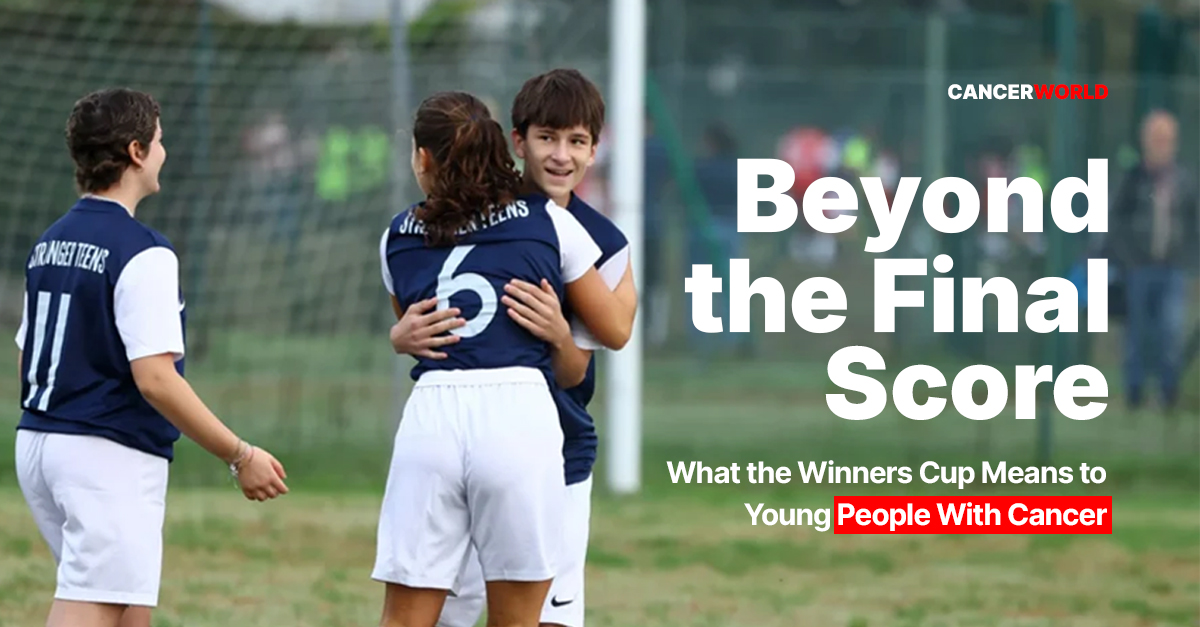
For more than 200 young people with cancer from across Europe, a football tournament in Milan offered something that cancer can make difficult to find: a chance to be with friends, feel understood and enjoy being young.
At the end of a football tournament, someone usually remembers the score. Who won, who missed a penalty, who scored the winning goal. At the Winners Cup, those things matter too. The players are competitive, and nobody arrives hoping to lose.
But ask what stays with them afterwards, and the answers can be very different.
For Matteo Davide, it was not the number of goals scored or conceded. It was the friends, the shared experiences, and the people who were no longer there.
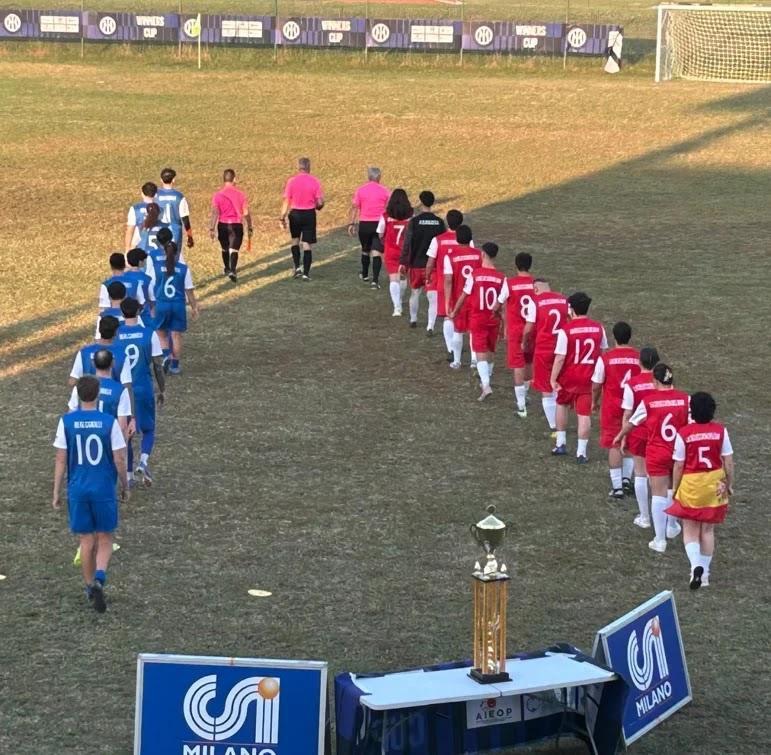
On October 9 and 10, more than 200 young people aged 15 to 21 gathered in Cornaredo, near Milan, for the seventh edition of the Winners Cup. Sixteen teams from oncology centres across Italy and Europe took part in the seven-a-side football tournament. All the players were undergoing cancer treatment or follow-up care.
Some had spent months in hospital. Others were learning to return to everyday life after treatment. They came from different countries and spoke different languages, but they shared experiences that many people their age would struggle to understand.
For two days, they also shared a football field.
A Place Where Cancer Needs No Explanation
There is no convenient age to have cancer, but adolescence brings particular difficulties.
At 15 or 16, life is supposed to be opening up. Friendships become more important, independence begins to take shape, and plans for the future start to feel real. A cancer diagnosis can interrupt all of that.
School is replaced by hospital appointments. Friends continue with their lives while treatment determines where a young person can go and what they can do. Even after treatment ends, returning to school or social life may not be as easy as everyone hopes.
And there are questions that can be difficult to share with friends who have never experienced cancer. Questions about scars, changes in appearance, the possibility of relapse, or simply how to feel comfortable in a body that has been through so much.
At the Winners Cup, many of those explanations are unnecessary.
The young people recognize something of their own experiences in one another. Professor Andrea Ferrari, a paediatric oncologist who has worked for years to improve care for adolescents and young adults with cancer and who conceived the Winners Cup,, has described how they recognizes one another through their scars and a particular light in their eyes.
Here, cancer is part of what brings them together, but it does not have to dominate every conversation.
There is football, of course. There are also the moments between matches, the evening celebrations, conversations and friendships that may continue long after everyone has returned home.
And there is the pleasure of being part of a team, of wanting to win a match for no other reason than that winning feels good.
This year, Real Camalli, representing Genoa, took home the trophy after defeating the Spanish team Seleccion Bar Spagna in the final.
It was a victory worth celebrating. But the meaning of the Winners Cup goes far beyond the final score. Matteo Davide, a former participant who has since passed away, captured this in a moving reflection written after one of the tournament’s earlier editions:
“It doesn’t matter how many goals you take or how many you score, the standings,
sore feet and sunburned faces.
All the friends were there.
There were those who went through adventures similar to mine.
There were those who shared them.
There were those who committed themselves to the lives of others.
And those who are no longer here were even more here than before.
For me, having been there already means having won everything.”
His words hold both the happiness of being together and the sadness that can accompany it.
For young people who have experienced cancer, friendship sometimes comes with an awareness of loss. They may have met others during treatment, shared difficult months with them, and watched some return to ordinary life while others did not.
The friends who were absent were still part of the gathering in Matteo Davide’s memory.
It is a reminder that survivorship is not always a simple story of illness followed by recovery. There can be gratitude, grief and uncertainty, sometimes all at once.
And there can still be room for football.
The Day Former Patients Beat Their Doctors
Among the matches played during this year’s Winners Cup was a competition that brought together three groups who usually meet under very different circumstances.
One team was made up of doctors representing the Italian Association of Medical Oncology (AIOM) and the Italian Association of Paediatric Haematology and Oncology (AIEOP). Another represented parents and families through FIAGOP, the Italian federation of associations supporting families affected by childhood cancer. The third team was made up of former Winners Cup participants who had grown older than the tournament’s age limit of 21. These were young people who had previously come to the competition as patients and had now returned to play again.
The final brought the doctors and former patients onto the same field. After a penalty shootout, the former patients won. There is a certain satisfaction in that result.
Inside a hospital, the roles are usually clear. Doctors explain diagnoses, recommend treatments and make clinical decisions. Patients ask questions, undergo procedures and live with the consequences of those decisions. Parents spend much of their time trying to understand what comes next.
On a football field, those roles become less important. A doctor can miss a penalty. A former patient can score the winning goal. A parent can join the competition rather than watch anxiously from the sidelines. The relationships remain, but the setting changes.
For the former players, returning to the Winners Cup carried another meaning. They were no longer eligible to compete in the main tournament, yet they still wanted to be there.
The connection they had found through the event had lasted beyond their years as participants.
That continuity is particularly important in adolescent and young adult cancer care, where support is often needed long after active treatment has ended.
The Age Group That Cancer Care Has Struggled to Serve
The Winners Cup is a football tournament, but it also draws attention to a question that oncology has not fully resolved: where do adolescents and young adults belong in cancer care?
They are often caught between services designed for children and those developed for adults.
A 16-year-old undergoing chemotherapy may have medical needs similar to those of a younger child, but their concerns about independence, education, fertility and relationships may be quite different. A patient in their early twenties may receive treatment in an adult oncology department without having access to support designed for someone at the beginning of adult life.
Professor Ferrari has long described this population as occupying the “middle ground” between paediatric and adult oncology.
The distinction is not simply about age. It can influence where patients receive treatment, whether they have access to specialised centres and clinical trials, and what psychological and social support is available to them.
In Italy, AIOM and AIEOP established a joint working group five years ago to address some of these gaps.
The two scientific societies have been working towards a more coordinated approach to adolescent and young adult oncology, promoting research pathways and seeking to define a model of care based on stronger links between paediatric and adult services, but also on the definition of minimal essential requirements that define age-specific standards of care, such as the need for access to fertility preservation, genetic counselling, age-specific psychosocial support, a hospital environment, and long-term follow-up.
One of their objectives is to establish a nationally recognised programme for adolescents and young adults within Italy’s National Oncology Plan.
It is an ambitious undertaking, and one that goes well beyond organising a sporting event.
But the Winners Cup gives these discussions a human face.
It is easy to speak about quality of life, psychosocial needs and long-term survivorship in medical conferences. It is quite another thing to see what those ideas mean for a young person who wants to spend a weekend with friends and play football.
The tournament also brings together many of the people involved in making better care possible: patients, families, doctors, scientific societies and community organisations.
Organised by FC Internazionale Milano alongside CSI Milano, FIAGOP, AIEOP and the Networks of Expertise on Adolescents and Young Adults with Cancer, with support from Fondazione Bianca Garavaglia and Regione Lombardia, the event has grown into a meeting place for both young people and the wider cancer community.
Its connection with European cancer networks reflects a broader effort to improve specialist care and reduce inequalities for adolescents and young adults across countries.
These are complicated challenges, involving healthcare systems, professional collaboration and public policy.
For the young players, however, their immediate value may be much simpler: having somewhere to belong.
What Remains When the Football Ends
By Saturday evening, the matches were over.
Real Camalli had won the Winners Cup. The former patients had beaten the doctors. The players had spent two days competing, meeting people and sharing an experience that few other sporting events could offer.
Then came the journey home.
Some would return to treatment. Others would go back to follow-up appointments, school, university or work. Some would still be finding their way through the uncertainty that can remain after cancer.
A weekend of football cannot remove those difficulties.
But it can offer something that is easily overlooked when so much attention is understandably focused on treating the disease.
Young people need more than medical appointments and good test results. They need friendships, opportunities to take part in ordinary activities and places where their experiences are understood without becoming their entire identity.
Not every young person will find that through sport. For some, it may come through music, education, art or simply spending time with others who have been through something similar.
At the Winners Cup, football creates that opportunity.
Matteo Davide’s words return to the people rather than the results. He remembers those who shared his experience, those who helped others through it, and those who could no longer join them.
His reflection does not pretend that everything is easy after cancer. Nor does it need to.
It makes room for the joy of being there, and for the people who are missed.
The football has finished, and the trophy has gone home with Genoa. But the friendships will not necessarily end with the tournament.
For Matteo Davide, being there had already meant winning everything.
About the Author
Marine Marachlian, MD is an oncology resident and Medical Content Writer and Editor at “OncoDaily”, passionate about cancer research and evidence-based medicine.