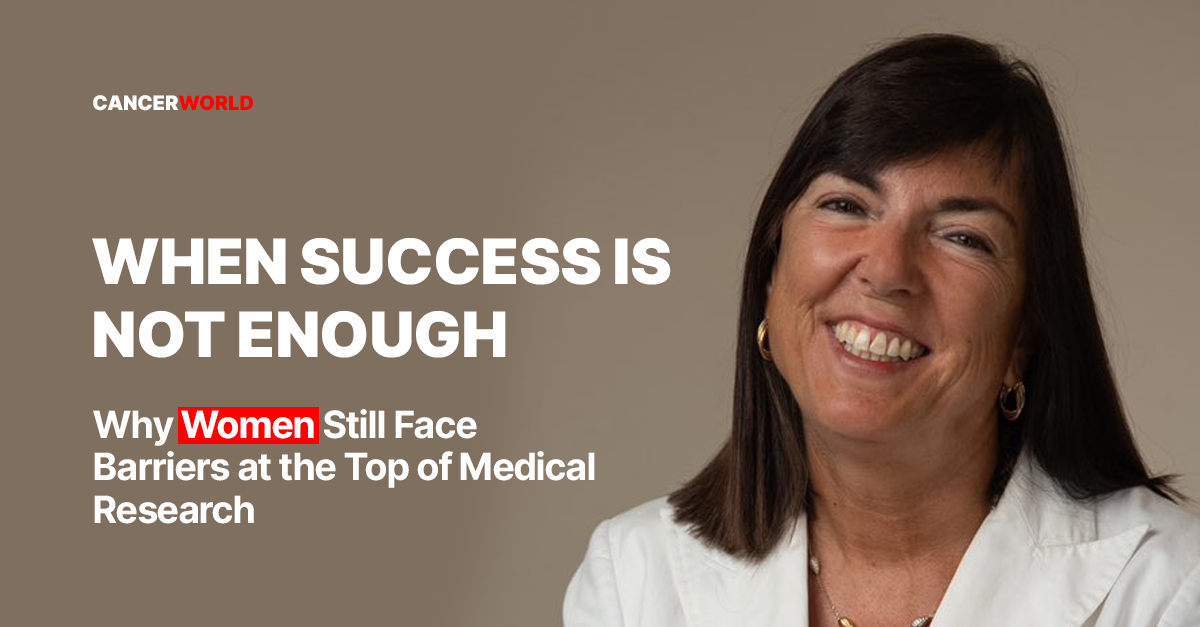
A study on highly cited women scientists who have succeeded by conventional measures of academic achievement suggests that reaching the top does not mean that barriers have disappeared.
For years, CancerWorld has documented the barriers that hold women back in leadership roles in oncology and medical research.
We have asked why surgery remains dominated by men despite the growing number of talented female surgeons. We have looked at the persistent inequalities affecting women pursuing academic careers in oncology. We have argued for change, and we have given women oncologists the opportunity to describe, in their own words, what it means to build a career in a profession where gender can still influence opportunities, recognition and advancement.
The evidence that a gender gap exists is therefore hardly new.
But there is another way of looking at the problem.
What happens if, instead of asking why women leave science or fail to reach its highest ranks, we ask the women who made it to the top?
That was the question behind our recent study, Challenges and barriers to women’s leadership in medical research and how to prevent and overcome them, published online in the European Journal of Cancer Prevention on 21 July 2026.
The study, by Adriana Albini, Elisabetta Vercesi, Eva Negri, Delia Goletti, Sara Gandini, Giovanni Corso and Sonia Levi, investigated the experiences of highly accomplished women scientists working in Italian academic and medical research.
Their answers were revealing – and, in many respects, disturbing.
Almost nine in ten reported encountering at least one gender-related obstacle during their careers.
These are not women whose careers stalled. They are not women who failed to find a place in science.
They made it. But they made it despite the barriers.
That distinction matters.
Looking at the women who made it
The study grew out of the Top Italian Women Scientists (TIWS) Club of Fondazione Onda ETS, the Italian National Observatory on Women’s and Gender Health.
TIWS was created in 2016 to bring together Italian women scientists distinguished by high scientific productivity and impact in biomedical sciences, clinical sciences and neuroscience. Its aim was not only to recognise scientific excellence, but also to build a network, to make accomplished women scientists more visible and to encourage younger women to consider careers in research.
That visibility is needed. Women represented only 18.8% of the researchers included among the Top Italian Scientists of viaAcademy in the analysis presented when the Club was developed, ranging from 25% in biomedical sciences to just 15.6% in clinical sciences.
From the outset, TIWS was about more than celebrating successful women. It also created a space in which they could talk about how those careers had been built.
The research followed a methodological survey conducted by Elma Research and promoted by Fondazione Onda ETS. A structured 33-item questionnaire explored work–life balance, caregiving and maternity, gender-related obstacles, access to leadership roles and perceptions of institutional support. One hundred senior women medical researchers with an h-index of at least 60 were invited to participate; 82 completed the questionnaire.
They had spent, on average, more than three decades in research. Most had substantial international experience.
TIWS is part of a much broader movement. Women scientists have been organising for decades to gain visibility, recognition and access to leadership. In cancer research, one of the most important examples is Women in Cancer Research (WICR) within the American Association for Cancer Research (AACR).
WICR provides a structure for advocacy, networking, mentoring, awards and professional development, while advising AACR leadership on issues of concern to women investigators.
In Europe, the European Women’s Management Development network (EWMD) set out to increase women’s visibility and participation in senior positions in business and society and to provide new female role models for younger generations.
These organisations emerged in different environments but share an important premise: talent is not enough if the structures that recognise, promote and select talent do not give women the same possibility to progress.
Almost four decades after WICR and EWMD were established, that proposition remains strikingly relevant.
Success – Despite the Barriers
Among the women in our study, 89% reported encountering at least one gender-related obstacle during their careers.
57% reported difficulties in accessing leadership positions and 52% difficulties in career progression. Only 17% were satisfied with the level of gender equality and inclusiveness in medical research.
These figures deserve attention precisely because of who answered the questionnaire.
We sometimes point to successful women as evidence that barriers have disappeared. There are now female professors, department heads, scientific directors, society presidents and internationally recognized researchers. Surely, the argument goes, the glass ceiling must be breaking.
But exceptional individual success cannot be used as evidence that everyone has an equal chance of achieving it.
The women we surveyed published, competed for grants, built research groups, trained younger scientists, accumulated citations and achieved international recognition.
Success tells us that they overcame the obstacles. It does not tell us that the obstacles were not there.
Indeed, studying only the women who reach the top may underestimate the scale of the problem, because it tells us nothing about those who disappeared along the way.
The Scissors are Still Cutting
The pattern has been recognised for years.
Women are strongly represented among students and early-career researchers, yet their proportion progressively decreases as academic rank rises. The resulting graph has become known as the “scissor-shaped curve”: as men’s representation rises towards the highest academic grades, women’s falls.
The persistence of this “scissor-shaped curve” is not simply a legacy of the past. As Johanna Joyce and colleagues argued in Cell in 2024, waiting for gender imbalances to correct themselves over time has not worked: closing the scissors requires proactive, data-driven and sustained institutional action.
Why do the scissors remain open? Our survey suggests there is no single answer. Disadvantages can accumulate through a series of pressures: gender bias, difficulties in career progression, unequal access to leadership and decision-making, family and caregiving responsibilities, lack of institutional support, and a scientific culture that often equates commitment with near-constant availability.
Some of these barriers are overt. Others are subtle.
Women can also encounter the familiar leadership double bind: behaviours associated with successful leadership, such as assertiveness and authority, may be evaluated differently when displayed by women. A woman is expected to be decisive enough to lead but risks being judged negatively if she is perceived as too assertive; collaborative enough to conform to gender expectations, but not so accommodating that she appears insufficiently authoritative.
No single episode necessarily determines a career.
But small differences in access to recognition, networks, funding, invitations, promotion and leadership can accumulate over 20 or 30 years.
The Hidden Cost of the ‘Ideal’ Scientific Career
Then there is time.
Scientific careers remain structured around a model of exceptional availability: long working hours, international mobility, conferences, evening meetings, grant deadlines, laboratory emergencies and the expectation that the most committed researchers will somehow always find additional time.
But time is not equally available to everyone.
In our survey, 91% reported difficulties balancing professional and personal responsibilities.
Most had also carried substantial caregiving responsibilities. Seventy-four percent had children and 72% had cared for other family members. Among mothers, nine in ten reported moderate or severe difficulties combining childcare with their professional commitments.
The survey also showed how deeply work could penetrate private life. Respondents described difficulty disconnecting from work, lack of time for themselves, working beyond normal hours and feelings of guilt associated with the time and energy devoted to their careers.
These are not marginal lifestyle issues.
They raise a more fundamental question about what we mean by scientific excellence.
If success in research requires almost unlimited availability, people who carry a disproportionate share of childcare or care for aging or dependent relatives begin the race from a different position.
And caregiving does not disappear when children grow up. For senior scientists, responsibility for elderly family members can become another major component of the same work–life equation.
Burnout Should Not Be a Badge of Honour
One of the most concerning findings was the prevalence of burnout.
Almost three quarters of the women reported having experienced one or more episodes of burnout. More than one third had considered leaving academic medical research because of the difficulties they encountered; the published study reports this figure as 37%.
For women who have achieved such distinguished careers, these are remarkable figures.
Science has traditionally celebrated endurance. Long hours, personal sacrifice and the ability to continue despite uncertainty are sometimes worn almost as badges of honour.
Resilience is certainly essential in research. Experiments fail, papers are rejected, grants are not funded, hypotheses prove wrong and careers inevitably contain setbacks.
But there is an important distinction.
Resilience should help scientists cope with the difficulty of doing science – not compensate for avoidable inequality in the system in which science is done.
Stop Fixing the Women
Many initiatives designed to improve gender equality have focused on women themselves.
Women are encouraged to find mentors, network more, develop leadership skills, negotiate better, become more confident, speak up, manage their time more efficiently and learn how to reconcile family and career.
Many of these interventions are valuable.
The long experience of networks such as TIWS, AACR-WICR and EWMD demonstrates the importance of visibility, mentoring, role models, networking and peer support. WICR, for example, has made career development and recognition of women’s scientific achievements central to its mission; EWMD has long combined networking with professional development and greater visibility for women in leadership.
For a young woman entering an environment where most senior leaders are still men, seeing women who have succeeded can be transformative.
But networks cannot substitute for institutional change.
There is a danger in framing gender inequality primarily as a problem women themselves need to solve. It can subtly imply that women need to become more confident, more strategic or more resilient in order to succeed within structures whose rules remain unchanged.
The women we surveyed hardly lack resilience. They have demonstrated extraordinary persistence and scientific productivity over decades.
The ultimate measure of success for initiatives supporting women should therefore not only be how effectively they help women navigate existing structures.
It should also be whether those structures themselves change.
From Mentorship to Sponsorship and Decision-Making
Mentoring remains important, particularly early in a career. But at senior levels another concept becomes increasingly relevant: sponsorship.
A mentor advises a scientist.
A sponsor says her name when she is not in the room.
Who should lead the new programme? Who should receive the award? Who should chair the committee? Who should be invited to give the keynote lecture? Who is ready to become department head?
Those apparently small moments can change careers.
This connects directly with one of the clearest messages from the TIWS survey: women need to be present not only in institutions, but where decisions are made.
Seventy-four percent of respondents considered increasing women’s representation in decision-making positions extremely important. Better support for work–life balance, greater recognition and visibility of women’s contributions, and concrete support for career progression and promotion were also among the measures most strongly endorsed.
Counting women in an institution is therefore not enough.
We need to ask who sits on recruitment and promotion committees, grant panels and editorial boards; who leads research programmes and clinical trials; who receives institutional nominations for prizes; who is invited to speak; and who participates in deciding the next generation of leaders.
Because today’s decision-makers select tomorrow’s decision-makers.
Equal Work Should Also Mean Equal Reward
Recognition is not only symbolic.
Gender equity must also include equal remuneration for comparable roles and responsibilities.
Salary gaps can reflect multiple factors and vary across institutions and countries, but institutions have the ability to examine their own data. Salaries, promotions, leadership appointments, funding, awards and other markers of professional recognition can all be monitored by gender.
Transparency matters.
It is difficult to correct inequalities that remain invisible.
Why should the cancer community care?
Gender equity is a matter of fairness, but for the cancer community it is more than that.
Cancer research invests in people for decades. Scientists acquire highly specialised knowledge, clinical expertise, international networks, leadership skills and the ability to mentor the next generation.
When talented women leave research, progress more slowly than their peers, experience burnout or remain excluded from positions where scientific priorities are determined, research loses part of that investment.
Leadership also influences which questions are asked, which programmes receive support and which problems attract attention.
A research system that makes it unnecessarily difficult for a large proportion of its talent pool to contribute at the highest level is clearly not making optimal use of that talent.
From Documenting the Gap to Closing It
Our study has some limitations, but they also point to important directions for future research.
It is cross-sectional and based on self-reported experiences. The participants constitute a highly selected population of successful Italian women scientists, and the h-index criterion favours researchers with long-established careers. There was no comparator group of male scientists or younger women researchers.
Future studies should therefore extend this work to younger generations of researchers and include appropriate comparison groups, allowing us to explore how these experiences may be changing over time.
The findings should therefore not be interpreted as representative of all women in medical research, nor can they establish that gender caused every difficulty reported by respondents. The published paper explicitly describes the results as descriptive evidence from a selected cohort.
But the selectivity of the sample is also precisely what makes it interesting.
For decades, organisations including AACR-WICR and EWMD have worked to make women visible, support their careers and increase their participation in leadership.
CancerWorld has repeatedly documented the gender gap in oncology – from women in surgery to inequalities in academic oncology, leadership and career progression.
This study looks at the problem from the opposite end of the career trajectory.
We asked the women who stayed.
We asked women who published, competed, travelled, built teams and accumulated the citations that mark scientific recognition. Women who navigated the system for three decades or more and reached levels where nobody could plausibly argue that they simply needed to work harder.
And they told us that the barriers were still there. Perhaps that should change the question we ask.
The challenge is no longer simply: how do we encourage more women to enter science?
It is how we create a scientific culture in which women can enter, stay, progress and lead without having to overcome barriers that have little to do with the quality of their science.
Celebrating successful women remains important. Visibility matters. Networks matter. Mentors and sponsors matter. But visibility is not the endpoint.
The next generation of women scientists should not have to be exceptional simply to overcome the system.
A system in which exceptional women can succeed despite the barriers is not the same as a system in which women have equal opportunities to succeed.
The study
Albini A, Vercesi E, Negri E, Goletti D, Gandini S, Corso G, Levi S. Challenges and barriers to women’s leadership in medical research and how to prevent and overcome them. European Journal of Cancer Prevention. Published online 21 July 2026. doi: 10.1097/CEJ.0000000000001031.
Relevant reference
Joyce JA, Masina S, Michalik L, Pot C, Sempoux C, Amati F. Closing the scissor-shaped curve: Strategies to promote gender equality in academia. Cell. 2024;187(6):1335–1342. doi:10.1016/j.cell.2024.01.050.
About the Author
Prof. Adriana Albini is Editor-in-Chief of “CancerWorld” magazine and Scientific Advisor to the Scientific Directorate of the IRCCS Istituto Europeo di Oncologia (IEO), Milan, Italy. She is President of the Top Italian Women Scientists (TIWS) Club of Fondazione Onda ETS and Past President of EWMD Italy. She is Past and Founding Chair of the “Cancer Prevention Working Group (CPWG)” of the American Association for Cancer Research (AACR).