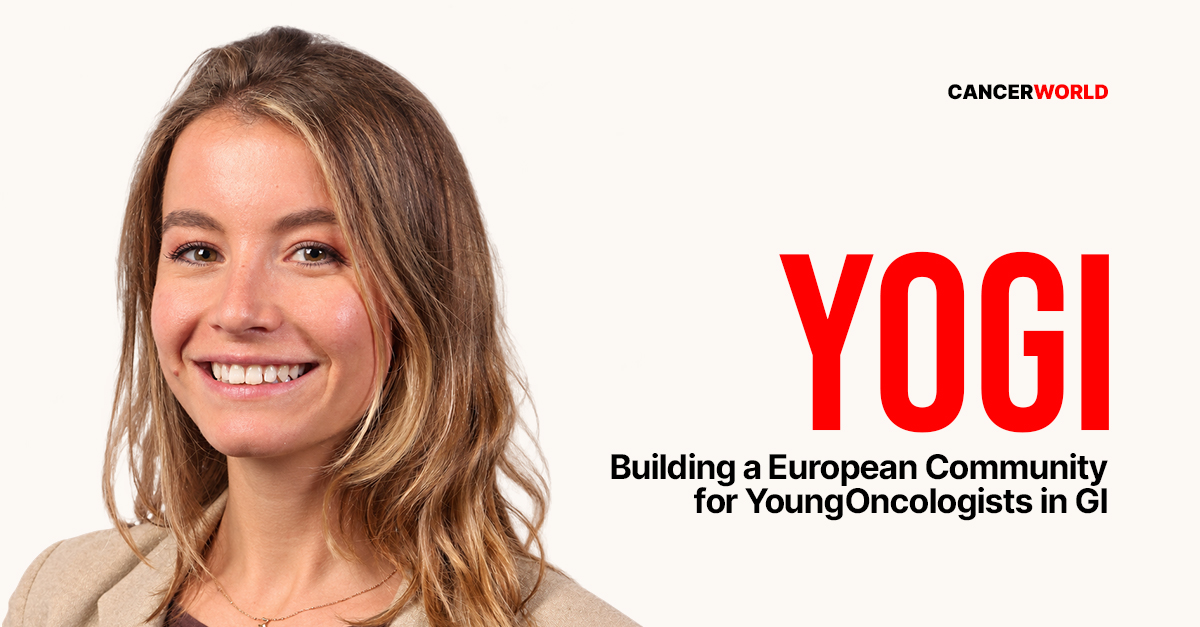
Research opportunities, mentorship and training still vary widely for young oncologists across Europe. YOGI – Young Oncologists in GI – aims to bridge those gaps by creating a community built around collaboration, education and shared opportunities.
Becoming an oncologist today means facing two different but closely connected aspects of the profession: clinical practice and research. The first one is driven by our patients and by the desire to help them. It is time-consuming, but probably also the most rewarding part of our job, offering the opportunity to build a unique relationship with each patient, different from other medical specialties. At the same time, caring for patients inevitably raises questions: how can we do better? How can we improve outcomes and quality of life? Research is the way we try to answer these questions.
At the beginning of your career, however, research often appears as a complicated world, where it is difficult to know where to start and how to move forward. One of the most important steps is finding a good mentor who can guide you in defining your future. However, this is not always straightforward and many of us have experienced these challenges firsthand. Finding the right mentor, identifying research opportunities, or simply connecting with peers from other institutions was often more difficult than it should have been. Access to international collaborations often depends on personal contacts rather than structured networks, meaning that talent is not always matched by opportunity. Moreover, research cannot be carried out alone, especially nowadays, as oncology is becoming increasingly personalized and focused on smaller and more selected groups of patients.
All these reasons clearly highlight how much we need a network, and how important it is that this network is accessible. This is the idea behind the YOGI (Young Oncologists in GI) Group.
Building the Network We Needed
The group was launched in April 2026 and brings together eight young oncologists from six different European countries (France, Italy, Spain, Austria, Germany and Belgium), all actively involved in both clinical practice and research, with experience in international collaborations. One of the main reasons behind this initiative is that the experience of being a young oncologist still differs considerably across Europe. Training pathways, research opportunities, protected academic time, and access to clinical trials vary substantially between countries. These differences should not be viewed as barriers, but rather as an opportunity to learn from one another. Sharing successful initiatives, discussing common challenges, and building collaborations across borders can ultimately improve both training and patient care throughout Europe.
The aims of the group are:
- To share research projects conducted and presented at international congresses by young oncologists in GI cancers, in order to encourage participation in academic collaborations and increase the visibility of young researchers.
- To create a community where young oncologists can openly share thoughts, fears and doubts with colleagues who have experienced, or are experiencing, the same challenges.
- To facilitate connections among different European countries, promoting research collaborations as well as fellowship and mentorship opportunities.
- To develop educational content through online videos, podcasts, journal clubs, onsite meetings and other initiatives, providing accessible educational material and opportunit ies for discussion.
Preparing for the Oncology of Tomorrow
These initiatives are designed to address today’s needs while also preparing young oncologists for tomorrow’s challenges. As gastrointestinal oncology continues to evolve, building international connections and sharing knowledge will become increasingly important. Precision medicine is redefining disease classification, therapeutic options are expanding, circulating biomarkers are reshaping diagnosis and surveillance, and artificial intelligence is rapidly entering both clinical practice and research. At the same time, patients are becoming increasingly informed and actively involved in treatment decisions, making communication and shared decision-making essential skills alongside scientific expertise.
Keeping up with this evolution is a challenge for every oncologist, but it also represents an extraordinary opportunity for the next generation. The complexity of modern oncology requires multidisciplinary teams, international collaborations, and the ability to connect researchers with complementary expertise.
“Building these connections early in one’s career is therefore an investment not only in individual professional growth, but also in the future of gastrointestinal cancer research.”
Creating Opportunity, Reducing Isolation
Despite these opportunities, important challenges remain. Young oncologists often struggle to balance demanding clinical responsibilities with research activities, frequently with limited protected academic time. At the same time, the expectations placed on early-career oncologists continue to grow. Beyond clinical excellence, they are expected to publish, secure research funding, present at international meetings, develop leadership skills, and continuously keep up to date. While these expectations reflect the dynamic nature of modern oncology, they also highlight the importance of creating environments where young professionals feel supported rather than isolated.
“Networks such as YOGI cannot solve all these challenges, but they can help reduce some of the barriers by facilitating mentorship, encouraging collaboration, and creating opportunities that might otherwise remain inaccessible.”
From Ideas to Better Patient Care
We hope it will become a community where ideas evolve into collaborations, collaborations into research projects, and research projects into improvements in patient care.
However, the future of YOGI will largely depend on the feedback we receive from the community, the interest it generates, and, above all, the active participation of young oncologists across Europe. We want YOGI to grow according to the real needs of early-career GI oncologists, adapting over time to the ideas and suggestions of the community itself.
“The future of gastrointestinal oncology will not be shaped by individual institutions or individual researchers alone, but by communities that are willing to learn from one another and work together, always keeping the improvement of patient care as the final goal.”
About the Author
Annalice Gandini is medical oncologist specialising in GI cancers, PhD student and researcher at Centre de Recherche des Cordeliers/Université Paris Cité and European Hospital Georges Pompidou (Paris, France), YOGI EU Lead.