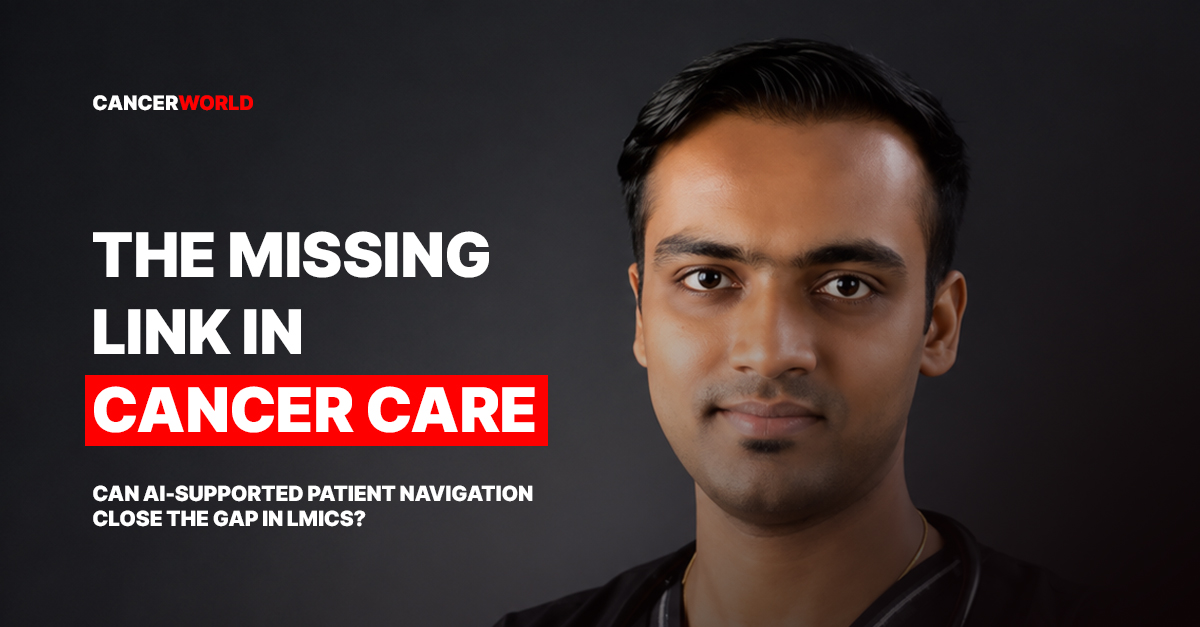
For many people with cancer in low- and middle-income countries (LMICs), the greatest barrier is not that treatment is unavailable. It is that the path to treatment is fragmented, difficult to navigate, and easy to fall out of. A person may notice a symptom, see a primary-care provider, travel for imaging, wait weeks for a biopsy, carry reports from one hospital to another, and then return repeatedly for surgery, chemotherapy, radiotherapy, or follow-up. Each step makes clinical sense on its own. Yet patients can quietly disappear between those steps—and in LMICs, many do.
Artificial intelligence (AI) is increasingly being explored as a way to identify these patients before they are lost, not by replacing the people who support them, but by helping overstretched navigation teams recognise problems earlier and intervene sooner.
The Problem is Coordination
A patient can be registered at a clinic, a laboratory, and a tertiary cancer centre, and still not truly belong to any of them. A missed appointment, a pathology report that takes too long to reach the right desk, or a family that cannot afford the next trip to hospital can bring a patient’s journey through the system to an end without anyone noticing. By the time they resurface, if they do, the disease has often progressed to an incurable stage.
Longer intervals between diagnosis and treatment have been linked to poorer outcomes across several common cancers. Fragmentation also breeds anxiety, distrust, avoidable expense, and treatment abandonment.
Patient Navigation as an Access Intervention
Patient navigation is a coordinated approach to helping people overcome the practical, informational, financial, and emotional barriers that interrupt cancer care. A navigator may be a nurse, social worker, or trained community health worker who ensures that clinical decisions are translated into timely care by booking appointments, tracking reports, explaining care plans in plain language, arranging referrals, helping with insurance paperwork, and routinely following up with patients who miss a critical visit.
The evidence base in LMICs is still limited. One review identified only a small number of studies evaluating cancer-navigation interventions across Asia, Africa, and South America, most of them focused on women’s cancers. A more recent systematic review concluded that navigation programmes can meaningfully reduce barriers to treatment and improve access for underserved populations.
India Offers a Practical Example
Tata Memorial Centre’s KEVAT programme is the first model in India to focus on an emerging navigation approach that can be applied across cancer institutions. It is built around barriers commonly encountered in LMICs, including language, low health literacy, economic hardship, and the logistical challenges of travelling for specialised care.
KEVAT also runs a one-year postgraduate diploma in oncology patient navigation, mentored by national and international experts. To date, 130 navigators working across nine Tata Memorial Centre hospitals have supported approximately 600,000 patients over five years.
In patients with advanced lung cancer, navigation was associated with a median nine-day reduction in the time taken to start cancer-directed therapy. During the COVID-19 pandemic, navigators also helped patients secure financial support, accommodation, and transport, demonstrating that navigation extends well beyond appointment scheduling.
While programmes such as KEVAT illustrate what organised navigation can achieve, they also highlight an important challenge. As patient numbers continue to grow, even experienced navigation teams cannot manually track every referral, pending investigation, or missed appointment. This is where AI-supported tools may provide valuable support—not by replacing navigators, but by helping them identify which patients need attention first.
Where AI Can Help
Limited navigation teams cannot manually track every referral, pending test, or missed appointment across large patient volumes. AI-supported tools can help identify who needs attention first, and several early models illustrate how.
One approach scans clinical records or radiology reports for language suggestive of malignancy and flags patients who have not yet reached a biopsy or specialist review within an agreed timeframe. In the United States, one such programme used natural-language processing to identify imaging reports suggestive of possible pancreatic cancer, after which a human navigation team coordinated biopsy and referral. Mean time from imaging report to biopsy fell from 22 days to seven, mean time to an outpatient oncology visit decreased from 32 days to 15, and mean time to treatment initiation fell from 56 days to 34.
A second approach uses predictive modelling to identify patients most likely to miss an upcoming appointment, based on prior attendance patterns, travel distance, and clinic history. A study from Massachusetts General Hospital and Harvard Medical School, Boston, found that patients identified as being at high risk of a no-show were prioritised for a telephone call from a navigator shortly before their appointment. The no-show rate fell to 10.2% compared with 17.5% under usual care, with the greatest benefit seen when the navigator successfully reached the patient.
A third approach involves AI-supported chatbots and remote symptom-monitoring tools that check in with patients between visits and escalate concerning symptoms to a human navigator, rather than requiring every patient to be followed manually. A review by German researchers described the dual-edged role of AI chatbots, highlighting their potential to support patient education and reduce clinical workload, while also emphasising the risks of inadequate algorithmic transparency, misinformation, and the ethical challenges posed by AI-driven interactions. Algorithmic transparency—the ability to understand the data and reasoning behind AI-generated decisions—is particularly important because a lack of transparency can make it difficult for clinicians to evaluate recommendations or take appropriate action.
However, some patients still prefer to speak directly with a person, and poorly designed digital triage systems can increase workflow burden rather than reduce it. This is an important consideration for LMICs, where simple, well-tested tools that are tailored to the intended patient population and supported by a responsive human navigation team are likely to be more effective than complex technological solutions.
Roadblocks to Avoid
Many LMIC health systems continue to face fragmented medical records, unreliable electricity and internet connectivity, and too few staff to respond to digital alerts. An algorithm that identifies delayed care has little value if no one has the time, resources, or authority to address the underlying problem.
AI systems trained predominantly on data from high-income countries may not perform reliably in settings where disease patterns, languages, healthcare infrastructure, and care pathways differ. In addition, adherence-prediction models still face limited external validation and remain vulnerable to bias.
The World Health Organization (WHO) has warned that AI could widen existing health inequities unless systems are developed with human rights, privacy, transparency, and local context at their core. Likewise, tools that depend on smartphones, English-language interfaces, or continuous internet access risk excluding the very populations most likely to benefit, including people living in poverty, socioeconomically disadvantaged communities, and those with limited literacy.
These challenges reinforce an important principle: AI cannot compensate for weak health systems. Rather, it is most effective when introduced into services that already have the people, governance, and infrastructure needed to respond to the needs it identifies.
What Should Change?
For policymakers, three priorities matter more than any single technological tool.
First, patient navigators should be recognised as a core part of the cancer workforce, not as a charitable add-on. Their roles should be clearly defined, supported by formal training pathways, and funded through sustainable health-system budgets.
Second, governments should invest in the infrastructure that AI depends on: interoperable health records, reliable digital connectivity, and high-quality local-language data. Without these foundations, even the most sophisticated algorithm is little more than a technical demonstration.
Third, AI should be introduced into cancer care only with appropriate human oversight, robust privacy safeguards, and local validation. These should be prerequisites for implementation, not afterthoughts once pilot programmes have already expanded.
From Pilot Projects to Cancer Policy
Patient navigation is not an optional courtesy layered on top of cancer services; it is the connective tissue that determines whether diagnostic capacity, treatment protocols, and referral networks actually reach the people they were designed to serve.
For many patients, the greatest obstacle is not the absence of treatment but the difficulty of reaching it. Every missed appointment, delayed biopsy, or failed referral represents another opportunity for someone to disappear from care.
LMICs can no longer afford to treat navigation as a pilot project when, in practice, it is often the difference between a health system that treats cancer and one that merely diagnoses it.
AI can help make those gaps visible and help navigation teams respond to them earlier. But technology alone cannot coordinate care, build trust, or guide patients through increasingly complex health systems. Those responsibilities remain fundamentally human.
The future of cancer care in LMICs will depend not on choosing between AI and patient navigators, but on combining the strengths of both. AI can help navigation teams work more efficiently, identify patients at greatest risk of being lost to follow-up, and prioritise limited resources. Human navigators, in turn, provide the judgement, empathy, and continuity of care that no algorithm can replace.
Investing in patient navigation should therefore be recognised as an essential component of cancer control.
In cancer care, the smartest technology will never replace the value of someone making sure a patient reaches the next step.
About the Author
Uddiptya Goswami, MD, DrNB, is a medical and hemato-oncologist, health systems researcher and educator. He did his ESMO fellowship in palliative and supportive care from Clatterbridge cancer centre, Liverpool, UK. He is currently “OncoDaily” Hub Leader from India. He is also part of the ISMPO Young Leadership Program batch 2026-27.