Daraxonrasib nearly doubled median survival in previously treated metastatic pancreatic cancer. For Dr Eileen O’Reilly, the result is not simply a remarkable curve on a conference screen, but the beginning of a new way to think about a disease long dominated by chemotherapy.
By the time metastatic pancreatic cancer has progressed after a first treatment, the questions in the clinic are rarely abstract. Can the person still eat comfortably? Is pain controlled? Is there enough energy left for another treatment? And will the next treatment take more from daily life than it gives back?
“This disease is particularly challenging at any time point,” says Eileen O’Reilly, Pancas and GI Medical Oncologist, Winthrop Rockefeller Endowed Chair at Memorial Sloan Kettering Cancer Center. In the metastatic setting, she says, pancreatic cancer can affect appetite, energy, weight, pain and a person’s ability to function. Existing treatments can help, “but they leave a lot to be desired.”
That is the context for RASolute 302, the phase III trial of the oral drug daraxonrasib in people with metastatic pancreatic ductal adenocarcinoma, the most common type of pancreatic cancer – whose disease had progressed after one prior line of treatment.
The results are clear. In the 500-patient, international, open-label trial, median overall survival was 13.2 months with daraxonrasib and 6.7 months with investigator’s-choice chemotherapy. In the overall study population, median progression-free survival, the time before the cancer grew or spread, was 7.2 months with daraxonrasib and 3.6 months with chemotherapy. Tumours shrank in 31.6% of patients receiving daraxonrasib, compared with 11.2% of those receiving chemotherapy.
For O’Reilly, a gastrointestinal medical oncologist at Memorial Sloan Kettering Cancer Center, the significance is not contained in the survival curve alone. “It’s not just that it’s a new drug,” she says. “It’s a new way of thinking about this disease, a new way of treating this disease” – and, she adds, evidence that RAS is no longer the untouchable target it was for most of her career.
Why RAS Matters
The biology behind the result is central to its promise.
More than 90% of pancreatic ductal adenocarcinomas carry activating mutations in RAS genes—usually KRAS—which act like a jammed growth switch, continually telling cancer cells to divide and spread.
For decades, RAS was regarded as one of cancer medicine’s most frustrating targets. Researchers could see that it was driving the disease, but could not find a reliable way to switch it off.
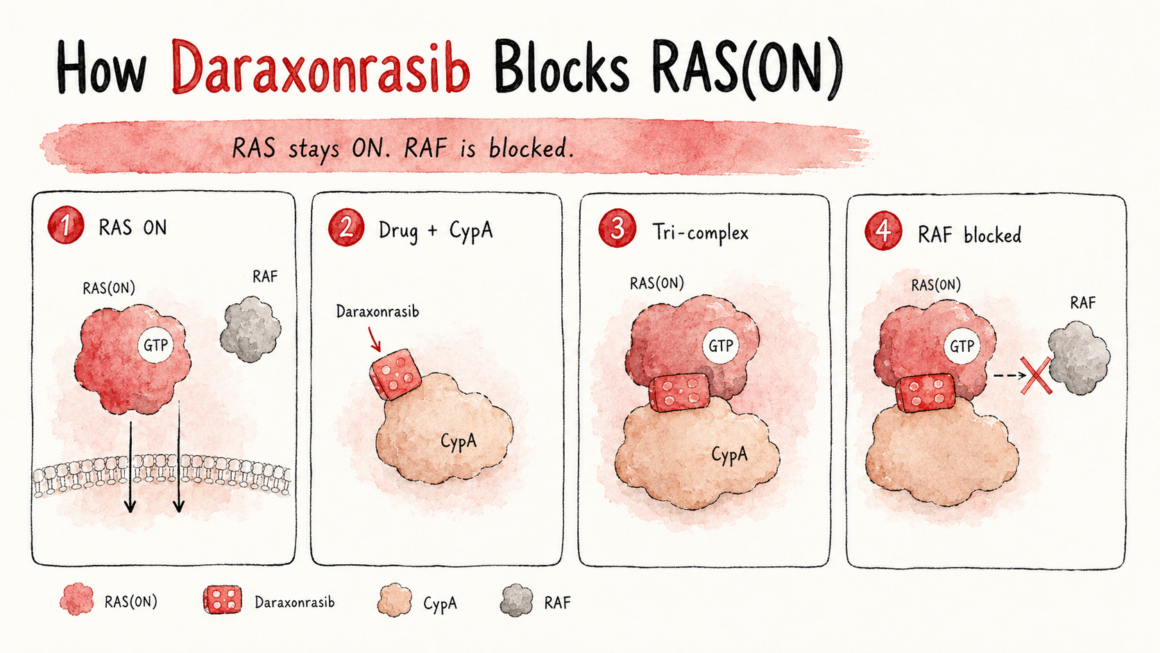
Daraxonrasib takes a broader approach. It is described as a RAS(ON) multi-selective inhibitor: rather than targeting one mutation only, it is designed to block the active form of both mutant and normal RAS proteins. It does this by forming a three-part complex with RAS and a cellular protein called cyclophilin A, preventing RAS from activating downstream growth pathways.
“The current class of drugs targets essentially everybody with this disease,” O’Reilly tells Sargsyan. That should not be read as a guarantee that every patient will respond. But it does mark a shift from the earlier era of RAS-targeted drugs that applied to only a small molecular subgroup.
Survival is Only Part of The Story
A survival difference is important. In pancreatic cancer, however, the quality of the months gained may matter just as much.
RASolute 302 found that daraxonrasib delayed deterioration in cancer-related pain: median time to worsening pain was 9.2 months, compared with 3.8 months with chemotherapy. The time before global health status and quality of life worsened was also longer, 5.7 months versus 2.6 months.
That does not mean the treatment is free from burden. But it changes the conversation from simply adding time to asking what that time feels like.
O’Reilly says the benefit was apparent in the clinic before the phase III results were complete. “These drugs are meaningful therapeutics,” she says. “They are inducing responses and people are feeling it, and feeling it relatively quickly.”
The trial was open label, meaning patients and clinicians knew which treatment was being given. That is worth keeping in mind, particularly when interpreting patient-reported outcomes. Progression-free survival, however, was assessed by blinded independent review, and the overall survival difference is less vulnerable to expectation bias.
A Better Treatment Does Not Mean an Easy Treatment
Daraxonrasib was not without toxicity. A rash is very common and can be severe; mouth inflammation, diarrhoea, nausea, fatigue and nail changes also occur. In RASolute 302, severe (grade 3 or higher) treatment-related side effects affected 43.6% of patients on daraxonrasib, compared with 57.5% on chemotherapy. One patient on daraxonrasib died from treatment-related lung inflammation — a reminder that “targeted” does not mean “without risk.”
What stands out is not that the drug is effortless, but that far fewer patients stopped because of side effects: 1.2% on daraxonrasib against 11.2% on chemotherapy, with most patients able to stay close to the full dose.
In O’Reilly’s clinic, managing the rash now begins before it appears. “We use and recommend prophylaxis,” she says, – antibiotics, topical steroids, moisturiser, sun protection, with brief treatment breaks or dose reductions when symptoms flare. The early nausea and diarrhoea, she notes, are usually controllable with prompt attention, and the mouth inflammation tends to come later and respond to dose adjustment.
She is careful not to wave the toxicities away. But she keeps coming back to a dynamic she did not expect to weigh so heavily. “Because people are feeling better, they’re very motivated to want to continue,” she says. When patients can feel their symptoms easing, they judge the trade-offs differently, and they tell their doctors so.
The Next Questions
If RASolute 302 settles one question, it opens several.
The most immediate is whether daraxonrasib belongs earlier in treatment. RASolute 303 is testing it in newly diagnosed metastatic disease, alone, combined with gemcitabine and nab-paclitaxel, and against chemotherapy, while a separate phase III trial is examining it after surgery, where the goal is to prevent relapse. Early first-line data reported at this year’s AACR meeting, including a combination cohort with a response rate near 58%, have been enough to sustain interest without yet answering the durability question.
Beyond that lies the harder, more interesting work of combinations. O’Reilly sketches several lines at once. Pairing a broad RAS inhibitor with a mutation-specific one – for example a KRAS G12D–selective agent now in development, might delay resistance. For the roughly quarter to third of pancreatic cancers that carry an MTAP deletion, drugs targeting an enzyme called PRMT5 are a promising partner; early readouts, she says, “look very encouraging,” with the caveat that they apply only to that subgroup. And the prize she is most cautious about naming is immunotherapy. “Can we combine immunotherapy with RAS targeting and convert some of these responses into a more durable setting?” she asks. “That’s one to stay tuned and look out for.”
There is also a quieter consequence that may matter as much as any combination. A targeted pill, taken at home, changes who can be treated at all. “It’s going to open up a new group of people,” O’Reilly says, patients who might have declined chemotherapy, or who were never well enough for it. Pancreatic cancer chemotherapy is hard on the body even in fit, younger patients; a treatment that more people can start, and stay on, expands the population that stands to benefit.
What it Asks of Practice
The result also raises the bar on something more basic: testing. O’Reilly’s view is that two kinds of testing should now be routine for everyone with the diagnosis. The first is germline testing – looking for inherited risk, done regardless of age or family history. She tells the story of identifying a family carrying Lynch syndrome through an 88-year-old patient with pancreatic cancer, a finding that mattered for the whole family. “We just have to be age-independent in our thinking,” she says.
The second is somatic testing of the tumour, done as early as possible, often using both a tissue sample and a blood-based test that can return results quickly. The amount of cancer in the body affects what the blood test can detect, she notes, which is why tissue still matters. In an era of targeted drugs, the test is no longer an academic exercise; it is part of deciding what to do.
The Access Gap
For now, daraxonrasib remains investigational. The US Food and Drug Administration has allowed an expanded-access programme for eligible people with previously treated metastatic pancreatic cancer, but expanded access is not the same as regulatory approval.
The distinction has a wider dimension that is easy to overlook from a conference hall in Chicago. An oral drug is, in principle, easier to deliver in lower-resource settings than infusional chemotherapy – no infusion chairs, fewer hospital visits, less supportive infrastructure. That is a genuine potential advantage for much of the world. But it is conditional. The drug must be affordable, and its rational use depends on molecular testing that many health systems cannot yet offer at scale.
For the first time, a drug designed around the dominant biology of pancreatic cancer has outperformed chemotherapy in a large randomised trial.
A High Goal
Asked what headline she hopes to read in five years, O’Reilly does not reach for caution. Today’s five-year survival sits around 12–13% across all comers; she wants it nearer 40%.
“It’s ambitious,” she says. “That’s a lot. That’s a high goal. But I’m for it.”
The standing ovation was for a survival curve. But the deeper reason people stood was the possibility that pancreatic cancer, so long treated as a disease beyond the reach of precision medicine, may finally be entering a different era.
About the Author
Amalya Sargsyan MD, MSc in Precision Medicine, GI and Sarcoma Medical Oncologist at Yeolyan Oncology and Hematology Center and D’Clinic, Clinical Research Physician at Immune Oncology Research Institute, VP for R&I OncoDaily.