
The scan was stable.
I remember feeling a quiet sense of satisfaction as I shared the news with my patient and his wife. After all, in oncology, stable disease is something worth celebrating. I had already moved mentally to the next part of the consultation: treatment, prescription, follow-up.
Then my patient asked an unexpected question.
“Doctor, can I have two extra weeks before my next chemotherapy? My son is getting married. I want to be in shape for his wedding. What do you think?”
His question caught me off guard. I had been celebrating the scan. He was thinking about celebrating his son’s wedding.
What We Measure, and What Patients Live For
In that moment, I realised how easily we can become focused on the cancer in front of us while forgetting the life surrounding it. Research on oncology patients consistently shows that what matters most to them extends well beyond disease control — practical, emotional and relational needs that rarely surface unless we ask directly [1]. In one international study across seven countries, more than half of patients felt their doctor did not actually know what mattered most to them [2]. We measure cancer in scans, cycles and survival. Patients measure life in weddings, birthdays and moments with the people they love.
The Weight of a Crowded Clinic
I work in a crowded public oncology clinic in Annaba, Algeria, where the reality of daily practice is not gentle. Time pressure in oncology is not a matter of perception — it is documented, and a study of Canadian oncologists found subjective time pressure at work to be a key predictor of burnout [3]. One observational study of hospital physicians found they spent, on average, just over four minutes in direct communication with each patient, against nearly five hours combined on documentation and discussions with colleagues [4]. In that environment, it is easy to unintentionally reduce patients to their disease, even when we deeply care about them.
Small Choices, Not Big Reforms
I no longer believe that putting patients first requires more time, more staff, or a redesigned system. It requires using the time we already have differently. This is, in essence, what shared decision-making asks of us — not a grand restructuring of care, but a genuine effort to understand what a patient hopes to preserve, and to build the treatment plan around that [5,6,7]. When I told my patient we could safely postpone his treatment, the happiness on his and his wife’s faces stayed with me. Clinically, I had changed the date. For them, I had protected a precious family moment.
What I Do Differently
Over the years, I have built a few small habits into my practice — none of them costly, none requiring institutional change, all of them within reach of any busy clinician:
1. I take a few minutes between patients. Not long — just enough to reset before the next person walks in, so they meet someone present, not someone still carrying the last consultation.
2. I write my own notes. Delegating documentation might save minutes, but it costs something more valuable: the next time that patient sits across from me, I can open their file and pick up exactly where we left off. Patients notice when they are remembered. It puts them at ease almost instantly.
3. I visit my patients during their chemotherapy infusions. Not for a formal check-in, but so they know I am reachable if a question or a worry surfaces while they wait.
4. I take the time to explain what is coming — how the treatment will be given, what side effects to expect, and what to do and what not to do — because uncertainty, left unaddressed, is its own kind of suffering.
None of these habits demand extra hours in the day. They simply ask that the hours we already spend with patients be spent with attention rather than on autopilot.
Beyond the Scan
I still celebrate stable scans. I still track cycles and survival curves, because they matter enormously. But I have learned to ask a second question after the first one: not only “How is the disease responding,” but “What is this person hoping to live for.” Sometimes the answer is a wedding. Sometimes it is a birthday, a harvest, a graduation, or simply an ordinary Sunday with grandchildren.
Perhaps our role as oncologists is not only to treat the disease, but to understand what our patients are hoping to live for — and to protect it, two weeks at a time if that is what it takes.
Acknowledgement
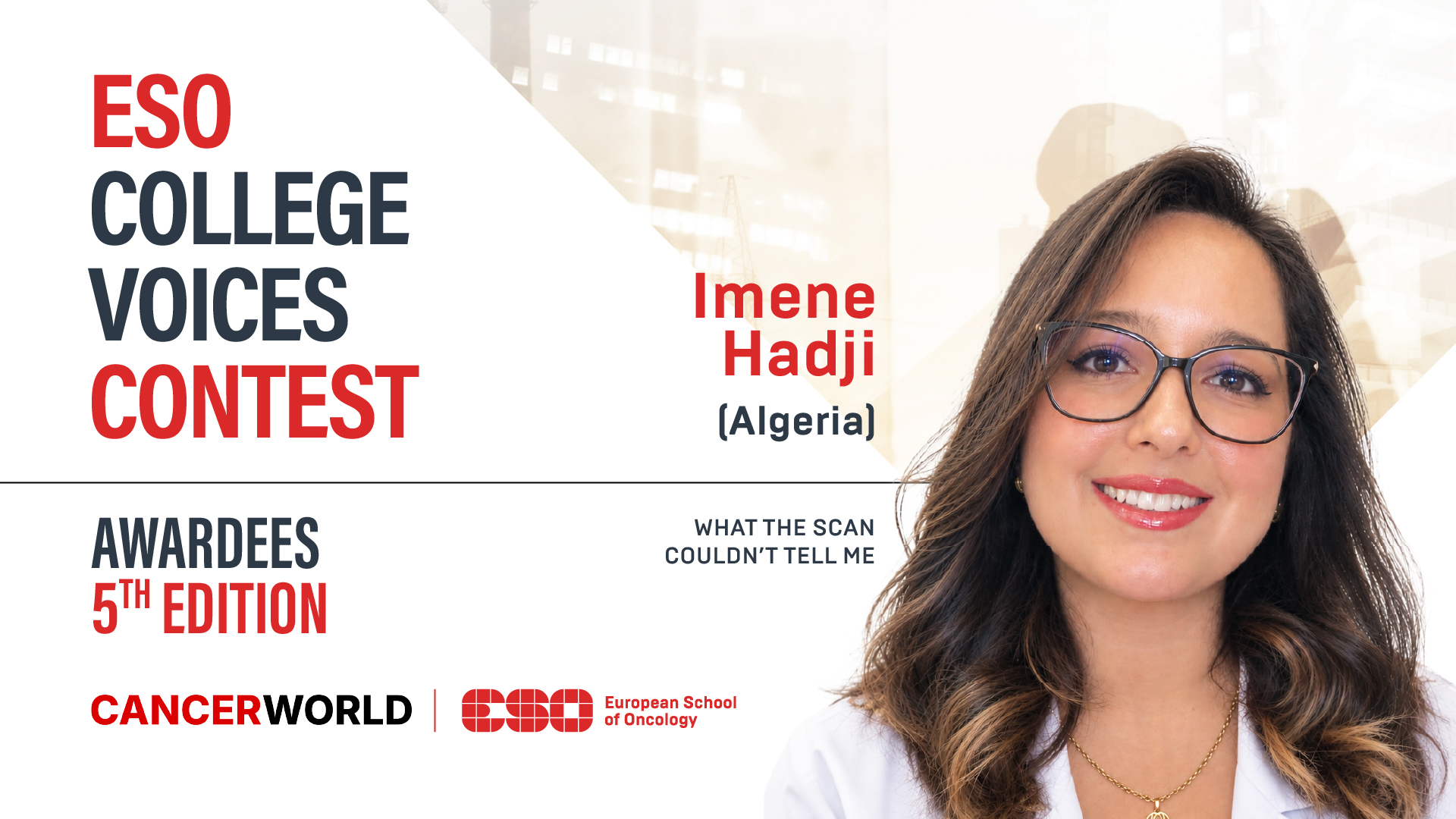
This article was written by Dr Imène Hadji, one of the two winners of the ESO College Voices Contest 2026, on the topic “Making time for what matters most”.
This year’s contest once again proved that doctors can also be excellent cancer writers. We received 23 proposals from ESO College members across 19 countries, each exploring the chosen theme. After careful deliberation, guided by CancerWorld’s editorial standards, as well as criteria of clarity, relevance, originality, potential impact, and our hallmark style of weaving in interviews and firsthand perspectives, Dr Hadji was selected as one of the winners, and we are proudly publishing her impactful voice.
References
1. Waelli M, Minvielle E, Acero MX, Ba K, Lalloué B. What matters to patients? A mixed method study of the importance and consideration of oncology patient demands. BMC Health Serv Res. 2021;21:256.
2. van den Ende ES, Schouten B, Kremers MNT, et al. Understanding what matters most to patients in acute care in seven countries, using the flash mob study design. BMC Health Serv Res. 2021;21:474.
3. Kleiner S, Wallace JE. Oncologist burnout and compassion fatigue: investigating time pressure at work as a predictor and the mediating role of work-family conflict. BMC Health Serv Res. 2017;17:639.
4. Becker G, Kempf DE, Xander CJ, Momm F, Olschewski M, Blum HE. Four minutes for a patient, twenty seconds for a relative — an observational study at a university hospital. BMC Health Serv Res. 2010;10:94.
5. Bardes CL. Defining “patient-centered medicine.” N Engl J Med. 2012;366(9):782–783.
6. Barry MJ, Edgman-Levitan S. Shared decision making — the pinnacle of patient-centered care. N Engl J Med. 2012;366(9):780–781.
7. Politi MC, Studts JL, Hayslip JW. Shared decision making in oncology practice: what do oncologists need to know? Oncologist. 2012;17(1):91–100.