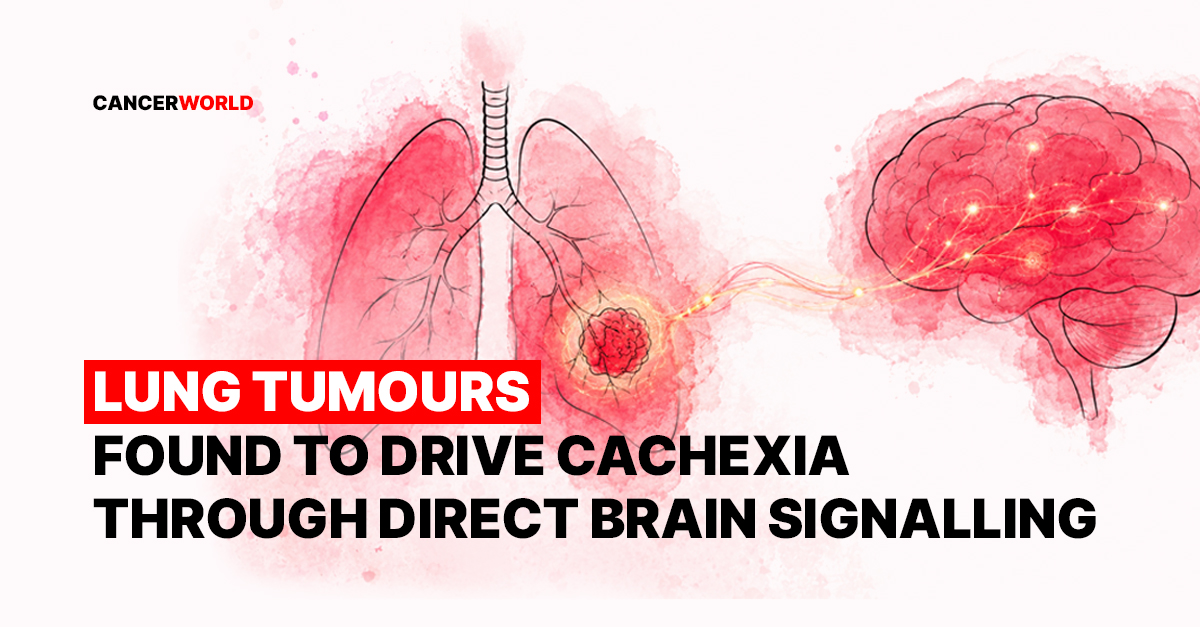
A mouse model of lung cancer has uncovered a potential new therapeutic strategy for treating cancer cachexia. The study, published in Science on 2 July, found that Lkb1-mutant lung tumours—a common subtype of lung cancer—can communicate directly with the brain through lung sensory neurons. The researchers showed that disrupting this tumour-to-brain signalling by silencing the sensory nerves reduced cachexia. Suppressing production of the lipid signalling molecule prostaglandin E2 (PGE2) through dietary intervention delivered similar benefits.
“In our study we’ve identified peripheral sensory nerves—not just circulating inflammatory factors—as a direct route through which tumours drive cachexia. We also found that PGE2 acts as the local messenger, while dietary fat supplies the raw material needed to make it,” senior author Thales Papagiannakopoulos tells CancerWorld.
“Together, these findings point to three potential ways to intervene with cachexia: targeting the nerves, blocking the signalling pathway with drugs, or modifying diet.”
The study, he says, argues for a fundamental shift in thinking: cachexia should be reframed as a neuro-metabolic syndrome, rather than being regarded as a purely metabolic disorder.
Why Cachexia Matters
Cancer cachexia is a multifactorial syndrome characterised by progressive loss of skeletal muscle, often accompanied by fat loss, that cannot be fully reversed by conventional nutritional support. Affecting around 80% of patients with advanced cancer, it causes profound weakness, fatigue, and reduced tolerance of anticancer treatment, and is estimated to contribute to around 20% of all cancer deaths.
“As development of cachexia is associated with impaired quality of life, decreased tolerance to therapy, and reduced overall survival, there is an urgent need to understand the mechanisms that promote cachexia in translationally relevant animal models to develop effective treatments for this syndrome,” write Papagiannakopoulos and colleagues.
Following the Tumour’s Signals
To investigate how common genetic mutations influence the development of cachexia, the researchers created three genetically engineered mouse models of lung adenocarcinoma, a subtype of non-small cell lung cancer (NSCLC) in which cachexia is particularly common. They used CRISPR–Cas9, a gene-editing technology that enables scientists to precisely switch off specific genes, to inactivate either Lkb1, Cdkn2a/2b, or p53 in mice with Kras-driven lung adenocarcinoma, thereby modelling the three major genetic subtypes of the disease.
Traditional cachexia models typically use tumours implanted beneath the skin, rather than in their natural environment, and often at sizes unlike those seen in patients.
“We used autochthonous lung cancer models, in which tumours develop naturally in the lung at clinically relevant sizes while preserving the local nerve supply. This enabled us to ask a question previous models couldn’t: does the tumour communicate directly with neighbouring nerves?” says Papagiannakopoulos, who conducted the research while at the New York University (NYU) Grossman School of Medicine. He will move to the Salk Institute for Biological Studies in September.
The team found that only the Lkb1-mutant mice experienced cachexia. Since this variant did not produce substantially larger tumours than the other subtypes, they proposed that Lkb1-deficient tumours might be producing something that the other tumour types were not.
Hypothesising that reduced food intake was responsible for the weight loss, the researchers fed Lkb1-deficient mice a high-fat diet to investigate whether this would rescue their caloric deficit. For comparison, the other two mouse models were also given high-fat diets and quickly gained weight.
The researchers were surprised by the results.
Rather than correcting their energy deficit, mice with inactive Lkb1 in their tumours ate even less, lost more weight, and died sooner than those on the standard diet. Increased brainstem activation was also observed within days of starting the high-fat diet.
Instead of reversing cachexia, the findings suggested that dietary fat amplified a pathological signalling loop that exacerbated the syndrome.
A Direct Route to the Brain
To understand how high-fat diets might be exacerbating cachexia, the investigators collected fluid from the tumour-bearing lungs of mice with Lkb1-deficient tumours and measured levels of signalling molecules that they believed might be driving the syndrome.
Compared with Lkb1-deficient mice on a normal diet, those fed a high-fat diet had much higher levels of PGE2—a signalling molecule known to amplify inflammation—as well as increased infiltration of immune cells into the lungs.
Since PGE2 was elevated only in lung fluid and not in the bloodstream, the team hypothesised that it was exerting its cachexia-causing effects locally within the lungs.
At this point, Papagiannakopoulos recalled a 2023 Nature study by Stephen Liberles and colleagues showing that influenza infection triggers a dedicated nerve pathway from the upper airway to the brain. In that study, PGE2 activated sensory neurons that induced sickness behaviours such as loss of appetite, lethargy, and reduced activity. Blocking this pathway reduced these symptoms and improved early survival without preventing infection, revealing a previously unrecognised mechanism through which the nervous and immune systems communicate during respiratory viral illness.
“We reasoned that if a virus can hijack this lung-to-brain sensory pathway, a tumour growing in the same tissue might exploit it too. That reframed the question away from blood-borne inflammatory factors, which is where the field had been looking, and towards local tumour–nerve interaction,” says Papagiannakopoulos.
To investigate the role of sensory neurons, Papagiannakopoulos and colleagues used two complementary approaches: surgically disrupting the vagus nerve and chemogenetically silencing vagal sensory neurons that innervate the lungs.
Both interventions restored feeding behaviour in tumour-bearing mice.
When the team genetically modified mice to prevent PGE2 production, the animals no longer developed cachexia. Similarly, in smaller studies, mice treated with aspirin or ibuprofen—drugs that inhibit the enzymes required for PGE2 synthesis—were protected from cachexia.
Interrupting the Pathway
Cachexia could also be prevented through dietary intervention.
PGE2 is derived from omega-6 fatty acids found in animal fats. By switching mice from a high-fat diet containing animal fat to one containing only omega-3 fatty acids, the body’s ability to produce PGE2 was limited. Without sufficient PGE2, the tumours could no longer use the signalling molecule to communicate with the nervous system and brain to drive cachexia.
“Our study doesn’t overturn the cytokine model—circulating inflammatory factors clearly matter in many contexts but it adds a parallel axis that the field has largely overlooked: local, anatomically restricted signalling between tumours and nearby sensory nerves that can independently drive systemic sickness behaviour,” says Papagiannakopoulos.
“For lung tumours in particular, which lie adjacent to a dense sensory nerve network, this local pathway should be considered alongside, not instead of, the systemic inflammatory one.”
Towards New Therapeutic Strategies
The findings point to three potential therapeutic strategies: inhibiting PGE2 production using inexpensive, already approved cyclooxygenase (COX) inhibitors; reducing the supply of PGE2 precursors by shifting patients’ diets from omega-6-rich fats towards omega-3 fatty acids; and, in the longer term, targeting the lung’s sensory nerves through neuromodulation.
“The PGE2 and dietary approaches are the most immediately actionable because they build on existing drugs and straightforward dietary counselling,” says Papagiannakopoulos. “Neuromodulation of the sensory nerve pathway is likely to be the most precise long-term strategy, but we first need a much better understanding of the underlying neural circuits before it becomes clinically feasible.”
The study was partly funded by the Cancer Cachexia Action Network (CANCAN), one of the Cancer Grand Challenges teams—a global initiative co-funded by Cancer Research UK and the US National Cancer Institute to tackle the toughest unanswered questions in cancer research.
As part of InteroCANCEption, a recently funded Cancer Grand Challenges team, Papagiannakopoulos is now focused on mapping the neural circuitry that underpins cachexia.
“We want to pinpoint exactly which sensory neuron subtypes and downstream brainstem and hypothalamic circuits are involved. We’re also asking whether this same neural circuit contributes to other cancer-associated symptoms beyond appetite loss, such as depression and cognitive impairment.”
Proximity to sensory neurons, adds Papagiannakopoulos, is not unique to lung cancer.
“Tissues like the gut, pancreas, and liver are also richly innervated by peripheral and vagal sensory afferents, and tumours there are well positioned to exploit the same kind of local signalling. That’s a direct, testable prediction, and one we want to follow up on.”
A Broader View of Cachexia
In an accompanying commentary, Yetiş Gültekin and Matthew Vander Heiden, both from the Massachusetts Institute of Technology (MIT), write: “Recognising cachexia as a disorder of tumour, organ, and nerve communication rather than as a condition caused by specific circulating factors is also important when considering how to treat it in the context of cancer.”
They add that how peripheral sensory neurons decode chemically diverse tumour-derived signals remains unknown and is likely to vary across tumour types and disease stages. Cachexia, they suggest, probably reflects a spectrum of mechanistically distinct but phenotypically convergent states rather than a single biological process.
Nevertheless, they conclude that defining how tumours recruit neural circuits to sustain their own metabolism and reshape host physiology will be important for understanding both cancer and cachexia biology.
About the Author
Janet Fricker is a UK medical writer with an MA in Physiology from the University of Oxford. She is the News Editor of CancerWorld. Janet has worked for the Cancer Drug Development Forum, Cancer Research UK, Lancet Oncology, European Journal of Cancer, Molecular Oncology, Ecancer Medical Science, and European School of Oncology (where she wrote the Oncopaedia sections on breast cancer). She has written for consumer publications including The Times, The Economist, The Daily Mail, The Independent and Marie Claire.