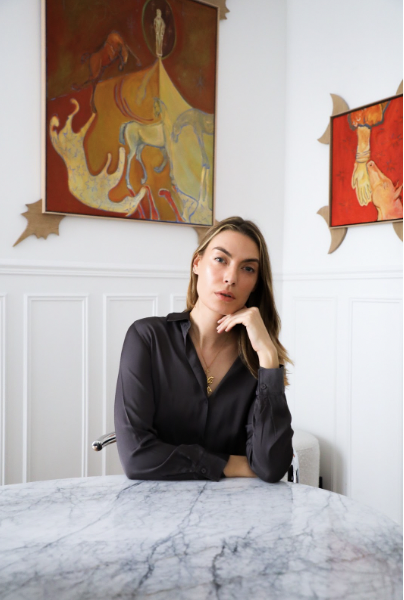
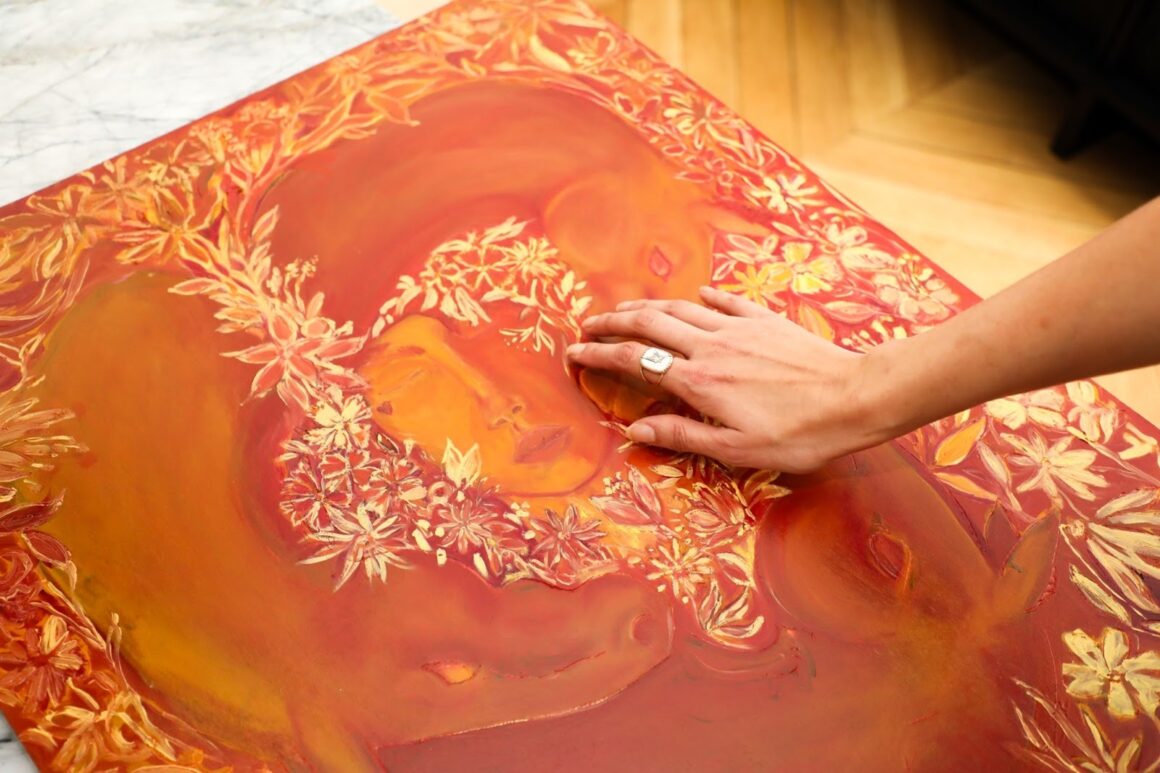
When Isabel Deprince, a formerly successful model, describes the moments she feels most like herself, she doesn’t mention spotlights or runways. She talks about being alone in her studio, sleeves rolled up, paint drying on her hands. Painting, she says, is “a way of a language for me to speak.”
It became that language out of necessity. After losing her younger brother to cancer at just twenty-one, Isabel returned to art as the only space where grief could breathe and where words would no longer reach.
“Often when I’m just in my atelier doing nothing and lying on the sofa,” she says, “I’m just thinking, looking at the wall and dreaming and imagining my next project, my next idea, and just building that world in my head.”
In those imagined worlds she lays down not only color and movement but something far more intimate. “Every artwork you have is also a piece of yourself,” she says. “People ask me sometimes, ‘But is it not hard to sell a part of yourself?’ and I’m like, actually I feel proud… that is a part of me that I translated onto a physical form. I feel very proud to let them travel all over the world and live in someone else’s house.”
Born with “a Free Spirit”
Isabel can’t remember a life before drawing. “I think I was born an artist,” she says. “I had this free spirit, and my mother encouraged me a lot for that, and I’m super grateful.”
Her mother recognized early that art was not a hobby for her daughter; it was a refuge. She enrolled Isabel in small art camps, weekend workshops, and early art classes. “It was just fun,” she recalls, “but my mother felt like it was something that I was feeling good and safe in. She actually built that world for me before I could build my own because I was too small.”
By fourteen, school no longer fit. “Normal school didn’t work for me,” she says. “It just didn’t make sense. I’m not not smart, it’s just that I could not fit in, and I thought out of the box, I thought differently.”
She entered art school, where she balanced academic courses with creative training until eighteen. Then she left Belgium altogether, stepping into a world that would both expand and unravel her sense of self.
A Beautiful Experience That “Was Not Nourishing for the Soul”
Becoming a full-time model at eighteen offered a version of life that many dream of and few achieve. “I left Belgium and I went on a worldwide model, an experience of a lifetime,” she says. “It allowed me to travel to places that I wouldn’t have at that age, to meet amazing people, to get very big connections, and to see the fashion world from inside.”
“I view it today as a beautiful experience,” Isabel says. But beauty, she learned, is not the same as belonging.
“The other side is that I did feel very disconnected with myself,” she explains. “Even though I got success quite quickly, the longer I was in it, the more I felt like I was losing my own identity.”
In fashion, identity is fluid, but not by choice. “We’re always a bit the view created by the brands,” she says. “You’re all the time incarnating another persona almost.” Over time, her sense of self blurred. “After years and years I did not know who I was and this was making me depressed. To be judged all the time on exterior and appearances, it was very hard because it’s not very nourishing for the soul.”
She remembers asking herself the questions that eventually forced her to walk away: Who am I? What do I want? Who is Isabel, beyond the images she performed?
“For the moment I’m just one of the models,” she thought. “Everyone knows Isabel but this is not me. This is just the image they created and I created and I was acting the whole time.”
Leaving the industry, she says, became an act of survival. “For me it would be ultimate freedom,” she says. “The freedom of being you and the freedom of expressing yourself to the world without any fear. If they don’t like it… at least there will be one that likes it. The moment you let go of fear and just say, I do what I do… that’s the ultimate freedom.”
But her escape from modeling wasn’t born from ambition. It came from grief.
“My Brother in Belgium”: A Wake-Up Call
When Isabel explains the moment she realized modeling no longer made sense for her, she answers without hesitation: “My brother in Belgium.”
Her younger brother was twenty-one when he was diagnosed with cancer. The day after he died by euthanasia, Isabel woke up feeling as if something fundamental inside her life had broken open.
“I woke up the next day feeling like my whole life was meaningless,” she says. “Not that modeling was meaningless to me, but I just realized how fragile time is and how easily we can spend our lives passing through and not really truly living it.”
She called every agent she had and quit. “I didn’t want to pass anymore,” she says. “I wanted to create something, something of my own. I felt like I had a bigger purpose in life.” His death, she says, removed the illusion of infinite time. “It just made me realize: it’s very rare when you die at 21 of cancer, but it made me realize, you know, it’s so crazy if in one year my life ends. Models will be replaced… you can Google and find a few pictures but you didn’t do anything of yourself.”
“It was kind of a wake-up call,” she says. “I had fun, but now it’s time for me to live my life.”
She was twenty-four. “It ages you in an instant, the way a decade might,” she says. “It’s so profound that either you let yourself be carried away completely and it destroys your life, or you turn around your whole life.”
She chose the second path, but first she had to survive a year defined by isolation.
Grief in a 45-Square-Meter Apartment
Her brother’s euthanasia and funeral occurred in the first year of the COVID-19 pandemic. She spent a week with him before his death, and another week before the funeral, restricted to only fifteen attendees. The next morning, she boarded a train back to Paris.
“I directly went into confinement,” she recalls. “One month not seeing anyone, not hugging anyone.”
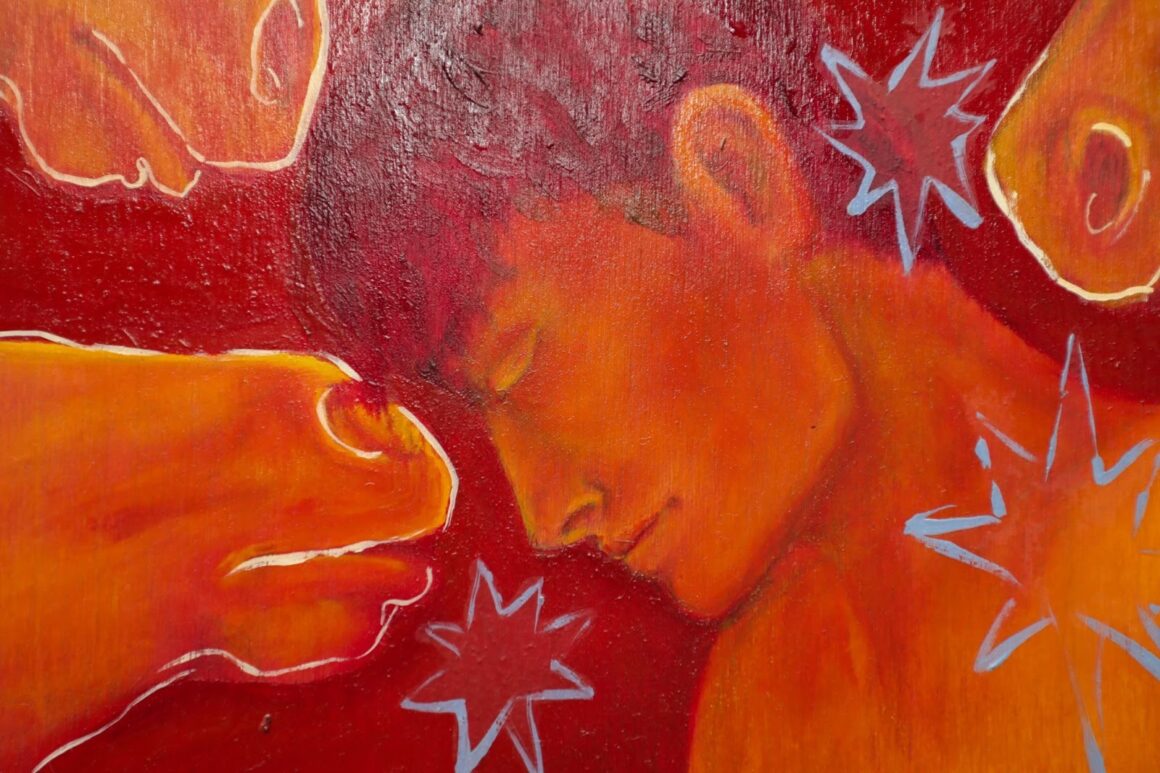
Her Paris apartment was small, 45 square meters,and silent. “I had a lot of grief,” she says. “I closed myself completely off and I was just painting morning till evening. Painting and painting.”
One of the first works she made was a raw depiction of the moment he slipped away. “That was for me like when my brother was taken away from me,” she says. “Every painting that came out in that week was just me talking, talking, talking to myself.”
But painting wasn’t her only coping mechanism.
“Sadly to say, I was just drinking,” she admits. “It started with a glass in the evening because I was so alone, there was nothing to do, and it became a bottle.”
Her mother, a doctor, had warned her that witnessing the euthanasia could be psychologically devastating. Isabel went anyway. “I promised my brother I want to be there,” she says. “If I didn’t see it, I don’t believe it. I would maybe never accept it and still wait for him to come back.”
The images replayed in her sleep. “I would wake up at 2, 3, 4, 5 a.m. screaming, reliving that scene,” she says. “The only way for me to sleep was to drink until I passed out.”
Healing, she says, didn’t arrive alone.
“It Was a Stability That I Needed”
Isabel speaks with softness about her former partner of nearly five years. “I have to give credit to my ex-partner,” she says. “He offered me stability, not only financially but emotionally, during that period. It gave me three years to work on my art in the way I wanted.”
“I don’t know if we were not together if I would have gone on the same path,” she says. “He let me be my own and explore my freedom.”
They eventually helped each other reduce their drinking. “I actually sobered him up,” she says, laughing lightly. “We needed to find a healthy balance. We helped each other.”
Soon after, he lost his father to leukemia. Isabel, still grieving, stayed beside him. “I knew how to be there because I went through it,” she says. “I knew it was more important to be there in silence.”
“It was the stability that I needed,” she repeats. “I was so young, in another country, far from my family, and a lot of my friends disappeared when I went through that loss. I’m super grateful I crossed paths with him so early on. It gave me beautiful support.”
A Swing, a Fall, and a First Understanding of Love
When asked about her most vivid childhood memory with her brother, Isabel falls quiet. “I lost a lot of memories of us,” she says. “I think maybe my brain is adapting to a world where he doesn’t exist and protecting myself from that.”
But one memory remains intact. “We were on this swing balance when I was like five or six, and he was three,” she says. “I was a hyperactive kid… my brother was the calm one, and I was jumping like a maniac on it.”
Her brother fell and hit his head. “I thought I killed my brother,” she says. “I ran to my grandmother… I thought he was dead.”
He wasn’t, but the moment altered her sense of responsibility. “I think I realized in that moment that I was a big sister,” she says. “I always felt like a protector over him. That was a very big key moment for me.”
Daydreaming, her upcoming exhibition, feels like a continuation of that instinct: a world built to protect him when she no longer can.
The Color of Cancer
What color is cancer in her work?
Isabel retrieves a painting from the period just after her brother’s diagnosis. “I was very inspired by Miró at that time,” she says. “I painted my brother, and it has this turquoise green. It’s not really a warm color. It’s a very cold color.”
Many works from that time share similar tones: “green, blue, cold.”
When told that green is often associated with spring, she answers gently: “Well, it was kind of a new beginning of my life. I mean it was the end of the year, but…”
Colors, Isabel says, aren’t choices, they arrive. “Colors are like an emotion and I do not think about colors. My colors evolve a lot. When I was very depressed there was a lot of blue, but sometimes a little bit warmer as well.”
One early painting mixes orange and blue. “It is very sad,” she says, “but it has the warmth of that hug of that goodbye.”
“I think that is the translation… the non-communication between souls,” she says. “It goes through color because it does move something in us.”
Horses as Messengers Between Worlds
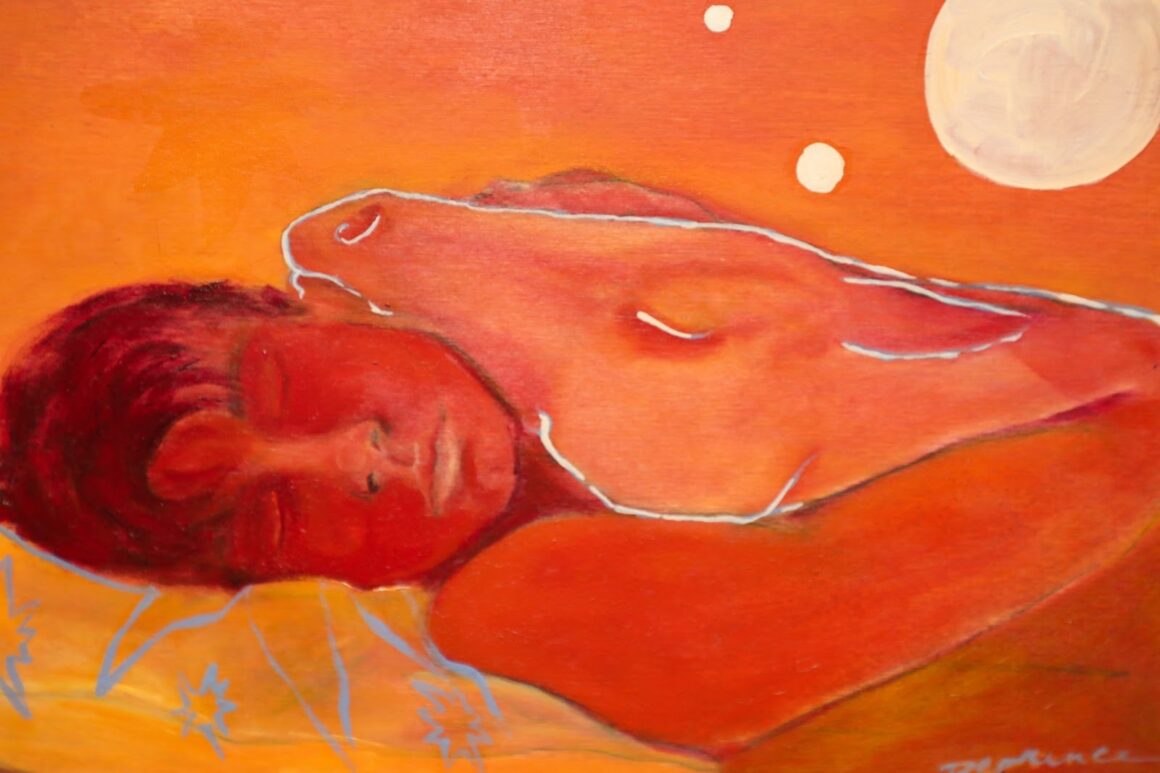
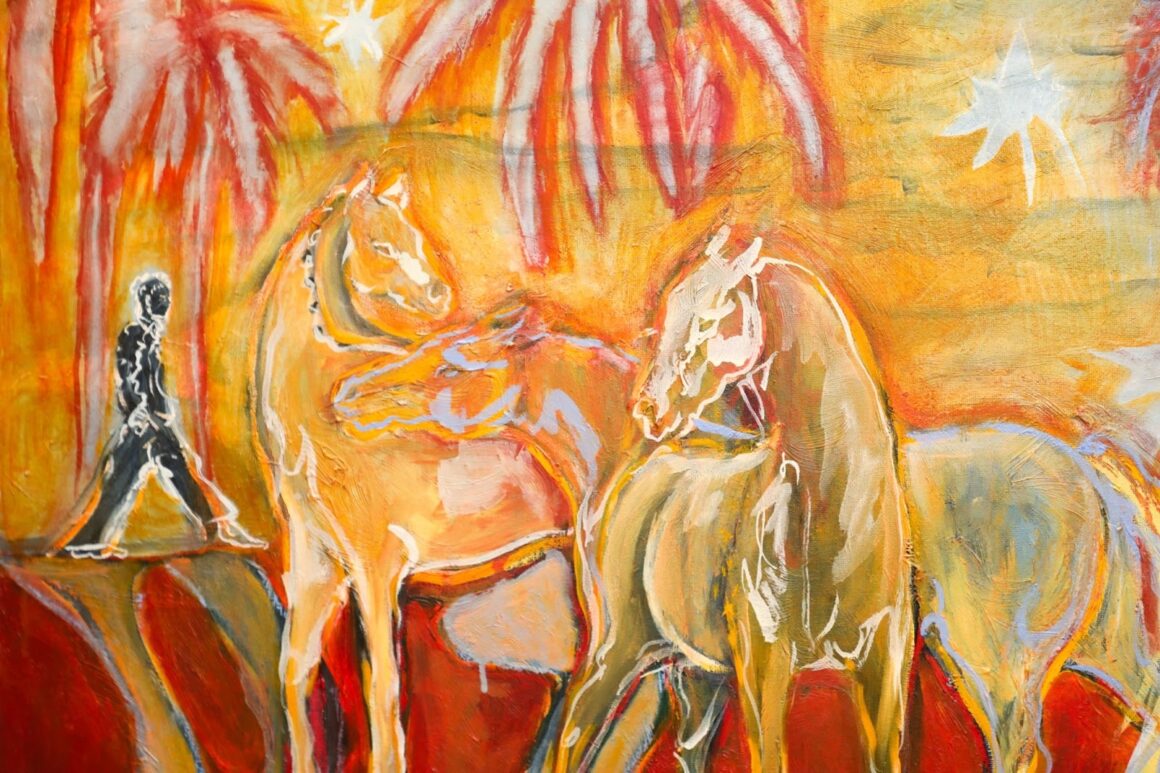
In Daydreaming, Isabel’s new collection, horses appear across every canvas, realistic in some, abstract or dreamlike in others.
“In Daydreaming I’m actually portraying my brother in a physical form in every single painting,” she says. “They come in different ways, but it’s always him.”
The horses serve a purpose, too. “For me, they are like a guide, a totem, a presence,” she says. “I portray myself maybe through the horses, those are kind of me with him.”
Because in her imagination, they can go where she cannot. “I cannot be in that world with him because I’m here,” she explains. “So I created horses, and I send my own horses as my messenger to that world to be with him and to keep him safe.”
“Daydreaming is really an open book of my mind,” she says. “A portrait of how I imagine him living today inside a world.”
If her brother could walk through the exhibition, Isabel believes “he would recognize himself in all of them.”
“His portrait is in every single one and his energy is really in every single one,” she says. “It’s not fully about resemblance but about that emotion. You start to feel them as an energy, as a light. That’s how I painted him, not as a fixed image but as an organic living feeling. It’s a trace of him, a heartbeat light.”
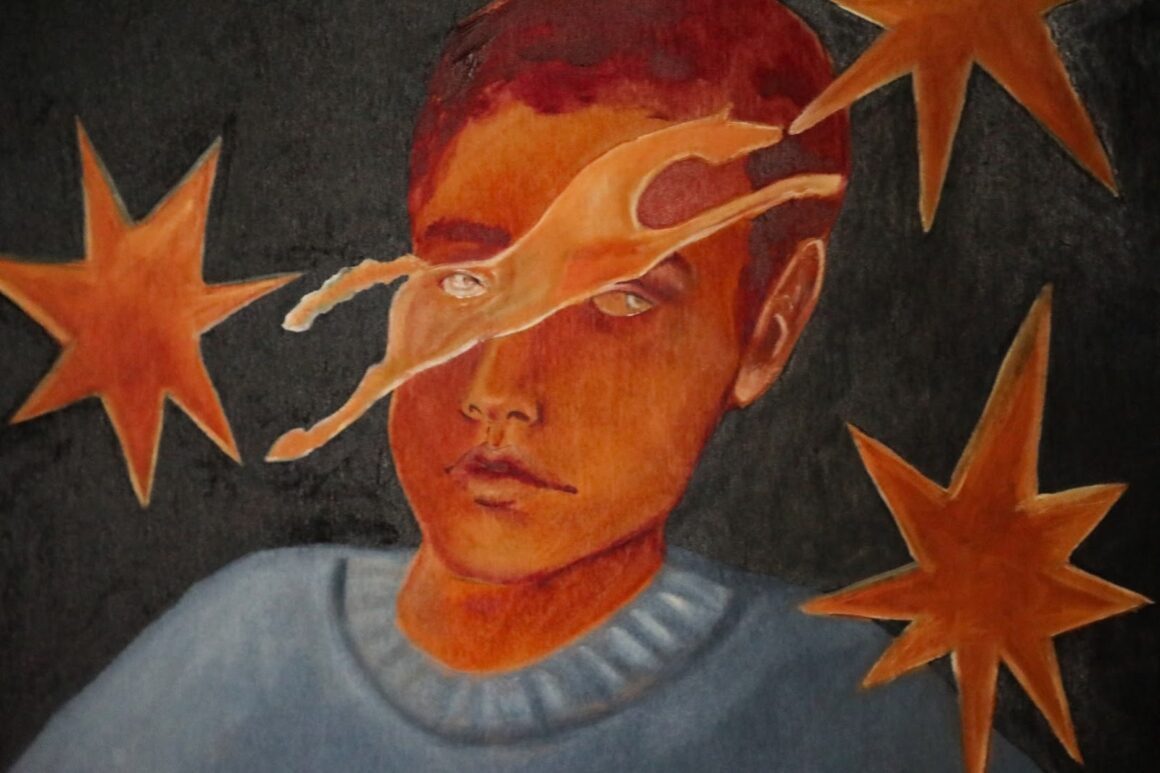
Daydreaming: An Exhibition of Liberation
Daydreaming is both an homage and a release.
“I created this collection as a world for him to live in,” she says. “And I realized that this is the beginning of my real existence as an artist.”
For years, her brother’s death felt like a blockage. “I’m freeing myself from that blockage with creating a world and leaving him in that world,” she says. “It’s a goodbye, not forever, but a moment to liberate myself and give him a place.”
“After this collection I want to become me and free myself of everything that happened,” she says. “It’s my exhibition of liberation.”
She plans to donate a percentage of sales to cancer research and to children living with the disease, turning pain into forward movement.
But more than anything, Isabel hopes Daydreaming becomes a point of light for anyone navigating darkness. “The most important for me would be that this whole collection inspires people to not give up when it’s hard, when it’s dark,” she says. “If we look at one light point long enough, the whole room will light up. We can find lights again, whatever situation we’re in.”
Art as a Language “From Soul to Soul”
For Isabel, art is what remains when language collapses.
“I think I can speak much more honestly through a painting than I ever could with words,” she says. “Vocabulary is quite limited… to capture the complexity of certain situations and how we feel, that’s true art.”
Art, she believes, is “a more universal language. Everyone understands it. You don’t need to learn it.” Even a baby, she says, can feel its energy.
“I can make someone feel exactly what I feel without ever having to explain it,” she says. “For me that emotion, that transmission, is real communication because it’s when you talk from soul to soul.”
In a world that scrolls faster, hides more, and numbs more easily, Isabel fears we are losing something vital. “We’ve disconnected with so many things,” she says. “We miss out on so much emotion. And I’m surprised with how much depression there is within the young community. We really need to address how to feel again.”
“I think it’s now or never that we need to change something,” she says. “We need to make a new movement and make people aware again.”
Her contribution to that movement is Daydreaming, a world of turquoise greens and warm oranges, swing-set memories and galloping horses, grief and stubborn hope. A place where love continues, shape-shifts, and refuses to disappear. And where a young woman who left the catwalks behind can say, with quiet certainty:
“I live for two.”