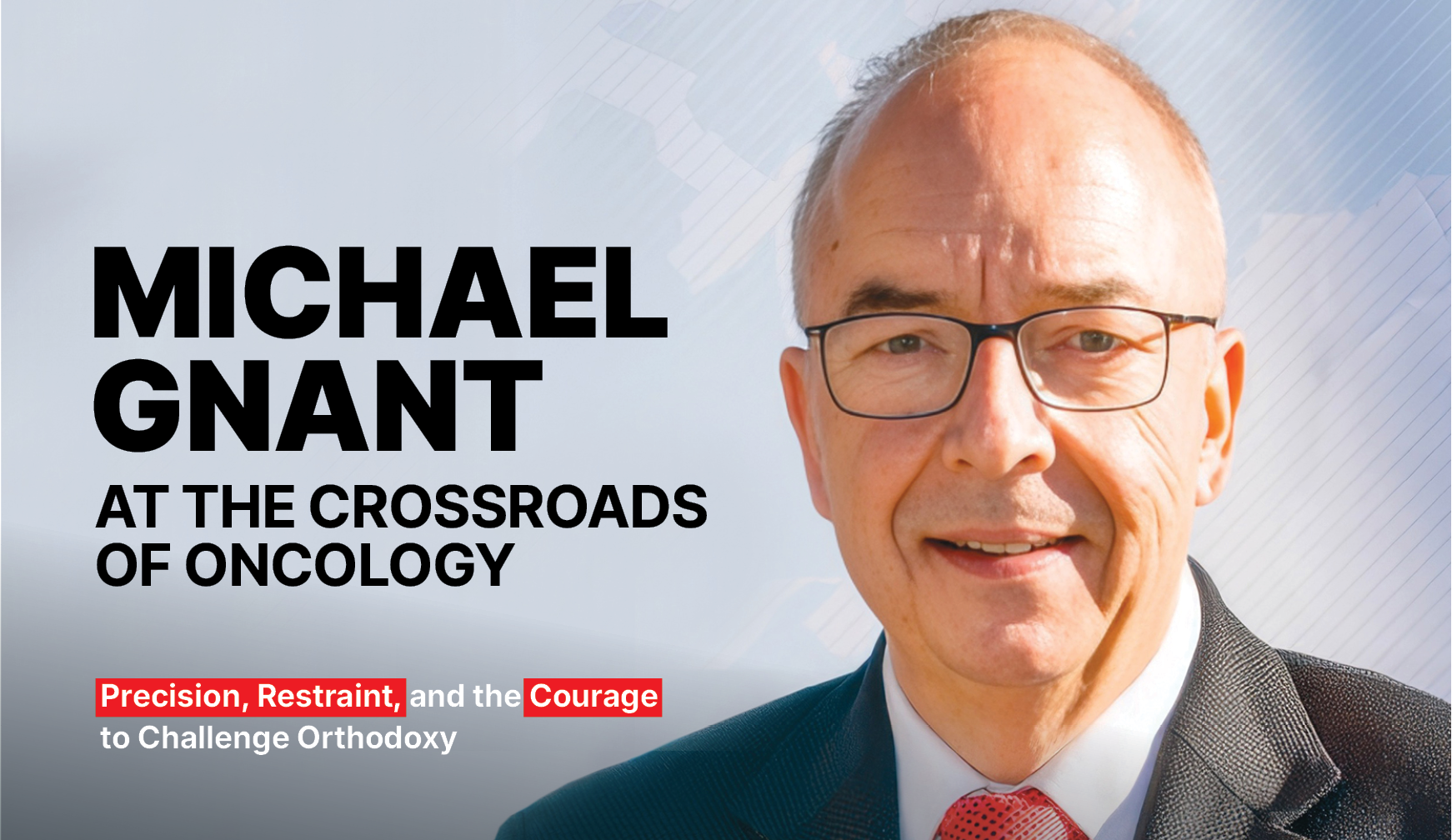
Sixteen years ago, Dr. Michael Gnant was portrayed in CancerWorld as a surgical oncologist unafraid to push boundaries in breast cancer care. Today, his perspective reflects not retreat but evolution. The boundary-pusher remains, but his focus has widened. His work is increasingly global, his travel more frequent, and his role more firmly anchored in teaching and mentorship.
What emerges is a physician who has moved from individual innovation to broader influence. The scope of Dr. Gnant’s work now extends well beyond the operating theatre and beyond Europe, shaped by decades of clinical trials, international collaboration, and sustained commitment to education. In many ways, his trajectory mirrors the maturation of modern breast oncology itself: more data-rich, more interconnected, and more complex to navigate.
He acknowledges the passage of time with characteristic understatement.
“The pushing-the-boundaries thing kind of worked. We have made huge progress in several fields that we discussed 16 years ago.”
From Surgeon to Global Mentor
What has changed most, Dr. Gnant suggests, is not only the science, but his role within it. Increasingly, he sees himself as a transmitter of accumulated experience, a transition many senior oncology leaders recognise, but few articulate so plainly.
His work now centres on international engagement: supporting programmes across health systems and mentoring younger clinicians. The emphasis has shifted from proving concepts to ensuring they are implemented wisely.
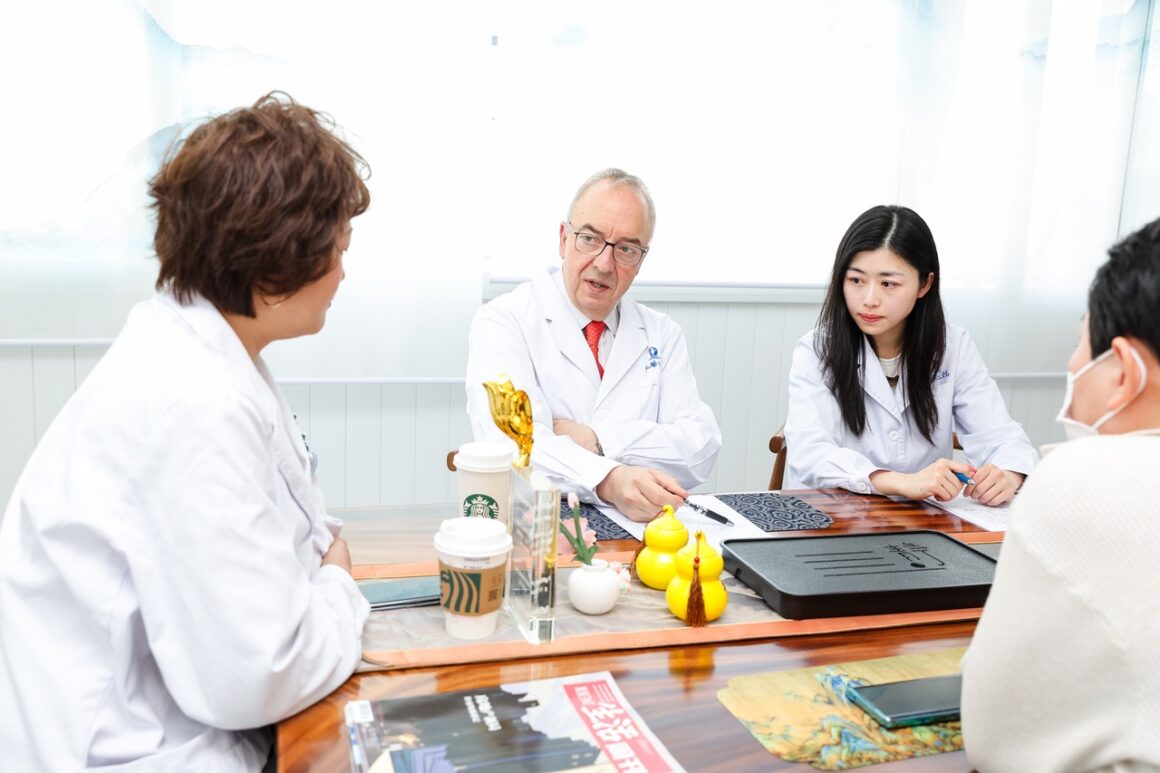
Consulting patients together with fellows at Dalian Cancer Hospital, China, April 2025
“This is now really a global activity… I have become more, even more of a teacher, I would think.”
Yet the broader vantage point has sharpened his concerns about modern surgery. Technological progress is undeniable, he says, but it risks pulling attention toward tools and away from patients.
“Surgeons have a tendency to be focused too much on technology… and maybe… a little bit too little on the people who trust us.”
For Dr. Gnant, the core contract of surgery remains profoundly human, and increasingly easy to obscure in a high-tech era.
Seed and Soil. Validated, But Unfinished
Few areas better illustrate Dr. Gnant’s long-view thinking than his early work on the tumour microenvironment. Bone-targeted strategies that once felt exploratory are now embedded in guidelines worldwide, a translational arc many investigators aspire to but rarely achieve.
“Bisphosphonates and antibodies are now a standard of care… what was like a sensation back then… has now found inclusion into all the guidelines.”
Yet the biology that matters most, dormant tumour cells driving late relapse, remains difficult to observe directly. Parts of the original “seed and soil” hypothesis are still inferential.
Where he now sees the most momentum is in liquid biopsy, particularly circulating tumour DNA (ctDNA). For Dr. Gnant, ctDNA offers a new window into minimal residual disease, the possibility of detecting what he calls “the tiny traces of the enemy” in peripheral blood.
But he is careful to draw the line between detection and action.
“Having said that, we still don’t know what to do… if I tell you, okay, I found something in your blood, now what are you doing then?”
Even so, his forecast is clear: within the next decade, ctDNA monitoring is likely to move into routine early breast cancer care, reshaping how clinicians track treatment response and residual risk.
Academic Oncology in an Era of Consolidation
Scientific progress does not unfold in isolation. Behind each biomarker advance lies a clinical trial ecosystem that has itself undergone quiet but profound change. Over the past 15 years, investigator-driven groups have faced mounting pressure to professionalise, or risk fading from relevance.
Few organisations illustrate this shift more clearly than the Austrian Breast & Colorectal Cancer Study Group (ABCSG). What began as a relatively lean academic network has matured into a highly structured international trial platform.
“I think it has become more challenging… those academic groups who did not manage the transition… are disappearing.”
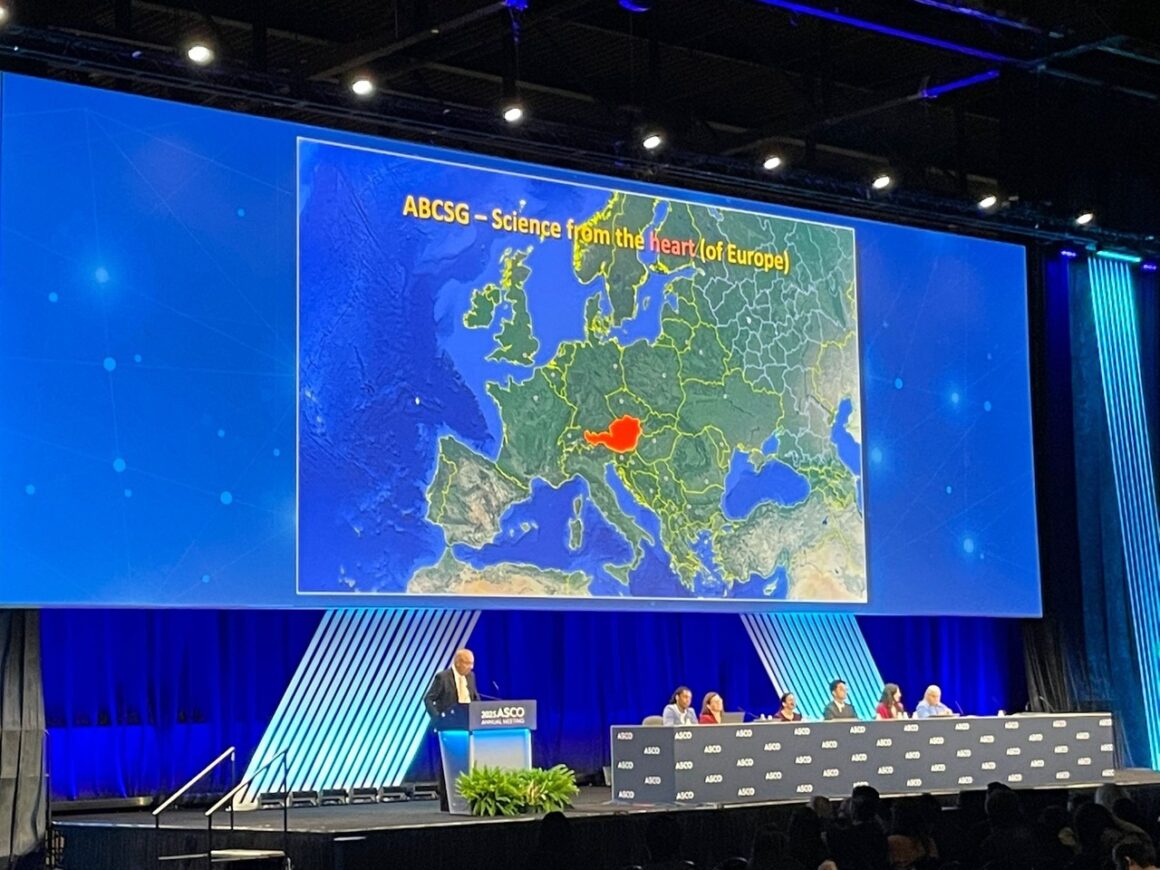
Presenting at ASCO 2025, with the Austrian signature slide on screen
Scientific credibility alone, Dr. Gnant argues, is no longer sufficient. Operational depth, regulatory expertise, and global reach have become prerequisites for survival, a reality that has quietly redrawn the research landscape.
The Funding Fault Line
Even the most sophisticated academic infrastructure rests on a fragile financial foundation. In Europe, particularly, limited public investment continues to shape not only how trials are conducted but which clinical questions are pursued.
“Particularly in Europe, we still don’t invest a lot of public… money into clinical research.”
When industry inevitably carries more of the research burden, the centre of gravity shifts toward commercially viable interventions. For clinician-scientists focused on optimisation rather than escalation, this creates persistent friction.
“The priority of research questions has a tendency to be in fields where there is a commercial perspective.”
Few areas expose this tension more clearly than de-escalation trials, studies designed not to add treatment, but to safely remove it.
“We have done trials of leaving something out… it’s so difficult.”
Bureaucracy, Safety, and the Risk of Overcorrection
Dr. Gnant is equally concerned about the expanding administrative architecture surrounding clinical research. What began as well-intentioned safeguards has, in his view, accumulated into a system that risks diverting energy away from patients.
“In clinical research, we could, as society, request to limit the bureaucracy.”
Across institutions, he observes back-office functions expanding while frontline clinical capacity struggles to keep pace.
“We see these parts are growing, growing, growing… and the actual people in the field who care for patients… they are fewer and fewer.”
His argument is not for deregulation but proportionality.
“We don’t need 300… we just need these 50.”
Beneath the procedural debate lies a deeper concern: how risk-averse can oncology become without slowing the innovation patients ultimately depend on?
“If you do something new, there’s always some risk… we need to live with some risk to go there.”
The goal, he insists, is recalibration, not retreat.
The Sad Reality of Europe: We are About to Become a Museum
As the conversation widens beyond breast cancer, Dr. Gnant’s concerns take on a more geopolitical tone. For a clinician who has spent decades working across continents, the shifting balance of scientific power is impossible to ignore.
Europe, once the unquestioned intellectual engine of modern medicine, now faces a more uncertain position. The continent still produces high-quality science, but speed, scale and strategic investment increasingly favour competitors elsewhere.
Gnant’s assessment is characteristically blunt.
“We are about to become a museum. This is sad.”
Yet what follows is not resignation but a call to realism. Europe retains enormous structural advantages, population size, educational depth, and scientific heritage, but, in his view, has not fully translated these into coordinated innovation power.
“We are 500 million people… we have the power to change.”
To illustrate what is possible, he reaches outside medicine to industrial history. The Airbus story, Europe’s strategic response to Boeing’s former dominance, serves as a template for what focused political will can achieve.
“In the airline industry, it just took two decades, and now we are leading. So why can we not?”
For oncology policymakers, the implication is clear: scientific leadership is rarely accidental. It is built.
Strength, Values, and the Price of Influence
Beneath the innovation debate lies a deeper philosophical concern about Europe’s global posture. Dr. Gnant is openly supportive of the continent’s social and environmental standards, but warns that values without competitive strength risk losing practical influence.
In a world increasingly shaped by economic and technological power, moral leadership alone may not suffice.
“You need to be powerful with solutions rather than harassing people with your principles.”
His travels across diverse health systems have reinforced a pragmatic view: countries set standards most effectively when they combine ethical ambition with operational success.
“We can only impose a value standard if we are reasonably successful in economic terms.”
The conclusion is not ideological but strategic.
“We need to be strong.”
I was Right: Reducing Unnecessary Chemotherapy
If Dr. Gnant sometimes sounds like a systems thinker, nowhere has his clinical influence been more tangible than in the effort to reduce unnecessary chemotherapy in endocrine-responsive breast cancer.
Here, the tone shifts, not to triumphalism, but to measured vindication.
“We predicted that that’s going to happen, and it actually happened. So I was right.”
Two decades ago, withholding chemotherapy in selected patients required both data and conviction. Dr. Gnant recalls treating patients without chemotherapy at a time when many peers would have escalated by default, always, he emphasises, through transparent discussion and shared decision-making.
Today, the landscape has decisively shifted. For most postmenopausal patients with endocrine-responsive disease, chemotherapy omission has become standard practice worldwide.
“Most patients… after menopause, will not receive chemotherapy everywhere in the world.”
Yet he does not consider the work finished. Important grey zones remain, particularly in younger patients. The next phase of de-escalation is already underway.
His group is now testing layered safeguards, including ctDNA risk stratification and short preoperative endocrine sensitivity testing, to identify additional patients who can safely avoid chemotherapy.
“We have just started two neoadjuvant trials where we try to identify the next subset… to treat them without chemo.”
The direction of travel is unmistakable. In Dr. Gnant’s practice, fewer than one-third of patients now receive chemotherapy, roughly half the proportion seen 16 years ago.
What began as selective restraint is becoming something more precise: not simply adding the right therapy, but confidently withholding it when biology allows.
AI, Empowerment, and the Enduring Role of Trust
Artificial intelligence, like many technological advances before it, provokes both enthusiasm and caution in Dr. Gnant’s assessment.
“AI probably is smarter than the physician.”
But clinical care, he insists, involves more than pattern recognition.
“Do you really want to have… AI telling you… you can die?”
For him, the answer lies in governance and collaboration, not rejection.
“Eventually, the people need to take control… where we want to use it.”
If technology is reshaping oncology, so too are patients. Dr. Gnant views the rise of patient empowerment largely as progress, even when consultations become longer and more complex.
“I actually have patients who come with 20 pages printed out… and sometimes it’s a lengthy conversation.”
At the centre of modern care, he says, remains what he calls the “gift of trust” that patients extend to their physicians.
A Modest Beginning of Wisdom
Asked to describe himself today, Dr. Gnant’s answer is notably unvarnished. The travel schedule remains heavy. Burnout has been a lived experience. Perspective, however, has deepened.
“I had burnout once… I have learned to be a little bit more economic with my resilience.”
What he values most now is a particular professional vantage point, maximal experience paired with more time to engage directly with patients.
And, characteristically understated:
“There might be… a modest beginning of wisdom.”
The Last Word
Across four decades of surgical oncology, Dr. Michael Gnant has repeatedly occupied uncomfortable territory, challenging overtreatment, questioning systems, and insisting that progress be measured not only by what medicine can do, but by what it should do.
His legacy is visible in guidelines, trials, and in the millions of women who have safely avoided unnecessary chemotherapy. But his more enduring contribution may be philosophical: a persistent insistence on balance.
Between innovation and restraint. Between technology and trust. Between speed and wisdom.
In an oncology landscape defined by exponential data and accelerating tools, that equilibrium may prove harder, and more necessary, than ever.
Progress, his career suggests, is not always about moving faster. Sometimes it is about knowing precisely when not to.