In the quieter corners of European health policy, where attention is often fragmented and political capital fiercely contested, pancreatic cancer has long remained an uncomfortable outlier—aggressive, difficult to detect, and historically underprioritised. Yet, as Europe confronts an evolving cancer burden, a coordinated movement is emerging with the ambition to rewrite this narrative. At the centre of this shift is Pancreatic Cancer Europe (PCE), a coalition determined to elevate one of the continent’s deadliest cancers from the margins to the mainstream of policy and research.
From Neglect to Political Priority
As PCE marks its 10th anniversary in 2026, its trajectory reflects both the urgency of the disease and the complexity of the challenge ahead. Founded in 2016, the organisation has built a pan-European platform that unites patient groups, clinicians, researchers, and advocates around a shared goal: to improve prevention, accelerate diagnosis, enhance care, and ultimately increase survival rates across Europe. In a policy landscape often defined by national silos, PCE’s model is deliberately integrative bridging science and politics, and translating evidence into coordinated advocacy.
The stakes are unambiguous. Pancreatic cancer, while representing a relatively small share of total cancer diagnoses in Europe, has emerged as the third leading cause of cancer death in the EU and is projected to rise further in the coming years.(1) Survival rates remain stubbornly low, frequently in the single digits, a consequence of late diagnosis and the absence of reliable early detection tools. “Late diagnosis continues to cost many lives,” notes Alfredo Carrato, Chairperson of PCE, underscoring the need for early detection, prevention, and sustained investment in research as shared European priorities.
This challenge of late detection lies at the heart of the disease’s intractability. Unlike many other cancers, pancreatic cancer often progresses silently, with vague symptoms that evade early clinical suspicion. By the time it is identified, the disease is frequently advanced, leaving limited therapeutic options. This biological reality has historically translated into slower progress in outcomes compared to other major cancers, despite its rising mortality burden.
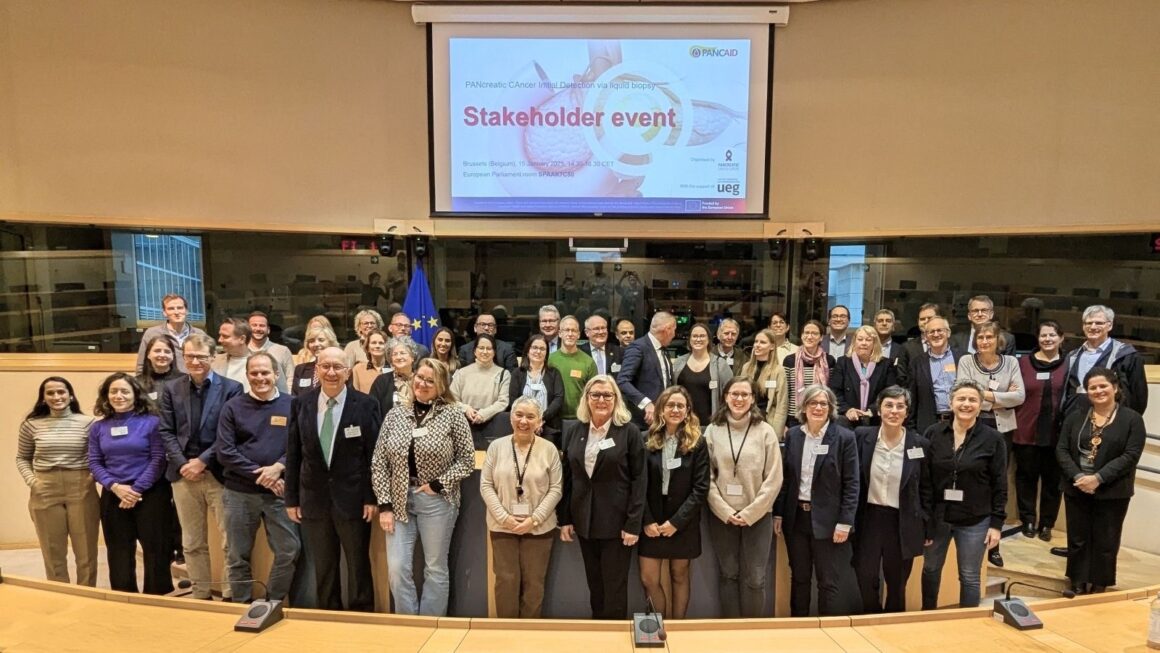
PANCAID Stakeholder Event group picture organised by PCE at the European Parliament
Recognising this gap, PCE has positioned itself not merely as an awareness campaign, but as a policy-driven coalition. One of its foundational contributions is its comprehensive Position Paper, endorsed by a wide range of stakeholders. The document outlines a series of concrete policy priorities: strengthening cancer registries and data collection, investing in prevention and early diagnosis, supporting research into tailored treatments, ensuring equitable access to multidisciplinary care, and promoting coordinated European action.(2) These recommendations have been actively used as an advocacy tool, including engagement with candidates for the European Parliament and subsequent outreach to elected Members of the European Parliament (MEPs).
This strategic engagement reflects a broader shift in cancer advocacy—one that recognises the European Union as a critical arena for driving systemic change. Through targeted campaigns and events, PCE has helped anchor pancreatic cancer within discussions linked to broader initiatives such as the EU’s cancer strategy and the evolving Europe’s Beating Cancer Plan.(3) The aim is clear: to ensure that pancreatic cancer is not only acknowledged, but actively prioritised within Europe’s public health agenda.
Bridging Fragmentation Across Europe
A defining strength of PCE lies in its ability to unify a fragmented advocacy landscape. Across Europe, pancreatic cancer organisations are often small, volunteer-led, and resource-constrained. By providing a European-level platform, PCE amplifies these voices, enabling shared learning, coordinated awareness efforts—particularly during World Pancreatic Cancer Awareness Month and a stronger collective presence in policy debates.
Yet, beneath the progress lies a persistent and uncomfortable truth: inequality. Access to high-volume surgical centres, multidisciplinary care, clinical trials, and specialist support varies significantly across Europe. These disparities translate directly into differences in patient outcomes, revealing a healthcare landscape where geography can determine prognosis. Data from European cancer registries demonstrate significant differences in outcomes, often linked to disparities in healthcare infrastructure and early referral pathways.(4) For PCE, such disparities are not abstract, they are systemic failures that demand policy intervention.
Compounding these challenges is the inherent complexity of the disease itself. Pancreatic cancer is biologically heterogeneous and deeply embedded within a complex tumour microenvironment. As Ilse Rooman of Vrije Universiteit Brussel highlights, advances in spatial and single-cell technologies are beginning to reveal the intricate interplay between tumour cells and their surrounding ecosystem, including immune cells, fibroblasts, and vascular structures. Understanding this complexity requires interdisciplinary collaboration precisely the kind of cross-border scientific cooperation that PCE seeks to foster.
This emphasis on collaboration reflects a broader strategic insight: in a disease with relatively fewer patients compared to other cancers, progress depends on pooling knowledge, data, and expertise. European research networks, data-sharing initiatives, and joint clinical trials are therefore not optional; they are essential. PCE’s advocacy for such collaboration underscores its commitment to accelerating innovation through collective effort.
At the policy level, Europe is gradually laying the groundwork for this transformation. Initiatives such as the European Cancer Imaging Initiative (7), the Knowledge Centre on Cancer (8), and the EU Mission on Cancer are designed to strengthen early detection, harmonise standards, and reduce disparities across member states. Complemented by investments in digital infrastructure and the development of the European Cancer Inequalities Registry (9), as well as networks of Comprehensive Cancer Centres promoted at EU level, (10, 11) these programmes aim to translate political commitment into measurable improvements in care and outcomes.
Still, the challenge remains one of alignment: bridging the gap between policy ambition and real-world implementation. This is where organisations like PCE play a pivotal role—ensuring that political frameworks are informed by patient experience, clinical insight, and scientific evidence.
Indeed, the human dimension of pancreatic cancer advocacy is impossible to ignore. Many within PCE’s network are patients, survivors, or family members who have experienced the disease’s devastating impact firsthand. Their testimonies bring urgency and moral clarity to policy discussions. They speak of late diagnoses, limited treatment options, lack of emotional, physical or nutritional support, and the burden of navigating fragmented healthcare systems. By integrating these voices into its advocacy, PCE reframes pancreatic cancer not only as a clinical challenge, but as a societal responsibility.
Innovation, Inequality, and the Road Ahead
Looking ahead, the future of pancreatic cancer care in Europe sits at the intersection of innovation and uncertainty. Advances in genomics, artificial intelligence, and precision medicine hold promise for earlier detection and more targeted therapies. The emerging European Health Data Space (6) may further enable effective data sharing, a crucial factor in rare and hard-to-treat cancers. At the same time, economic constraints, competing health priorities, and the lingering effects of the COVID-19 pandemic risk slowing progress.
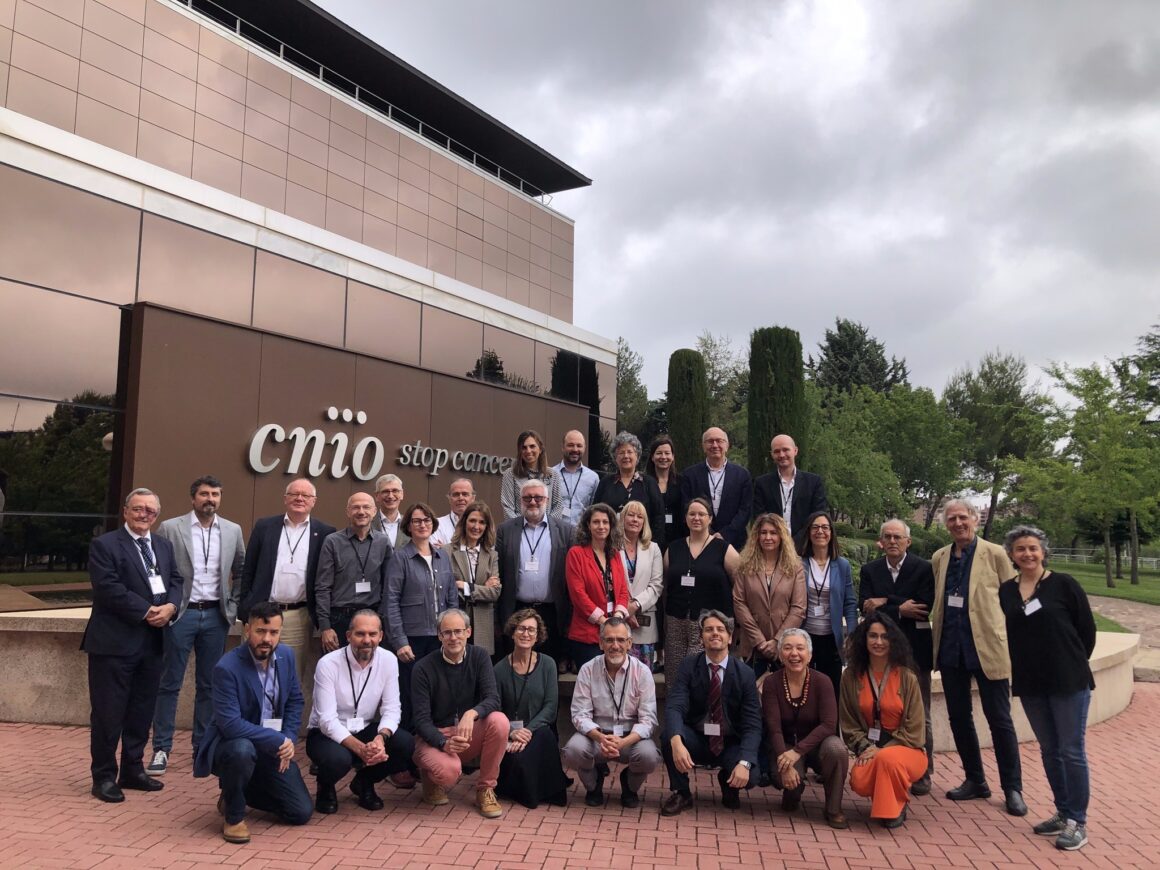
PCE Multistakeholder meeting, 2023
For PCE, the next decade will be defined by its ability to maintain and expand this momentum. Its strategy increasingly combines policy advocacy, professional education, public engagement, and research collaboration, with the aim of embedding pancreatic cancer within Europe’s core health priorities, including funding programmes such as EU4Health.
As Patrycja Rzadkowska, Patient Advocate and Vice-Chair of PCE, cautions: “Pancreatic cancer patients cannot wait another decade for incremental change.” Her words capture both the urgency and the ethical imperative at the heart of this movement.
In a healthcare landscape often marked by fragmentation, Pancreatic Cancer Europe offers something increasingly rare: a model of coordinated, cross-sectoral action. By aligning science, policy, and lived experience, it is helping to reshape how Europe confronts one of its most formidable cancers. Whether this effort will ultimately transform survival outcomes remains to be seen. But one thing is clear: pancreatic cancer is no longer invisible and in the realm of public health, visibility is the first step toward change.
References:
European Commission. CraNE Joint Action. [cited 2026 Mar 13]. Available from: https://crane4health.eu/
European Cancer Information System (ECIS). Pancreatic cancer burden in Europe. European Commission, Joint Research Centre; 2024. [cited 2026 Mar 05].Available from: https://ecis.jrc.ec.europa.eu
Pancreatic Cancer Europe. Position Paper on Pancreatic Cancer. Brussels: Pancreatic Cancer Europe; 2024. [cited 2026 Mar 05]. Available from: https://pancreaticcancereurope.eu
European Commission. Europe’s Beating Cancer Plan. Brussels: European Commission; 2021. [cited 2026 Mar 09].Available from: https://commission.europa.eu/topics/public-health/european-health-union/cancer-plan-europe_en
OECD, European Observatory on Health Systems and Policies. State of Health in the EU: Cancer Profiles. Paris/Brussels: OECD Publishing; 2023[cited 2026 Mar 09]. Available from: https://eurohealthobservatory.who.int/publications/country-health-profiles/2023
International Agency for Research on Cancer (IARC), World Health Organization. Global Cancer Observatory: Pancreatic cancer fact sheet. Lyon: IARC; 2022. [cited 2026 Mar 10 ]Available from: https://gco.iarc.fr/today/fact-sheets-cancer/fact-sheets-cancers
European Commission. Proposal for a Regulation on the European Health Data Space. Brussels: European Commission; 2022. [cited 2026 Mar 10] Available from: https://health.ec.europa.eu/ehealth-digital-health-and-care/european-health-data-space_en
European Commission. European Cancer Imaging Initiative. [cited 2026 Mar 13]. Available from: https://digital-strategy.ec.europa.eu/en/policies/cancer-imaging
European Commission. Knowledge Centre on Cancer. [cited 2026 Mar 13]. Available from: https://knowledge4policy.ec.europa.eu/cancer_en
European Commission. European Cancer Inequalities Registry (ECIR). [cited 2026 Mar 13]. Available from: https://cancer-inequalities.jrc.ec.europa.eu/
European Commission. The European Comprehensive Cancer Center Network. [cited 2026 Mar 13]. Available from: https://ecc-cert.org/health-service-research/eunetccc/