
After more than a decade in oncology practice, I have come to recognise that my professional development has been shaped as much by patients’ stories as by scientific progress. While advances in systemic therapies, diagnostics, and supportive care continue to transform outcomes for many, the human experience of cancer remains defined by fear, hope, resilience, conflict, and love. Each clinical encounter unfolds within this emotional landscape, reminding us that oncology care extends far beyond diagnosis, staging, and treatment protocols. It is within these moments, often quiet, complex, and deeply personal, that the principles of patient-centred decision-making are most clearly tested.
Over the years, I have cared for patients facing not only life-limiting illness but also profound personal challenges. I recall a young mother struggling with whether, and how, to explain her diagnosis to her children; a father approaching the end of life whose single remaining wish was to take one final trip with his young son; and a young man with advanced pancreatic cancer caught between the competing expectations and emotional needs of his mother and his wife. Each of these cases required careful navigation of medical facts, emotional realities, and ethical responsibilities. While many patients leave a lasting impression, one particular experience fundamentally reshaped how I approach patient-centred decision-making in oncology.
When the Patient Finds His Voice
The patient was close to me in age and life stage, a father of three young children diagnosed with a rare and advanced small-bowel malignancy. From the outset of his illness, he deferred nearly all discussions and decisions to his father, a retired general practitioner. His father assumed the role of advocate with unwavering commitment, exploring treatment options, pursuing clinical trials abroad, and even expressing the wish that he could take his son’s place during chemotherapy. For many months, this dynamic remained unchanged. The patient and his father travelled together internationally in search of experimental treatment, driven by hope and determination.
During this period, the patient himself remained largely silent within consultations, allowing his father to speak on his behalf. This arrangement was initially accepted as a coping strategy, particularly in the context of serious illness and strong familial bonds. However, as the disease progressed, the physical and emotional costs of ongoing treatment became increasingly evident. When the patient eventually returned home, his condition had deteriorated significantly. His symptoms had worsened, his disease had progressed, and he was now entering the terminal phase of his illness.
At this stage, a notable shift occurred. For the first time since his diagnosis, the patient began to speak for himself. His tone was not angry or confrontational, but clear, firm, and determined. Recognising this change, and appreciating its ethical significance, I arranged to meet him privately with his wife, without his father present. This decision was deliberate. Patient-centred care requires not only listening to patients, but also creating the conditions in which they can safely express their own wishes, particularly when those wishes may differ from those of their family.
During this conversation, I asked a simple but pivotal question: where did he wish to spend his final days? In a quiet and resolute voice, he expressed a clear preference to be with his young family in a town several hours away, rather than remain in the city where his father lived and where he had received most of his care. His response was thoughtful, composed, and unambiguous. He did not ask for advice or reassurance. He had already decided. My role at that moment was not to guide or persuade, but to listen, acknowledge, and support.
With his consent, I organised a family meeting and explained to his extended family that he would be transferred to a hospice closer to his children. I made it explicit that this decision was his own and that my professional responsibility was to uphold and protect his expressed wishes. There would be no negotiation unless he chose otherwise. This was a difficult conversation. Family members were distressed, and emotions ran high. However, clarity was essential. In patient-centred decision-making, particularly at the end of life, ambiguity can undermine autonomy and prolong suffering.
The transfer took place shortly thereafter. When I spoke with him one week later, he described spending meaningful time with his children. Although he was approaching the end of life, his voice conveyed a sense of peace and acceptance. Three days later, his parents contacted me to inform me that he had died shortly before their call. They expressed gratitude for the care he had received and, importantly, for the support given to his final decision. Despite the pain of loss, they acknowledged that it had been the right choice.
Holding the Line: Ethics, Emotion, and Oncology Practice
This experience reshaped my approach to oncology practice. Since then, I have been deliberate in ensuring that patients’ values and preferences remain central to all clinical decisions, even when these differ from the wishes of family members. In oncology, where outcomes are often uncertain and control is limited, preserving patient autonomy is one of the most meaningful contributions clinicians can make. Patient-centred decision-making is not simply about offering choices; it requires active advocacy, clear communication, and, at times, the courage to hold firm in ethically challenging situations.
Oncology is a specialty defined not only by scientific complexity but also by profound emotional intensity. Consultations frequently involve discussions about prognosis, treatment limitations, and end-of-life care, all of which take place in the context of fear, uncertainty, and anticipated loss. While the psychological impact of cancer on patients and families is well recognised, the emotional burden experienced by oncology professionals is less visible and often under-acknowledged.
A growing body of evidence demonstrates that oncologists, nurses, and allied health professionals experience high levels of emotional strain. This strain arises not only from workload, but also from the ethical and relational demands of caring for patients with life-limiting illness. Emotional labour, the ongoing regulation of one’s own emotions in order to support others, is central to oncology practice. Clinicians must balance empathy with clinical clarity, compassion with professional boundaries, and hope with realism. This sustained effort, repeated across countless patient encounters, contributes significantly to emotional exhaustion and burnout.
Cancer is rarely an individual experience; it is a family event. Family members bring love, fear, expectations, and sometimes unresolved conflict into the clinical encounter. Managing these dynamics is an essential component of oncology care, yet it is emotionally demanding. Family conflict, particularly when relatives’ wishes diverge from those of the patient, is a recognised source of clinician stress. Family meetings often require clinicians to mediate disagreement while simultaneously protecting patient autonomy and maintaining therapeutic relationships.
The case described here reflects a scenario commonly encountered in oncology: a family acting out of love and desperation, a patient asserting independence late in the illness trajectory, and a clinician required to provide clarity, structure, and support at a critical moment. These situations are emotionally challenging but also ethically significant. They highlight the oncologist’s dual responsibility: to care for families while remaining unequivocally committed to the patient’s expressed wishes.
Conversations about prognosis and end-of-life care are among the most challenging aspects of oncology practice. Repeated exposure to death and dying contributes to cumulative, often unprocessed grief among clinicians. At the same time, oncologists frequently feel responsible for sustaining hope while preparing patients and families for loss. Navigating this tension requires experience, reflection, and emotional resilience. The question I asked my patient—where he wished to spend his final days—illustrates the precision, timing, and sensitivity required in such discussions.
Reflective practice plays a crucial role in helping clinicians recognise the emotional impact of these experiences and reaffirm core professional values. Patient-centred decision-making is not merely a theoretical principle or policy directive; it is a daily ethical commitment enacted in conversations, silences, and moments of trust. By actively listening to patients, creating space for their voices, and prioritising their expressed wishes, oncology professionals can support dignity, autonomy, and meaning at the end of life—not only for patients, but also for themselves.
Acknowledgment
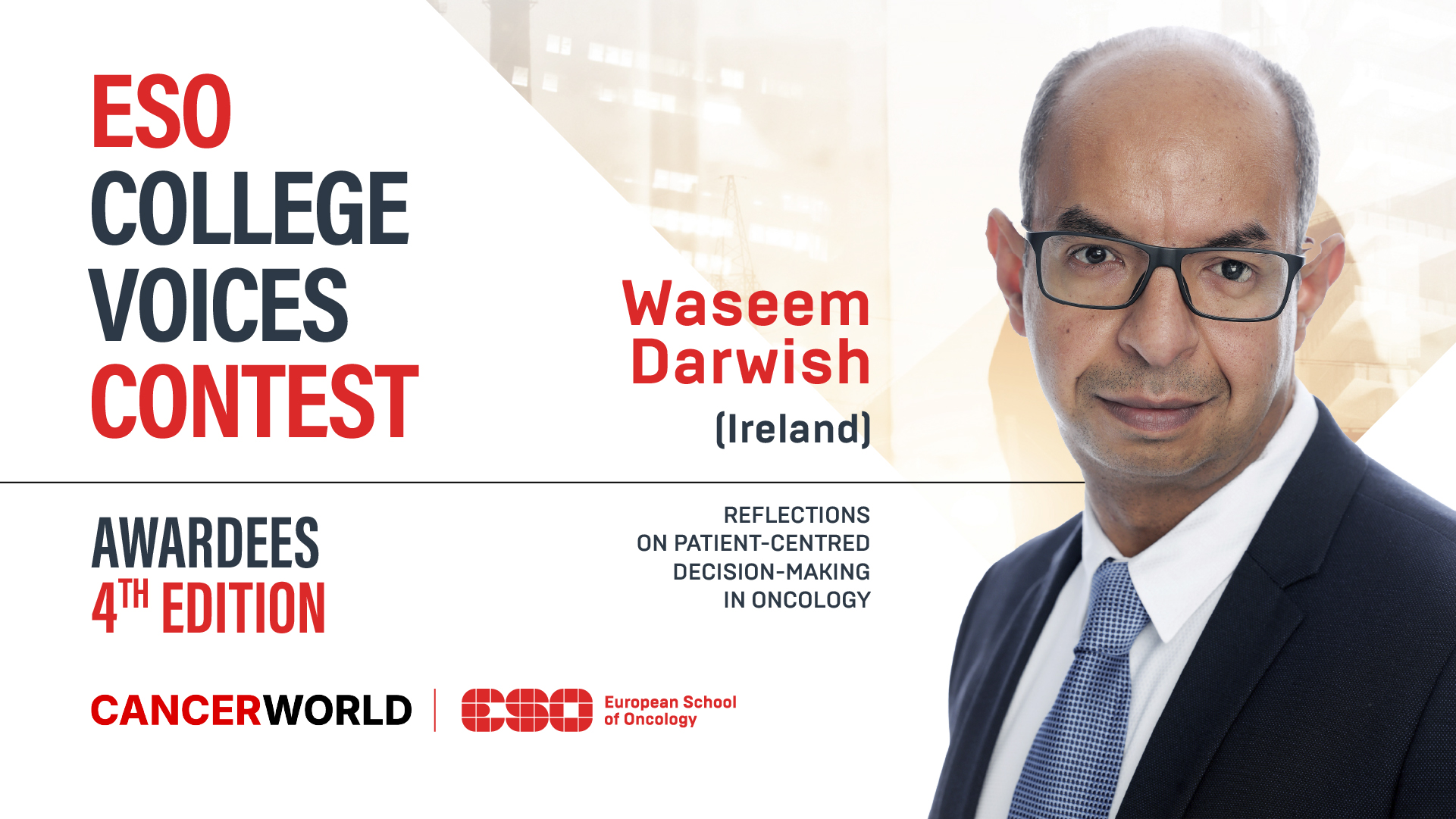
This article was written by Dr Waseem Darwish, one of the two winners of the ESO College Voices Contest 2026, on the topic “ One Disease, Many Languages: Communicating Cancer Across Cultures”.
This year’s contest once again proved that doctors can also be excellent cancer writers. We received 24 proposals from ESO College members across 16 countries, each exploring the chosen theme. After careful deliberation, guided by CancerWorld’s editorial standards, as well as criteria of clarity, relevance, originality, potential impact, and our hallmark style of weaving in interviews and firsthand perspectives, Dr Darwish was selected as one of the winners, and we are proudly publishing his impactful voice.
References
- Salehi M., Ghasemian A., Vafaee Najar A., Nazari H., Hooshmand E. From compassion to burnout: emotional labor in oncology nursing — a qualitative study. BMC Nursing, 2025.
- Lim K.H.J., Kamposioras K., Élez E., Blay J.Y., Banerjee S., et al. ESMO Resilience Task Force recommendations to manage psychosocial risks, optimise well-being, and reduce burnout in oncology. ESMO Open, 2024.
- Occupational Stress in Oncology Staff: Burnout, Resilience, and … Oxford Academic. https://doi.org/10.1093/med/9780190097653.003.0098