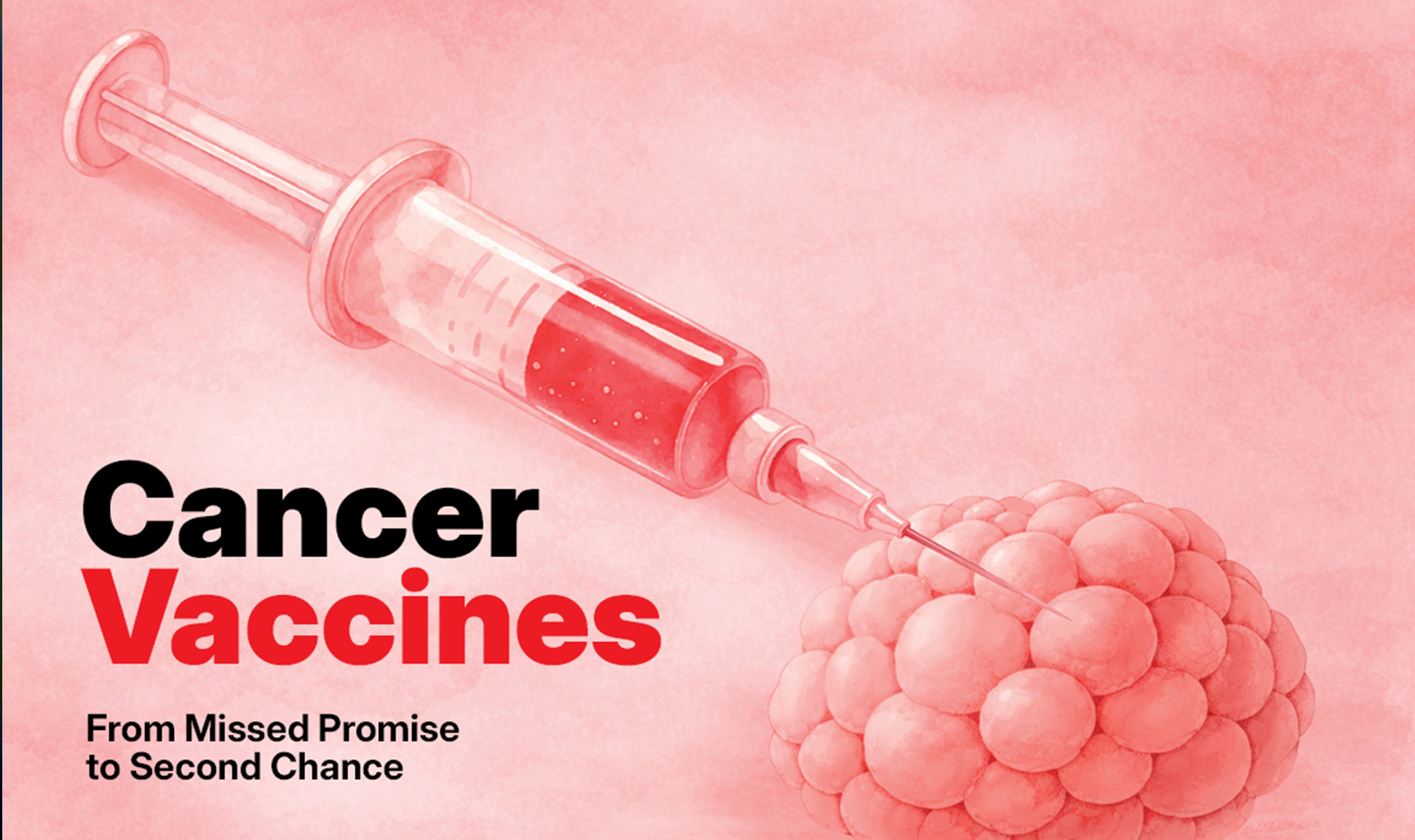
In oncology, some ideas arrive too early.
For decades, cancer vaccines were one of them. The concept was elegant: train the immune system to recognise tumour cells, much like it recognises viruses, and allow it to eliminate disease with precision and memory.
The reality was different. Early clinical trials were marked by modest responses, inconsistent outcomes, and growing skepticism. While chemotherapy and later targeted therapies reshaped survival curves, cancer vaccines remained on the margins of clinical practice.
And yet, they never disappeared.
Today, they are returning—quietly, but with renewed scientific credibility.
The Difference Between Prevention and Treatment
When most people hear the word “vaccine,” they think of prevention. In oncology, that exists: vaccines against human papillomavirus and hepatitis B have reduced the incidence of cervical and liver cancers worldwide.
Therapeutic cancer vaccines are different.
They are not designed to prevent cancer. They are designed to treat it—by activating an immune response against tumour-associated or tumour-specific antigens already present in the body.
In that sense, they belong to the same broad family as checkpoint inhibitors and cellular therapies, but with a distinct goal: to generate, rather than release, an immune response.
The Quiet Presence of Approved Therapies
Despite the perception that cancer vaccines are experimental, several have already entered routine clinical use.
Sipuleucel-T was approved for metastatic prostate cancer that no longer responds to hormone therapy. It is a personalised treatment: a patient’s own immune cells are collected, exposed to a tumour-associated antigen ex vivo, and then reinfused. Its clinical effect is not measured in rapid tumour shrinkage, but in improved overall survival—an outcome that reflects the slower kinetics of immune modulation.
Bacillus Calmette-Guérin, or BCG, has been used for decades in high-risk non–muscle-invasive bladder cancer. Administered directly into the bladder, it induces a strong local immune response. Long before the era of checkpoint inhibition, BCG demonstrated that activating the immune system within the tumour microenvironment could produce durable clinical benefit.
Talimogene laherparepvec (T-VEC) represents a more recent evolution. This genetically modified oncolytic virus selectively infects tumour cells, leading to cell lysis and the release of tumour antigens, while also stimulating immune activation. Approved for melanoma lesions not amenable to surgical resection, it bridges direct tumour destruction with systemic immune priming.
These therapies are not widely applicable across all cancers. Their indications are specific, and their effects are often modest. But they establish an important principle: immune-based vaccination can work in cancer.
Why Early Cancer Vaccines Struggled
The limitations of earlier vaccine approaches are now better understood.
Tumours are not passive targets. They actively suppress immune responses, creating an environment characterised by regulatory cells, inhibitory cytokines, and checkpoint signalling pathways. In this setting, simply presenting an antigen is often not sufficient.
In addition, many early vaccines targeted shared tumour-associated antigens, which are not truly specific to cancer cells. The immune system, trained to avoid attacking normal tissue, responded weakly.
Perhaps most importantly, vaccines were often tested in advanced disease, where tumour burden is high and immune dysfunction is profound.
The biology proved more complex than anticipated.
Why the Field is Changing
What has changed is not the concept but the context.
The emergence of checkpoint inhibitors has altered the immune landscape. By blocking inhibitory pathways such as PD-1/PD-L1, these agents create conditions in which vaccine-induced T cells can function more effectively.
At the same time, advances in sequencing technologies have enabled the identification of neoantigens—mutations unique to an individual tumour. This has opened the door to personalised vaccines designed to target truly tumour-specific signals.
mRNA platforms, validated at global scale during the COVID-19 pandemic, have further accelerated development. They allow rapid design and production, making individualised approaches more feasible.
The question is no longer whether cancer vaccines can work in principle, but in which context they are most effective.
Recent clinical data provide early evidence that cancer vaccines may enhance the efficacy of checkpoint inhibition. In the phase 2b KEYNOTE-942 trial, an individualised neoantigen mRNA vaccine (mRNA-4157/V940) combined with pembrolizumab, in patients with resected high-risk melanoma, demonstrated a reduction in the risk of recurrence or death compared with pembrolizumab alone (hazard ratio 0.56), with 18-month recurrence-free survival rates of 79% versus 62%.
Additional analyses have suggested a substantial reduction in distant metastasis or death, with combination therapy lowering this risk by approximately 65% compared with anti-PD-1 monotherapy.
These findings represent one of the first randomised signals that personalised cancer vaccines, when combined with checkpoint blockade, may translate into clinically meaningful benefit.
A Shift in Role
Cancer vaccines are unlikely to replace existing immunotherapies.
Instead, they may complement them.
Vaccines can provide the signal—introducing or amplifying tumour-specific immune recognition. Checkpoint inhibitors can sustain and enhance that response by preventing immune suppression.
This division of roles reflects a broader understanding of anti-tumour immunity as a multi-step process: antigen presentation, T-cell activation, trafficking, and persistence. Intervening at only one step is rarely sufficient.
An Unfinished Story
Cancer vaccines have not yet transformed oncology in the way checkpoint inhibitors have.
But they are no longer a failed concept.
They represent a strategy that was introduced before the field was ready, and is now being revisited with better tools, deeper biological understanding, and more appropriate clinical integration.
Their future will likely not be defined by standalone success, but by their role within combination approaches.
In oncology, progress is often incremental. Some advances are visible immediately, in survival curves and regulatory approvals. Others develop more slowly, shaped by changing context and accumulating evidence.
Cancer vaccines belong to the latter.
They are not a revolution.
But they may yet become an essential part of one.
About the Author
Toma Oganezova, MD, Medical Oncologist at Nairi Medical Center, Senior Scientist at Immune Research Institute, Editor-in-Chief at OncoDaily IO.