Five trials, five cancers, and what the ASCO 2026 plenary really promised patients
ASCO 2026’s plenary delivered five real advances across five cancers, and a standing ovation that pulled a hall full of oncologists to their feet. The harder question starts after the applause dies down: what does any of it actually buy the patient who isn’t in the room?
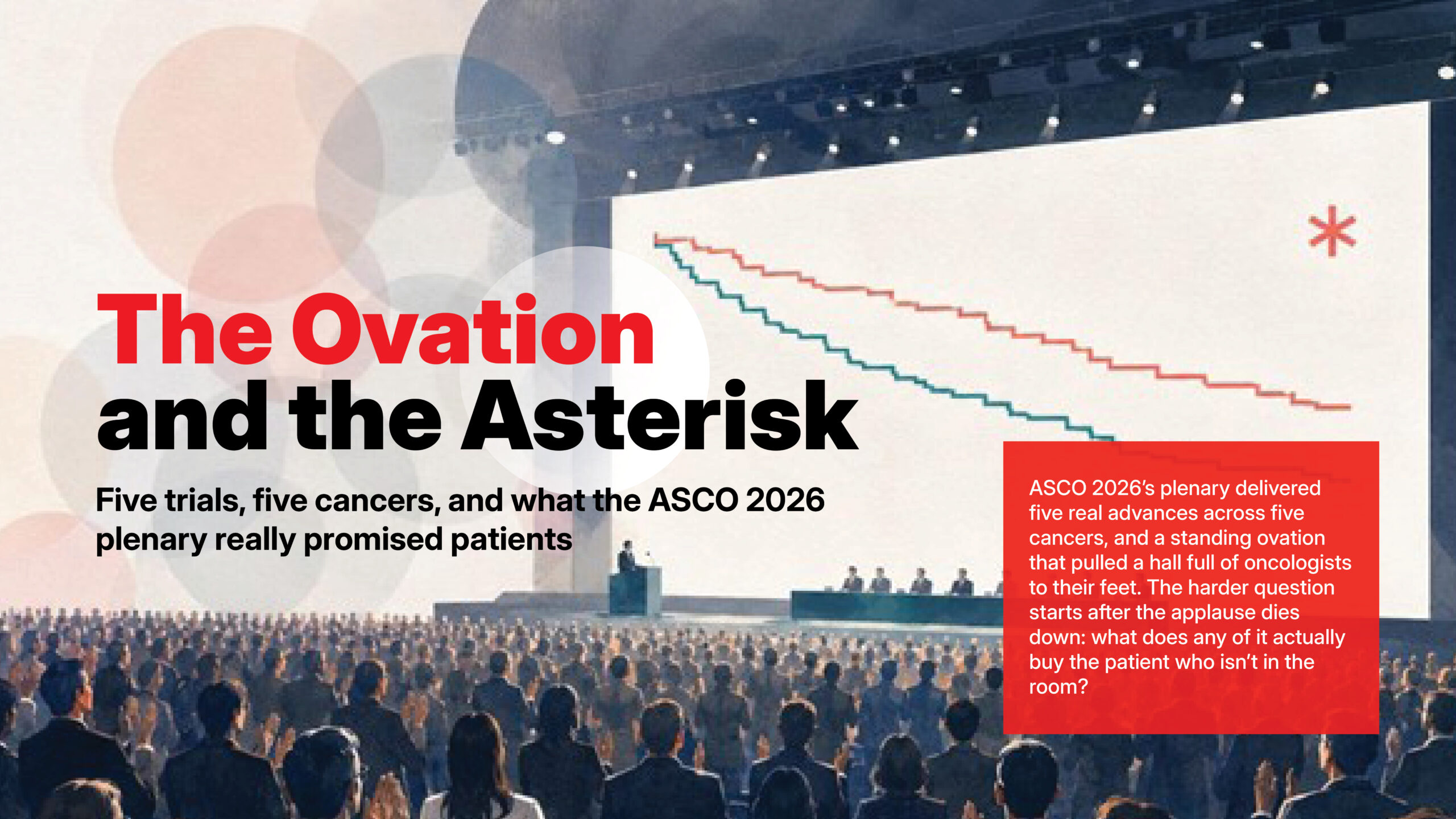
There is a particular sound a room of oncologists makes when it stops being a room of oncologists. It happened on the afternoon of 31 May, in Hall B1 of McCormick Place, when Brian Wolpin advanced to a slide showing two survival curves for metastatic pancreatic cancer — a disease where the curves almost never separate — and the gap between them was wide enough to be visible from the back of the auditorium. Thousands of people who spend their working lives being careful, hedged, and quantitative rose and applauded a graph. Some of them, by several accounts, were crying.
It is worth sitting with that image, because the rest of this story is an argument with it.
A standing ovation is an emotion, and emotions are not endpoints. The plenary session is the most selective stage in clinical oncology — five abstracts chosen from roughly seven thousand, presented to the whole field at once — and this year all five were, in their own register, genuinely good news. Prostate, sarcoma, lung (twice), and pancreas. Targets long written off as untouchable. Cancers long treated with a shrug. Every one of them moved.
But “moved” is doing a lot of work in that sentence, and the distance between a curve on a screen in Chicago and a drug in the hands of a patient in Yerevan, Lagos, or rural Ohio is the part the applause skips over. So this is a tour of what was actually on stage — the science, plainly explained, and the honest accounting of what each result means, for whom, and how soon. The day built, deliberately, toward that ovation. Let’s build toward it too, and then look hard at the asterisk attached to it.
First on Stage: A Nine-fold Answer, and a Number that Stays Small
The session opened with PROTEUS, presented by Mary-Ellen Taplin of Dana-Farber, and it took aim at a fact that has embarrassed prostate oncology for decades: roughly half of men with high-risk localized prostate cancer relapse within five years of surgery meant to cure them. Surgeons have refined the operation for over a century. The relapse rate has barely budged. Trial after trial of giving systemic therapy around the operation has failed.
PROTEUS asked whether hitting the androgen-receptor pathway harder and earlier — the drug apalutamide plus standard hormone therapy, given for six months before surgery and six months after — could change that. The answer, in 2,109 men, was striking in one direction and modest in another, and the gap between those two readings is the whole lesson.
| 8.9% vs 1.0%MINIMAL RESIDUAL DISEASE AT SURGERY — A NINE-FOLD IMPROVEMENT (PROTEUS) |
The striking part: men who got apalutamide were nine times more likely to have little or no cancer left in the prostate at the time of surgery — a pathologic complete response or minimal residual disease rate of 8.9% versus 1.0%. Johnson & Johnson, which makes the drug, called it the breaking of a decades-long paradigm, and it is not wrong that this is the first convincing randomized signal in this setting. The independent ASCO commentary agreed it was the first persuasive evidence of its kind. Time to needing the next round of treatment stretched out by nearly three years.
The modest part: that headline 8.9% is still 8.9%. Nine men in ten on the new regimen still had meaningful cancer in the specimen. And the endpoint that patients actually care about — staying free of metastases — improved with a hazard ratio of 0.80 and a p-value of 0.02. Real, but a 20% reduction in risk, not a transformation. Toxicity was higher too: more grade 3/4 events, more rashes, more dose interruptions, and the discussant noted the regimen has never been tested head-to-head against the radiotherapy-based intensification many of these men would otherwise receive. For a fit man with genuinely high-risk disease who is heading to surgery anyway, this is a real new option, and several surgeons said on the day they would adopt it. It does not rewrite the algorithm for everyone, and a pCR rate under 10% is a beginning, not a destination. What PROTEUS offers is intensification that helps a meaningful minority — which, in a disease this common, is still worth having.
The Rarest Cancer, The Cleanest Target, The First Win
Then came SARC041, and for those of us who work in sarcoma it carried a weight the numbers alone don’t capture. Dedifferentiated liposarcoma is rare — on the order of 3,000 cases a year in the United States — aggressive, and almost untreatable once it spreads. No chemotherapy reliably holds it for even four months. And it has been a graveyard for drug development: three prior phase 3 trials in this disease — selinexor, milademetan, and brigimadlin — all failed to beat their comparators. The field had begun to wonder whether anything would work.
What makes the disease maddening is also what made SARC041 logical. Nearly every dedifferentiated liposarcoma is driven by amplification of a single gene, CDK4 — about as clean an oncogenic target as exists in solid tumors. Mark Dickson of Memorial Sloan Kettering, who has spent much of his career on exactly this observation, tested abemaciclib, a CDK4/6 inhibitor already sitting on pharmacy shelves for breast cancer.
| 9.7 vs 1.5 monthsPROGRESSION-FREE SURVIVAL, ABEMACICLIB VS PLACEBO — HR 0.38 (SARC041) |
It worked. Median progression-free survival was 9.7 months with abemaciclib against 1.5 months with placebo — a hazard ratio of 0.38. Roughly one patient in ten saw the tumor actually shrink, which sounds unremarkable until you remember that tumor shrinkage in this disease is close to a unicorn. Dickson called it the first positive phase 3 trial in dedifferentiated liposarcoma — language the disease has never been able to use.
The discussant, Paolo Casali of Milan, supplied the discipline. One of the field’s most exacting readers of sarcoma trials, he pressed the caution that matters most here: the comparator was placebo, not chemotherapy. That strikingly short 1.5-month placebo result widens the gap on the slide without telling us how the drug stacks up against real alternatives. And because 85% of the placebo group crossed over to abemaciclib at progression — the ethically correct choice — the overall-survival signal, which trended in abemaciclib’s favour (median not reached versus about 25 months) without reaching significance, is genuine but blurred. Dickson himself was candid that the study was never designed for registration.
None of that erases the achievement. For a cancer with no approved targeted therapy, a drug that quadruples progression-free time is the difference between “we have nothing” and “we have something” — and abemaciclib is already approved and sold worldwide for breast cancer, so the fight here is about getting it into sarcoma guidelines and reimbursement, not building a supply chain from scratch. In rare cancers, that distinction is the whole game.
A Target So Small Most of the World Never Tests for It
LIBRETTO-432, presented by Jonathan Goldman of UCLA, is the quietest result of the five and, in a way, the most demanding of the system around it. RET fusions drive only about 1–2% of non-small cell lung cancers. The drug, selpercatinib, is already approved for advanced RET-positive disease. The question here was whether giving it after surgery, in early-stage disease, could keep the cancer from coming back — the same move that osimertinib (in EGFR-mutant disease) and alectinib (in ALK-positive disease) already proved out.
| −83%REDUCTION IN RISK OF RECURRENCE, PROGRESSION OR DEATH — HR 0.17 (LIBRETTO-432) |
It did, and emphatically. In the higher-risk stage II–IIIA group, selpercatinib cut the risk of recurrence, progression, or death by 83% — a hazard ratio of 0.17. At two years, 91.5% of treated patients were event-free versus 61.1% on placebo. The discussant, Christine Lovly of City of Hope, used three words in a row — field-changing, paradigm-shifting, practice-changing — that discussants almost never spend on a population this small.
Comprehensive genomic profiling at diagnosis is now evidence-based — not aspirational.
— Christine Lovly, invited discussant, on LIBRETTO-432
Sit with that phrasing. A drug that works spectacularly is useless to a patient whose tumor was never tested for the alteration it targets. RET testing is not routine in much of the world, including many high-income centers, and it is rare-to-absent across most low- and middle-income settings, where molecular profiling is a luxury line item. LIBRETTO-432 is a triumph of precision medicine and a quiet indictment of how unevenly precision is distributed: a new standard for a tiny, well-defined group, and another brick in the argument that you cannot treat lung cancer well without sequencing it first. The caveats are familiar — follow-up is still short, overall-survival data immature — but the deepest one is that the whole edifice rests on a diagnostic infrastructure that most patients who could benefit will never reach.
A Genuine First, and the Question of Where the Data Come From
HARMONi-6 was historic before a single number appeared: it is the first China-originated investigational cancer drug ever selected for an ASCO plenary in the society’s 61-year history. The drug, ivonescimab, is a bispecific antibody — one molecule that blocks both PD-1 (an immune checkpoint) and VEGF (a driver of tumor blood-vessel growth) at the same time. The trial pitted it, plus chemotherapy, against an active and credible comparator: tislelizumab, a standard PD-1 inhibitor, plus the same chemotherapy, in first-line advanced squamous lung cancer.
| −34%REDUCTION IN RISK OF DEATH VS AN ACTIVE PD-1 INHIBITOR — OS 27.9 VS 23.7 MONTHS (HARMONI-6) |
That design detail is what makes the result notable. Beating chemotherapy is routine; beating an established immunotherapy head-to-head is not. Ivonescimab did it, extending median overall survival to 27.9 months versus 23.7 — a 34% reduction in the risk of death, and survival past two years in a squamous population that rarely sees it. The benefit held even in patients with low or absent PD-L1, the group that usually gets the least from checkpoint drugs.
Right now… it’s not applicable to the global patient population.
— Julie Brahmer, discussing HARMONi-6’s China-only dataset
And then the room did something healthy: it pushed back. The entire trial was conducted in China. Julie Brahmer, discussing the data, said as much, adding that the next wave of studies is needed before that changes. David Spigel, commenting separately, called the results impressive but cautioned it was too early to judge their meaning beyond a Chinese population. Differences in patient genetics, smoking patterns, the specific chemotherapy backbone, and what treatments patients receive after the trial can all move survival curves in ways that don’t travel across borders. The result validates a genuinely novel mechanism and signals that the center of gravity in oncology drug development is shifting eastward — but a single-country trial, however well run, is a hypothesis for the rest of the world, not yet an answer. The appropriate response to a 34% improvement in survival is both applause and the demand for confirmation. Both can be true at once.
The One that Earned the Ovation
Which brings us back to the curves that made the room stand.
Pancreatic cancer is the discipline’s standing rebuke. Around 67,500 Americans will be diagnosed this year; more than half already have metastatic disease when they hear the words, and for them the five-year survival rate sits near 3%. When first-line chemotherapy stops working — and it nearly always does — second-line treatment has historically bought a median of six to seven months. The last time the field had a real reason to celebrate was fifteen years ago, with the chemotherapy regimen FOLFIRINOX. Since then: refinement, sequencing, and modest gains.
The reason is a gene called RAS. More than 90% of pancreatic cancers are driven by it, and for four decades RAS was the textbook definition of “undruggable” — a protein biochemists could see clearly and do nothing about. Nature used that exact word in its coverage of this trial; the framing was everywhere because it was earned.
| 13.2 vs 6.6 monthsMEDIAN OVERALL SURVIVAL, DARAXONRASIB VS CHEMOTHERAPY — RISK OF DEATH −60% (RASOLUTE 302) |
RASolute 302 tested daraxonrasib, an oral drug that targets the active, switched-on state of RAS, against investigator’s-choice chemotherapy in 500 patients whose pancreatic cancer had already progressed. In the RAS G12-mutated group — about 92% of patients — median overall survival was 13.2 months versus 6.6 months. The risk of death fell by 60%. Progression-free survival roughly doubled. About a third of patients responded. And crucially, this was not more benefit bought with more toxicity: serious adverse events and, especially, discontinuations due to side effects were lower with the targeted drug than with chemotherapy — 1.2% versus 11.2%. Patients reported their pain and quality of life held up longer. The results were published in the New England Journal of Medicine the same afternoon; the BMJ and Nature both ran the standing ovation as news in itself.
This is the rare case where the emotion in the room and the data on the slide point the same direction. Doubling survival in metastatic pancreatic cancer is not incrementalism. It is the thing the field has been failing to do for a generation.
RAS is no longer undruggable — it is increasingly actionable.
— Santiago Fontes, oncologist, on the RASolute 302 result
And yet the most useful voice in the aftermath belonged to a skeptic. Bishal Gyawali, who has built a career on disciplined enthusiasm, made the point that the drug is clearly good and that celebrating the p-value misses what matters — vanishingly small p-values can attach to mediocre drugs, and the real questions are durability, access, and what the survival curve looks like with longer follow-up. The median follow-up here was just 8.5 months. Thirteen months of median survival is a transformation relative to six; it is not, yet, a cure, and the people who will live longest on this drug are still being counted.
There is also the matter that already separates the patient in the room from the patient outside it. The US Food and Drug Administration has opened an expanded-access pathway for daraxonrasib, which means some American patients can get it now, before formal approval. That is genuinely good. It also means the global access clock is already running, and history is unkind here: the gap between a drug’s debut in Boston and its arrival in Yerevan or Nairobi is usually measured in years, sometimes never closed at all. A 60% reduction in the risk of death is a different fact depending on your passport.
What an Ovation is For
Step back from the five and a pattern resolves. PROTEUS pushes effective therapy earlier, into the curative window. SARC041 and LIBRETTO-432 take clean molecular targets — CDK4, RET — and convert decades of biology into clinical benefit. HARMONi-6 advances a smarter molecule and signals where new drugs will increasingly come from. RASolute 302 topples the most famous “undruggable” target in oncology. Two unifying ideas run through all of them: precision is no longer optional, and we are learning to use our best drugs before the disease has the upper hand. By any honest measure, this was a strong day.
But the spine of every one of these stories is the same, and it is the part the applause cannot resolve. A trial result is a possibility delivered to a population. Turning it into survival delivered to a person requires a test that gets ordered, a drug that gets approved, a system that pays for it, and a clinic close enough to administer it. Each of the five carries an asterisk on at least one of those: a pCR rate still under 10%; an overall-survival signal not yet mature; a comparator that flatters the result; a diagnostic most of the world cannot access; a dataset from a single country; a follow-up too short to promise durability.
None of those asterisks erases the achievement. They define the work that comes next, and that work is mostly unglamorous — guideline committees, reimbursement negotiations, biomarker testing programs, confirmatory trials in the populations that weren’t studied. There will be no standing ovation for any of it.
A standing ovation, in the end, is for the room. It is a profession allowing itself, for ninety seconds, to feel the hope it usually disciplines out of its language. That is not nothing; people who watch patients die of these diseases are entitled to a moment when the curves finally separate. But the measure of ASCO 2026 will not be how loud Hall B1 was on 31 May. It will be whether, three and five years from now, the patient who was never in that room — the one in the regional hospital, in the country without the test, on the waiting list for a drug that launched on another continent — gets to feel any of it too.
That is the asterisk worth keeping. Not as a counterweight to the hope, but as its unfinished sentence.
About the Author
Amalya Sargsyan MD, MSc in Precision Medicine, GI and Sarcoma Medical Oncologist at Yeolyan Oncology and Hematology Center and D’Clinic, Clinical Research Physician at Immune Oncology Research Institute, VP for R&I OncoDaily.