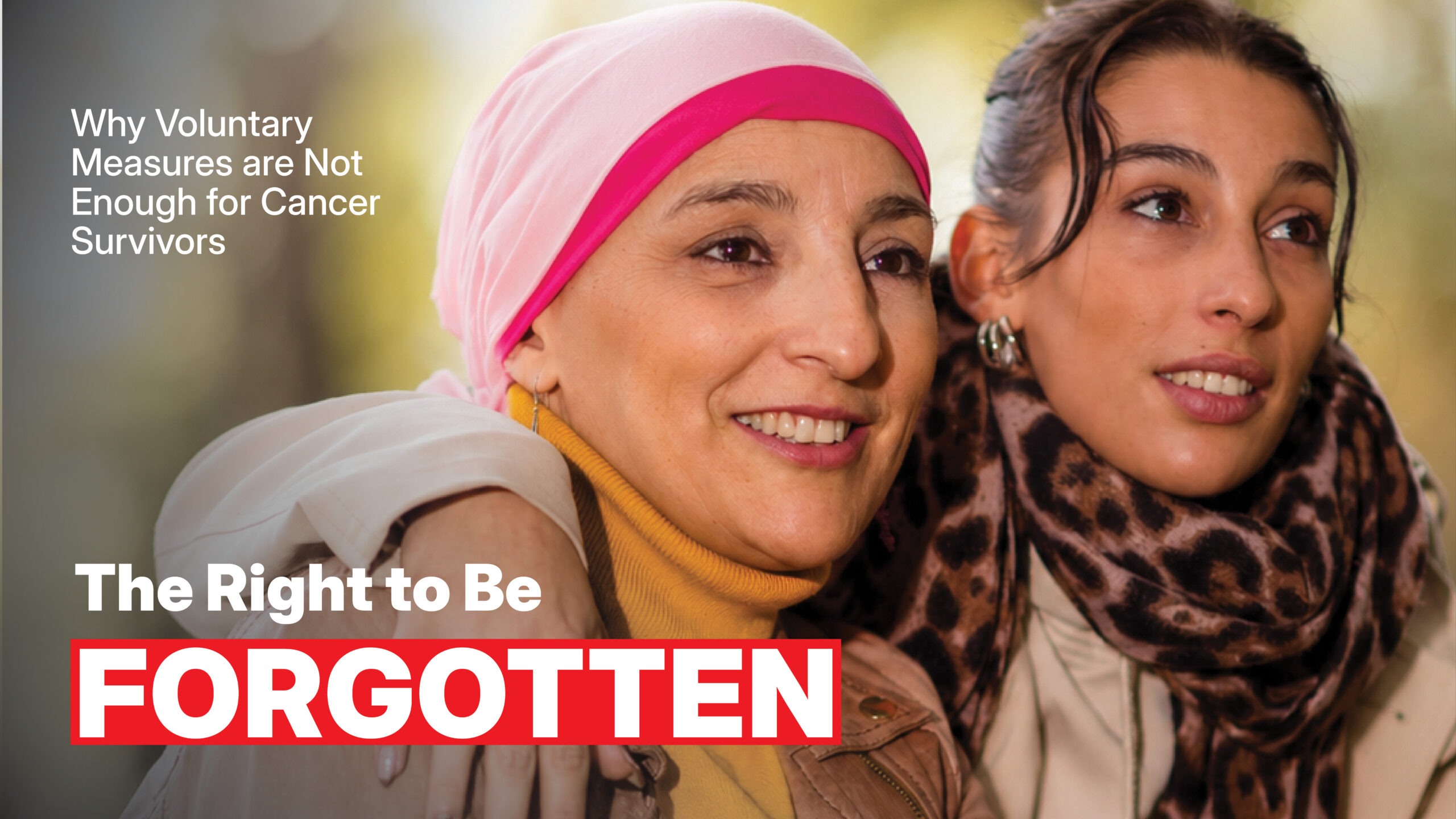
On World Cancer Day, Commissioners Várhelyi and Albuquerque reaffirmed the European Commission’s commitment to the right to be forgotten for cancer survivors. Yet their announcement of non-binding guidance to financial institutions in 2026 falls significantly short of what survivors and patient advocates have been calling for.
In response, on 17 April 2026,Cancer Patients Europe (CPE) and Ending Discrimination Against Cancer Survivors (EDACS) issued a joint statement calling for binding EU legislation to protect cancer survivors from financial discrimination. The message was clear: guidance is not protection, and voluntary instruments are not enough.
“At CPE, we have always believed that patient rights do not stop at the clinic door. Survivorship must mean more than being declared cured: it must mean being able to fully rebuild your life. As long as financial discrimination persists, and as long as where you live determines the protection you receive, Europe’s cancer agenda remains unfinished. We call on the European Commission and EU policymakers to move from commitment to action, and to deliver the binding framework that cancer survivors across Europe deserve.” – Francisco Rodríguez Lozano, Chair of the Board, Cancer Patients Europe
A Fundamental Right, Not a Technicality
The right to be forgotten is not an administrative nicety. It is a fundamental safeguard against financial discrimination and social exclusion — one that determines whether a cancer survivor can access a mortgage, take out insurance, or obtain credit after being declared cured.
Across Europe, survivors continue to carry a lifelong financial penalty for a past diagnosis. Fragmented, voluntary approaches leave them exposed to inconsistent protection depending entirely on where they live. As the statement puts it plainly, survivorship must not come with a mark.
The legal landscape is not without precedent. Ten EU Member States — France, Belgium, the Netherlands, Portugal, Romania, Spain, Italy, Cyprus, Slovenia, and Malta — have already implemented legally binding frameworks protecting cancer survivors. France, where the right to be forgotten has been in force since 2016, demonstrates that such legislation can be implemented without threatening the sustainability of insurance markets. The evidence exists. In many European countries, the political will has yet to follow.
The Gap Between Commitment and Protection
Although the 2023 Consumer Credit Directive embeds elements of the right to be forgotten into EU law, its allowance of remission periods of up to 15 years risks perpetuating the very inequities it seeks to address. Fifteen years is not a transition period. For many survivors, it is a lifetime of exclusion.
The consequences are not abstract. Financial barriers hinder survivors’ ability to rebuild their lives after cancer. They affect long-term quality of life, social participation, and the ability to make the kinds of decisions — buying a home, starting a business, or planning for the future — that define a life regained after cancer.
As CPE and EDACS have consistently argued, the ambition of Europe’s cancer agenda cannot be measured only in treatment outcomes. It must extend to survivorship and to what life after cancer actually looks like.
Non-binding guidance, however well-intentioned, cannot deliver this. Voluntary instruments cannot guarantee uniform rights across Member States. Survivors, already navigating the physical, emotional, and financial aftermath of cancer, should not have to depend on the goodwill of financial institutions to protect what should be enshrined in law.
“Cancer survivors have already fought one of the hardest battles a person can face. They should not have to fight another one just to access a mortgage or take out insurance. The right to be forgotten is not a privilege. It is a right. And rights must be enforceable. The Right to be Forgotten is already implemented in 10 countries in Europe, stressing the need to guarantee equal access and protection for all EU cancer survivors. Voluntary guidance will never be enough to guarantee equal protection across Europe. That is why we are calling for binding legislation, because no survivor should be penalised indefinitely for an illness they have overcome.” – Dr. Françoise Meunier, Founder, Ending Discrimination Against Cancer Survivors
A Clear Call to Action
The joint CPE and EDACS statement sets out a concrete call to action for EU policymakers and institutions.
We call on the European Commission to commit to a harmonised European legal framework on the right to be forgotten, establishing a five-year post-treatment protection period provided there is no relapse. We also call for enforceable protections to replace non-binding guidance, for the systematic involvement of cancer survivors and patient organisations in policymaking, and for EU standards to align with the best practices already demonstrated by Member States.
The statement also raises a broader concern beyond the legislative text itself: patient voices have not been adequately included in shaping the current approach. For an issue that affects survivors’ daily lives and long-term futures, this omission is not a procedural detail. It is a failure of the patient-centred principles that underpin Europe’s cancer agenda.

What Comes Next
The publication of the statement marks a beginning, not a conclusion. CPE and EDACS will continue building on the political momentum generated by this call to action to ensure that the right to be forgotten becomes a binding, enforceable, and uniformly applied protection across Europe.
The framework already exists in ten Member States. The evidence of its workability is clear. The survivors who need it are waiting. Voluntary promises are not enough. Cancer survivors deserve clear, enforceable rights, and CPE stands ready to work with policymakers across Europe to help deliver them.
The right to be forgotten will also take centre stage during a dedicated session at CPE’s Annual Conference 2026, “Europe’s Cancer Care Model: From Policy to Action,” taking place on 25 June 2026 in Brussels. Bringing together policymakers, patient advocates, and national representatives, the session will explore how to move from political recognition to concrete, enforceable solutions, drawing on existing national legislation and the critical role of patient-led advocacy in driving change.
More information is available on CPE’s website.