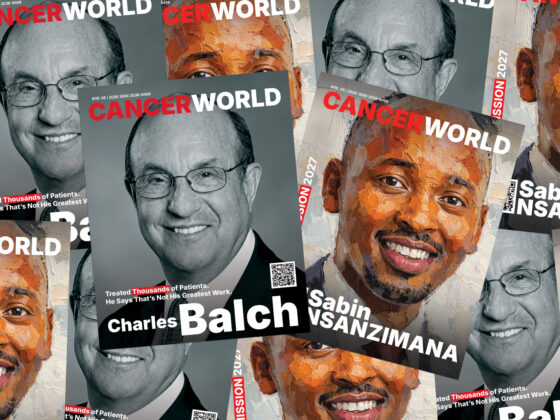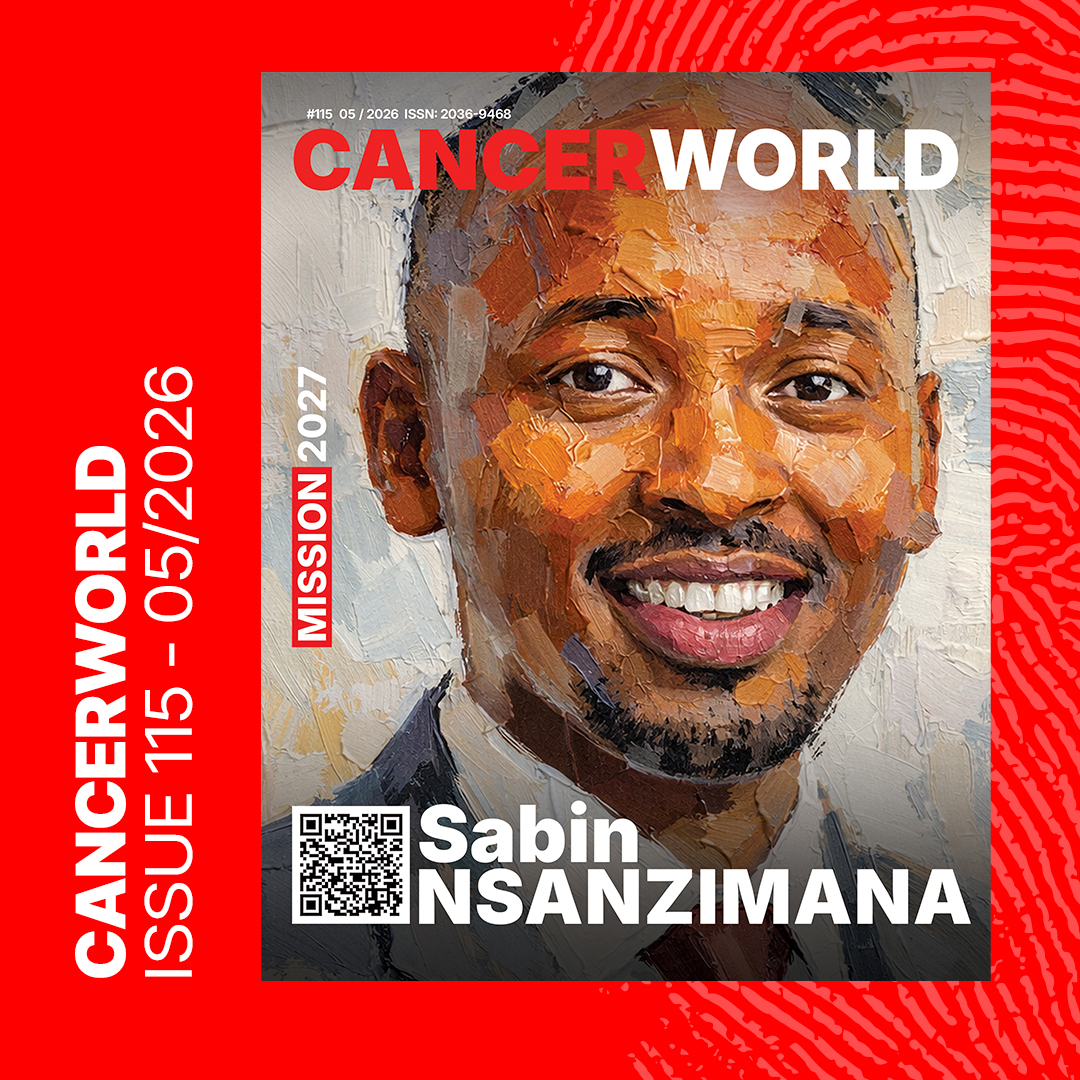
The Minister of Health of Rwanda Dr Sabin Nsanzimana on medicine, 1994 genocide against the Tutsi, leadership, workforce, technology, and the ambition to eliminate cervical cancer
The latest interview for CancerWorld features Dr Sabin Nsanzimana, Minister of Health of Rwanda, physician, epidemiologist, and a key contributor to Rwanda’s public health transformation . In this conversation, he reflects on why he chose medicine, the realities of training in post-genocide Rwanda, the country’s remarkable health reforms, and the bold ambition behind one of Africa’s most inspiring public health goals: Mission 2027 — the effort to eliminate cervical cancer in Rwanda ahead of the global 2030 target.
For Dr Nsanzimana, medicine was never simply a profession. It was a calling shaped by community, history, and responsibility.
“Doctors Save People’s Lives”
Why did he decide to become a doctor?
His answer begins with something simple and deeply human: what children see around them.
“Doctors save people’s lives. And it wasn’t a difficult choice to make, to be honest, because we all grew up in communities. We’ve been at the clinic, at the hospitals. And we’ve seen how health professionals are very important people in the community.”
As a child growing up in Rwanda, he saw health professionals not as distant experts, but as central figures in everyday life.
“So becoming one of them hasn’t been a difficult choice for me and for many other young people who are just beginning their career or starting university.”
But there was another force shaping that decision — the history of Rwanda itself.
“Another reason probably is associated with the history of my country, Rwanda. Three decades ago, we went into a genocide that took one million people’s lives in just 100 days. So I was a young man just growing up into adolescence. Having lived that impacted many of us, including the choice of becoming one of the health professionals.”
Those two realities — the example of doctors in the community, and the trauma of a nation rebuilding after devastation — stayed with him.
“So briefly, these are the two main reasons. And I believe if I have to go back, I’ll make the same choice.”
A Medical Student in a Country Rebuilding Itself
Entering medical school in Rwanda was never easy.
“To go into medicine, there are very strict criteria for entry. It’s not just a choice. It’s also how you evolved in high school, which section you’ve chosen.”
Competition was intense.
“Out of 100 asking to go through medicine, you probably talk about 1% or less. In our class, I remember, we were taking only 50 people. In the entire country, only 50 people enter medical school in the first year.”
Only students with a strong science background could even be considered.
“Only if you have done biology, chemistry, physics, and mathematics as basic high school education.”
His own path in latin and sciences through seminary education gave him that foundation.
“That helped because the seminaries were considered at that time having the top schools in terms of education in science, which I had a chance to go through.”
Medical school itself was shaped by the realities of a country facing severe shortages of health professionals.
“The first two years are basic sciences. And then in the third year, you start to go into hospital practice.”
Because Rwanda urgently needed doctors, students were exposed early to clinical responsibility.
“Given the shortage of health personnel in our time, students in medicine were exposed to so many advanced procedures from year three, year four. Including some surgical procedures in gynecology, obstetrics and surgery. So at the end of the six years as a young doctor, you have acquired so many skills because you’re expected to do almost everything in a country that had very few specialists; a country that had just lost 80% of its health workforce during the genocide against the Tutsis in 1994.”
From the Wards of HIV to the Discipline of Epidemiology
When Dr Nsanzimana completed medical school, Rwanda’s dominant health burden was still infectious disease.
“…primarily HIV, malaria, tuberculosis, diarrhea, so many outbreaks like cholera, meningitis. This is in the aftermath of the genocide.”
He remembers vividly what he saw in Kigali.
“I always remember the last year of training that I spent in the largest teaching hospital of Kigali (CHUK). The hospital had patients hospitalized for HIV and associated opportunistic infections to the level that there were two entire blocks that were dedicated for them.”
Those words became symbolic in Rwanda’s public health memory.
“They were known at that time, even in Rwanda, many still have that memory of Ward 4 and Ward 5. These are big wards where these HIV patients would go through before they die.”
At that time, treatment was only beginning to emerge globally, and had not yet reached most African settings.
“There was no treatment available. These programs like PEPFAR, Global Fund, were not yet in place. They were just coming in.”
His transition from medical school brought him directly into that frontline.
“My transition from the hospital went straight into that clinic. In 2005, the TRAC clinic (Treatment and Research for AIDS Center) , I remember, had 5,000 patients living with HIV… And my choice to go into epidemiology was likely based on the need that was there.”
He would go on to pursue a master’s degree and then a PhD, while continuing to work.
“From a personal perspective, from personal growth, career growth, I did most of my education also at work. After general medicine, I went into epidemiology masters at work, HIV was still the focus, then a PhD as well, with a model going for a couple of months, coming back to work, going back to Switzerland.”
In many ways, his career grew inside Rwanda’s public health institutions as the country itself evolved.
“That institution was like the driving entity to contain the largest health system challenge, HIV, TB, malaria… Later on, the institution grew up to become the Rwanda Biomedical Centre (RBC).”
He stayed in that ecosystem for around 15 years, witnessing one of the most important epidemiologic transitions in modern African health systems – “where infectious diseases were more or less contained, shifted into non-communicable diseases.”
Looking back now, from the office of Minister of Health, he describes that journey with characteristic humility and humor.
“Twenty years on, now serving as Minister of Health, with a bit less hair and in a similar public office; I remain grateful for the impact we’ve been able to make collectively.”
“I never saw this coming”
Why was he appointed Minister of Health?
He simply replies.
“I don’t know.”
Then he pauses, reflects, and reframes the question.
“There’s always a journey that you have to go through to be where you were supposed to be.”
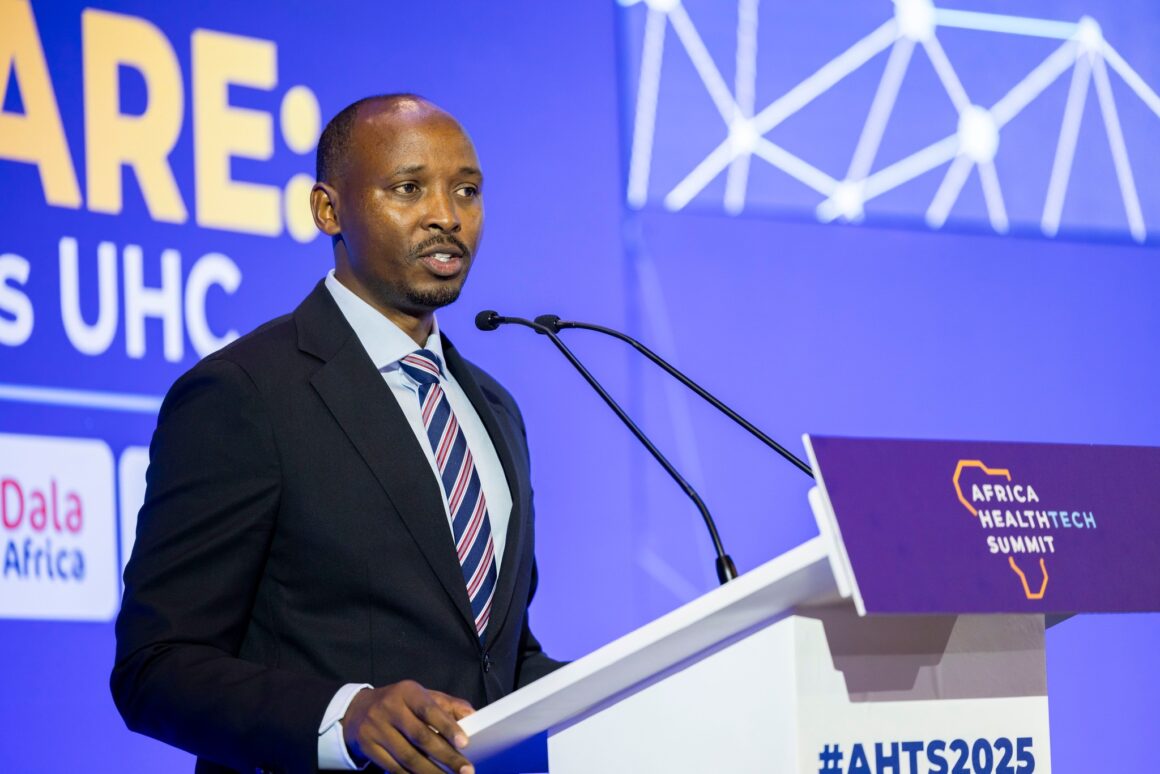
Dr. Sabin Nsanzimana speaking at the Africa HealthTech Summit 2025 in Kigali, Rwanda. Photo source: Africa HealthTech Summit 2025
For more than two decades, he had worked in public service, but never with a political appointment in mind.
With a background mainly in data, epidemiology, and analysis, the appointment was not an obvious one, including to me
At that point, I had spent nine months leading a university teaching hospital in southern Rwanda. Following 15 years in the capital city and three years of intense COVID-19 response, I was appreciating a calmer, more rural pace.
Still, if one quality defines him, it may be readiness.
“I’ve always been ready.”
He is drawn to difficult targets, innovation, and the challenge of building what does not yet exist.
“I enjoy discussing numbers, data. I enjoy challenging things, looking at how technology can help. I enjoy big targets, goals, and how we can get there.”
And perhaps most revealingly:
“When you achieve something that is difficult to achieve, or maybe has been before not tested or not tried, you feel that there’s a lot in this world that we can create, we can innovate.”
The Big Five
Dr Nsanzimana says he always asks himself what he will leave behind.
“My team and I always five things in mind”
Those priorities are not abstract. They are concrete, measurable, and deeply aligned with Rwanda’s needs.
1. Workforce: from one to four
The first priority is people.
“The first thing we did when we started the office was to look at the areas with the biggest need or the biggest challenge. So, we realised that we have a very limited number of health professionals in all areas.”
That led to an ambitious workforce plan.
“We created a programme called “4×4”s, quadrupling the workforce. It’s a programme of four years.”
The name reflects a stark reality.
“Our ratio, health providers per population was one per 1,000 people. And the World Health Organization recommends that at least the minimum for a health system to not collapse, you need four providers for 1,000 people.”
So the challenge became simple to state, if difficult to achieve.
“Our goal was, how can we move from one to four? It’s to quadruple our workforce.”
Without disruption, he says, the gap would take generations to close.
“Our estimate was that if we don’t do it now, it will take us 185 years to reach this ratio.”
So Rwanda chose not to wait.
“We had to disrupt the system by bringing this ambitious target.”
2. Technology as equalizer
The second priority is technology.
“We’re doing a lot into making technology our ally, our equaliser. All these gaps, all this legacy of a system that was destroyed, we’re trying to build, can be done faster with technology.”
This includes AI, digital systems, imaging connectivity, and tools in the hands of frontline health workers.
“We have connected all health facilities, we are centralising imaging interpretation centres, so that with technology, you don’t rely on heavy human individuals everywhere.”
He sees Rwanda’s young population and national investment in connectivity as a major advantage.
“Having the chance of having young people, very vibrant, with a country that has also been investing in connectivity, internet, is something that can actually be applied in other countries with similar resources.”
3. Strengthening primary health care
The Ministry’s third priority is primary health care and he speaks about it with particular conviction.
“If you want to spend less, ten times less, prevent diseases and treat people near their households.”
He gives a powerful example from malaria.
“We’re talking about equipping neighbours (community health workers) and training them so they treat their neighbours for malaria with one rapid test and treatment tablets, that would cost less than $1 for one person.”
Delay, by contrast, is devastating both medically and economically.
“But if you delay and that person has to go to the hospital, you’re talking about the cost moving from less than $1 to $1,000.”
Why? Because untreated disease triggers a chain reaction: transport, hospitalization, family burden, lost time, higher risk, and more suffering.
“So, treating at the community level is cheaper, faster, is not only a priority, it’s actually the best way to protect the health care system.”
In Rwanda, community health workers are not symbolic. They are the cornerstone.
“Equipping community health workers with smart phones, with BP machines, with glucometers, rapid testing devices, so that they manage complex diseases before they come to the clinic and they screen diseases before they appear and we can see it at the national health intelligence center.”
4. Emergency medical services
The fourth priority is emergency medical services.
“How do you save someone’s life within the golden hours?’’
You’re talking about someone, a pregnant mother who may have high blood pressure and impact her life and the baby. How do we intervene quickly?
Again, the answer returns to systems, speed, and technology.
5. Maternal, neonatal, and flagship disease priorities
The fifth priority includes maternal and neonatal health, but also Rwanda’s most visible flagship public health mission: cervical cancer elimination.
“Cervical cancer elimination is a very important priority. It’s actually the current elimination plan of any single disease that we are talking about today in Rwanda.”
And it has a name that now carries energy across the country.
“Mission 2027.”
Mission 2027
When Dr Nsanzimana speaks about Mission 2027, his tone changes. There is urgency, but also pride.
“When we talk about it, everyone is smiling and happy, because achieving that will mean you have removed something from your list of issues.”
Mission 2027 is Rwanda’s effort to eliminate cervical cancer by 2027 — ahead of the global WHO target of 2030.
“This Mission 2027 is particular, is unique.”
But he is careful to stress that this did not begin from zero.
“It doesn’t start now. It’s something we’ve been doing before with HPV vaccination.”
The campaign is rooted in prior public health successes and in sustained national leadership.
“It is championed by Her Excellency, the First Lady of the Republic of Rwanda, Mrs Jeannette Kagame,who has been a very active force in the health and education sectors through the Imbuto Foundation.
Under her leadership, we achieved Hepatitis C elimination… and now, the second to be eliminated is cervical cancer, with the same team, same leadership, same goal, same ambition.”
And then, simply:
“So, Mission 2027 is happening. So, the battle is ongoing.”
Why Rwanda Works
What is the key to Rwanda’s progress in health?
His answer starts with one word.
“Leadership.”
For Dr Nsanzimana, that is the central explanatory force behind Rwanda’s transformation.
“The leadership has been a key transformative factor of Rwanda to recover from the 1994 genocide against the Tutsi.”
But leadership, in his description, is not about hierarchy alone.
“It’s not about the years of service or the age you have… To be a cabinet member and to lead a ministry is the added value you bring into your institution.”
He also credits Rwanda’s whole-of-government approach.
“In Rwanda, the system works as one government, one government handling issues.”
He gives the example of outbreak response.
“When we had an outbreak, the response is, of course, technically led by the Ministry of Health, but you will see the Ministry of Local Government, the Ministry of Interior, people in finance involved. You form one team.”
That approach attracts people.
‘’Partners are always attracted to places where they see progress and momentum. No one wants to work in an environment where they have to persuade the government to take action. Rwanda has consistently taken the opposite approach – setting clear plans and goals, and inviting partners who are interested in working together to achieve impactful results at scale.’’
He returns often to accountability.
“Fight corruption, making sure this money is spent in the right place. Accountability is a key pillar of leadership in Rwanda.”
Then he recalls a defining national principle articulated by H.E President Paul Kagame after the genocide: “We have to make a choice to live/stay together, to think big, and to be accountable.”
For Dr Nsanzimana, health has been central to all three.
Paul Farmer, Butaro, and the Future of Cancer in Africa
When discussing cancer care in Rwanda, Dr Nsanzimana remembers the late Paul Farmer with warmth and respect.
“Paul Farmer came to Rwanda, and he went to the most remote areas, because he also had this will to make changes in an equitable manner.”
Their collaboration began early, in HIV care.
“I knew Paul Farmer when I was just starting as a young doctor.”
Later, as cancer began to emerge as a major health challenge, that collaboration evolved.
“In 2019, before COVID, actually, we were together, Paul Farmer and I, opening a rural facility for cancer patients in Butaro.”
The house provided dignity for patients traveling long distances for treatment.
“As the first cancer centre was introduced there, patients could come from all provinces, but didn’t get where to sleep before they got their medication. So Paul mobilised resources, built that house, went there, and we opened it together. Unfortunately, that was the last time I saw him in person.”
What stayed with him most was Farmer’s foresight.
“He said cancer is going to become the major threat and pressure to health systems across Africa in the coming years.”
Today, Dr Nsanzimana says, that warning has become reality.
“He was predicting exactly what we’re seeing today, that cancer is the main cause of death in Rwanda and in Africa, followed by cardiovascular diseases.”
Mentors, Influence, and One Constant Voice
Asked about mentors, he resists naming just one.
“I had the opportunity to meet so many great people who brought something of who I am today.”
He sees himself as shaped by many contributors — supervisors, scientists, public servants, leaders, colleagues.
“I don’t have a specific mentor whom I would say I’ve been really growing, evolving under someone’s 100% support. But there is an inspiration you get just by meeting someone for just an hour or a few minutes. And you pick something, you learn, and then you combine.”
Yet one person stands apart.
“I think my dad is probably the main advisor.”
His father is not a doctor. He was a teacher. But his influence has been profound.
“He’s still the person I ask about everything, including health. Every time I have a confusing situation, I always call him or go to see him.”
And then, with a touch of wonder:
“He seems to understand everything about health and about politics in general. His answers have always been actually more accurate than I think.”
The Person He Wants the World to Hear Next
At the end of the conversation, when asked whom he would like to see interviewed next, Dr Nsanzimana does not mention a famous scientist, a politician, or an international expert.
Instead, he points toward the foundation of Rwanda’s health system.
“A voice of someone who is being treated in the community, community health worker or beneficiary of this program, could be someone who survived a disease because of a successful program, someone in far rural Rwanda or somewhere else.
Recently, I went to visit a community health worker who has been for the past 19 years treating neighbors. And he understands and knows everyone’s life he has saved…
That is the person I wish to see interviewed after me.”
He explains that every week he asks his team the same question:
“What are we going to achieve today that will make a difference for someone in a village who doesn’t know we even exist?”
That question, perhaps more than any slogan, captures his philosophy of leadership: it must remain citizen-centered, and public service is meaningful only when its impact reaches every citizen.
Mission Possible
There is something striking about the way Dr Sabin Nsanzimana speaks. He is modest, often almost disarmingly so, yet everything in his story points to disciplined ambition.
He speaks the language of data, systems, and accountability. But he also speaks the language of possibility.
He believes a country can rebuild after a catastrophe.
He believes a workforce gap can be disrupted.
He believes technology can act as an equalizer.
He believes primary care can save both lives and systems.
And he believes cervical cancer can be eliminated not someday, but soon.
“Mission 2027 is happening.”
In Rwanda. Now.