
She nodded when I said cancer. Only later did I understand that she had heard something else.
The consultation unfolded with clinical precision. The translation was accurate. From a professional perspective, nothing was missing. And yet everything was.
When I spoke of treatment, she heard punishment.
When I spoke of uncertainty, she heard fate tightening its grip.
I said surgery; she felt pain already carving its mark.
I described chemotherapy; her future quietly dimmed.
I offered radiotherapy as a cure; she received it as a final sentence.
She agreed to everything, not from understanding, but from deference. In her world, a doctor is not questioned. A diagnosis like this is not spoken aloud.
Later, I learned that in her community cancer exists in whispers. It lives behind doors that close gently, but firmly. It is endured, not discussed, passed down in stories heavy with fear.
“We Had Shared Words, But Not Meaning.”
The distance between us had not been created by incompetence or indifference; it was shaped by culture, by silence, by the assumptions we both carried into the room.
Cancer is biologically universal. A malignant cell follows the same ruthless logic in Tirana, Rome, Tokyo or Toronto. But illness is never neutral. The word “cancer” does not travel untouched. In some places it carries shame; in others, inevitability. The survival curves that offer probability to physicians may feel like wagering a life to patients.[1]
Since then, I listen for more than answers. I listen for hesitation, for who speaks first, for what remains unsaid, for the fear hidden beneath ordinary words.
“Patients Rarely Hear Only Medicine.”
An oncologist may speak with clinical precision — “surgery,” “chemotherapy,” “radiotherapy” — yet patients often hear something entirely different. Culture shapes illness long before a patient enters the consultation room.[1] In some societies, even naming cancer openly feels dangerous, as though the word itself might extinguish hope.[2][3]
Across cultures, myths abound. Many people believe cancer to be fatal, contagious, or retribution for past deeds. Such stigma has a silencing effect on patients and families.[4] Clinicians must remember that “cancer” is never just a medical term; it is filtered through personal and cultural lenses.[4][5]
Culture can determine who speaks first, what is said, and how it is heard.[1] In some societies, the doctor is not questioned and the diagnosis is not named aloud.[1][2]
Relatives may insist on telling the patient only the “gentle” truth, or none at all. A survey in Albania found that family members were least supportive of full disclosure about a cancer diagnosis.[3] This reflects a silent understanding: silence preserves hope or dignity in the patient’s eyes. Physicians in such contexts often feel pressure to soften difficult truths.
Yet patients do crave understanding. Studies report that, despite cultural taboos, most patients prefer honest information and family involvement.[3][6] The lesson is that one-size-fits-all does not apply. Instead, we must listen for individual cues and ask each patient: How much do you want to know?[3]
Culture shapes whether cancer is seen as a death sentence or a challenge, how much control patients feel they have, and even whether the word “cancer” is spoken at all.[4][5] It provides a framework that shapes perception of illness, suffering, and the physician–patient relationship.[1] The science is global, but the meaning is deeply personal.
Emotional Walls and Empathy
We, as doctors, learn to build emotional walls for protection. This detachment can seem necessary amid daily grief, but it can also widen the distance between physician and patient. When clinicians withdraw emotionally, patients often notice the coldness and retreat in response.[7]
And sometimes the deepest suffering comes not from bad news itself, but from receiving it alone.
Empathy is not a weakness in medicine; it is a clinical skill. Patients trust physicians who remain emotionally present. That trust shapes communication, adherence, and willingness to endure difficult treatment.[6] Compassion is not separate from care; it is part of it.
Breaking bad news is therefore never only about delivering information accurately. It is about recognizing what the patient is actually hearing.
I have learned that listening often matters more than speaking. A pause after the word “survival.” Eyes filling with tears when discussing schedules or side effects. A family member answering every question before the patient can. These moments reveal fears no scan or laboratory value can measure.
Sometimes the most important question is not “Do you understand?” but “What does this mean to you?”
Listening and Narrative in Care
Narrative medicine reminds us that patients do not experience cancer as pathology alone. They experience it as disruption — of identity, family, future, faith, dignity.
Acknowledging that story is not an extra act of kindness; it is part of good oncology.[6]
“Treating Cancer is Our Science. Hearing the patient’s Silence is Our Art.”
Science is universal. Meaning is not.
Cancer may be one disease, but it is heard in many languages.
The difference between competence and compassion can be a single word, a single silence, or a single truthful nod. Oncology demands that we master both.
Acknowledgment
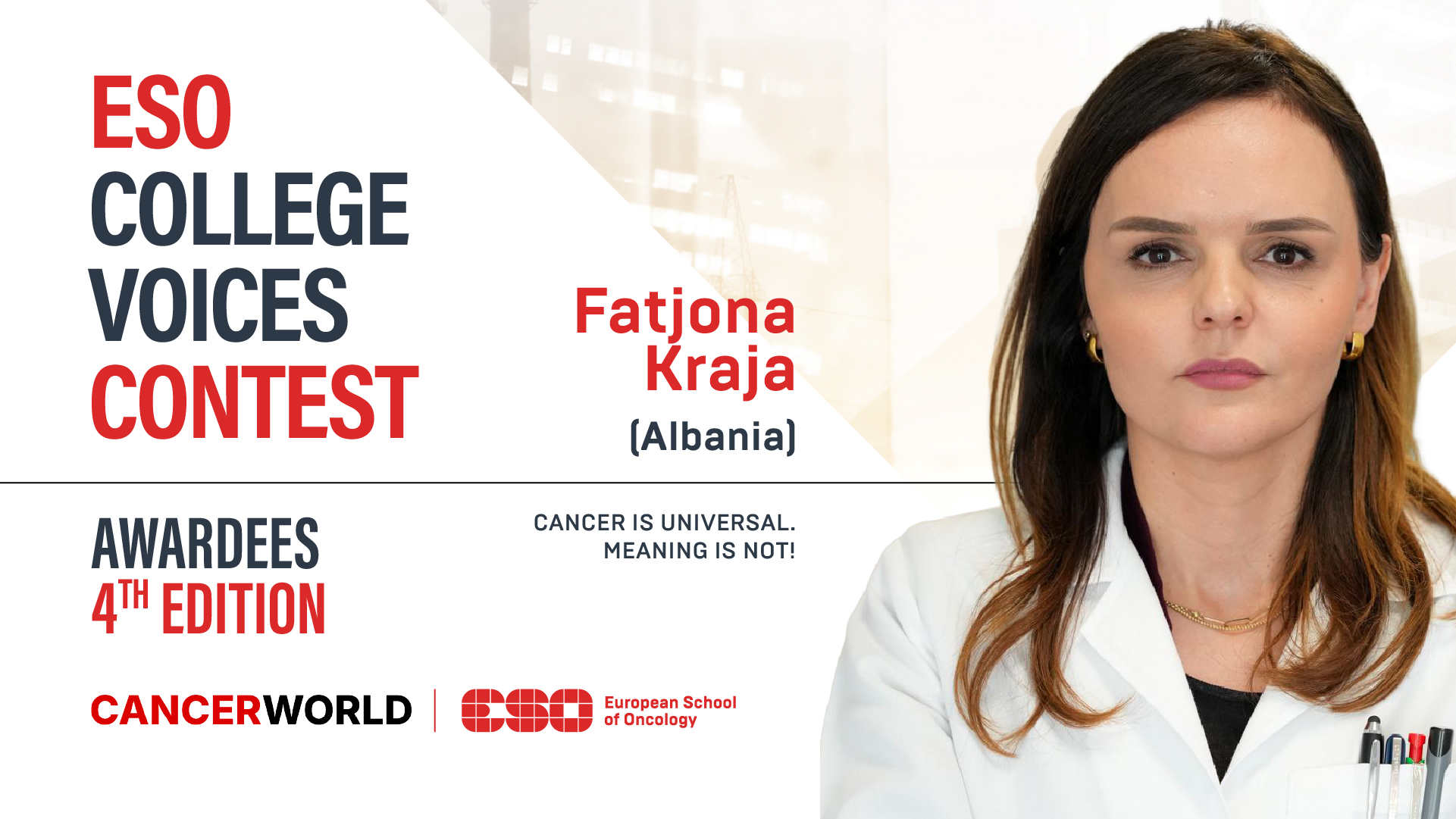
This article was written by Dr Fatjona Kraja, one of the two winners of the ESO College Voices Contest 2026, on the topic “Cancer is Universal. Meaning is Not!”.
This year’s contest once again proved that doctors can also be excellent cancer writers. We received 24 proposals from ESO College members across 16 countries, each exploring the chosen theme. After careful deliberation, guided by CancerWorld’s editorial standards, as well as criteria of clarity, relevance, originality, potential impact, and our hallmark style of weaving in interviews and firsthand perspectives, Dr. Kraja was selected as one of the winners, and we are proudly publishing his impactful voice.
References:
American Medical Association. Physicians and Patients’ Spirituality: Ethical Concerns and Boundaries in Spirituality and Health. American Medical Association Journal of Ethics October 2009, Volume 11, Number 10: 804-815.
Surbone, A. (2006). Cultural Aspects of Communication in Cancer Care. In: Stiefel, F. (eds) Communication in Cancer Care. Recent Results in Cancer Research, vol 168. Springer, Berlin, Heidelberg.
Beqiri A, Toci E, Sallaku A, Qirjako G, Burazeri G. Breaking Bad News in a Southeast European Population: A Survey among Cancer Patients in Albania. Journal of Palliative Medicine. 2012;15(10):1100-1105. doi:10.1089/jpm.2012.0068
Oncology Nursing Society. Breaking Bad News: An Evidence-Based Review of Communication Models for Oncology Nurses, Vol 21, Number 5, October 2017.DOI: 10.
Daher, M. (2012). Cultural beliefs and values in cancer patients. Annals of Oncology, 23(Suppl 3), 66–69.
National Cancer Institute (NCI). Patient-Centered Communication in Cancer Care: Promoting Healing and Reducing Suffering. https://cancercontrol.cancer.gov/sites/default/files/2020-06/pcc_monograph.pdf
Halpern, J. Empathy and Patient–Physician Conflicts. J GEN INTERN MED 22, 696–700 (2007). doi.org/10.1007/s11606-006-0102-3